Stock Analysis · Brixmor Property (BRX)
Overview
Brixmor Property Group is a retail real estate investment trust, or REIT. In simple terms, it owns shopping centers and rents space to tenants. Its portfolio is concentrated in open-air centers, especially grocery-anchored properties, where supermarkets help drive steady customer traffic for the rest of the stores. The company focuses on leasing, redeveloping, and improving these centers rather than operating retail businesses itself.
Based on the company’s recent annual reporting, revenue is overwhelmingly recurring and property-based. The main sources are:
- Rental and other real estate revenue: about 99%+. This includes base rent paid by tenants, reimbursements for common area and property costs, percentage rent where applicable, and other property-related income.
- Management and other fees: less than 1%. This is a small supporting category compared with rent collected from owned properties.
Within the property portfolio, grocery-anchored centers are the core economic engine. Brixmor’s tenant base is diversified across supermarkets, discount retailers, off-price chains, restaurants, fitness, health services, and other necessity-oriented categories. That matters because the business depends less on one single tenant and more on keeping centers busy, relevant, and well leased.
The business model is relatively straightforward: acquire or improve shopping centers in densely populated trade areas, maintain high occupancy, raise rents when leases roll over, and recycle capital into projects with better long-term returns. Over the past several years, revenue, operating income, and net income have trended upward, which suggests that leasing spreads, redevelopment activity, and portfolio management have been contributing to steady improvement.
The financial flow has been moving in a favorable direction: revenue has increased consistently since 2021, operating profit has expanded, and net income has also improved. Interest expense has risen, which is normal for a property owner using debt, but the increase has been more than offset by higher property earnings.
Key Figures
| Metric | Value | Sector ⓘ |
|---|---|---|
| Date | Oct 24, 2026 | |
| Context | ||
| Sector | Real Estate | |
| Industry | REIT - Retail | |
| Market Cap ⓘ | $8.41B | |
| Beta ⓘ | 0.95 | |
Value (Cheapness) | ||
| P/E Ratio ⓘ | 19.59 | 17.85 |
| P/B Ratio ⓘ | 2.88 | 0.87 |
| FCF Yield ⓘ | 7.52% | 7.30% |
| Dividend Yield ⓘ | 4.37% | 4.83% |
| EBIT / EV ⓘ | 4.88% | 3.78% |
| PEG ⓘ | 1.68 | |
Growth (Business expansion) | ||
| Revenue Growth ⓘ | 4.30% | 5.35% |
| RPS Growth (5Y CAGR) ⓘ | 3.68% | 6.02% |
| EPS Growth (5Y CAGR) ⓘ | N/A | -10.65% |
| BVPS Growth (5Y CAGR) ⓘ | 1.82% | 0.43% |
| Margin Growth (5Y Trend) ⓘ | 4.19% | -0.69% |
| FCF Growth (5Y CAGR) ⓘ | 4.24% | 5.40% |
| DPS Growth (5Y CAGR) ⓘ | 7.52% | 5.07% |
Quality (Business durability) | ||
| ROIC (Latest) ⓘ | 6.67% | 5.69% |
| ROE (Latest) ⓘ | 14.45% | 7.37% |
| ROA (Latest) ⓘ | 4.79% | 2.85% |
| ROIC (5Y Median) ⓘ | 5.66% | 4.26% |
| ROE (5Y Median) ⓘ | 11.61% | 6.04% |
| ROA (5Y Median) ⓘ | 3.94% | 2.45% |
| Net Debt / EBIT (Latest) ⓘ | 7.77 | 7.55 |
| Net Debt / EBIT (5Y Median) ⓘ | 9.25 | 8.26 |
| Net Debt / EBITDA (Latest) ⓘ | 4.75 | 5.26 |
| Net Debt / Assets ⓘ | 57.32% | 37.45% |
| EBITDA / Interest ⓘ | 4.59 | 4.11 |
| Operating Margin (Latest) ⓘ | 47.33% | 33.86% |
| Operating Margin (5Y Median) ⓘ | 43.21% | 37.49% |
| Debt to Equity (Latest) ⓘ | 176.50% | 88.76% |
| Profit Margin (Latest) ⓘ | 30.82% | 18.94% |
| Free Cash Flow (Latest) ⓘ | $632.81M | |
Momentum (Price trend) | ||
| 3Y Return ⓘ | +63.74% | +36.33% |
| 12M Return (excl. last month) ⓘ | +6.58% | +4.32% |
| 6M Return ⓘ | -4.36% | -1.74% |
| Price vs. 200-Day MA ⓘ | -2.26% | -1.42% |
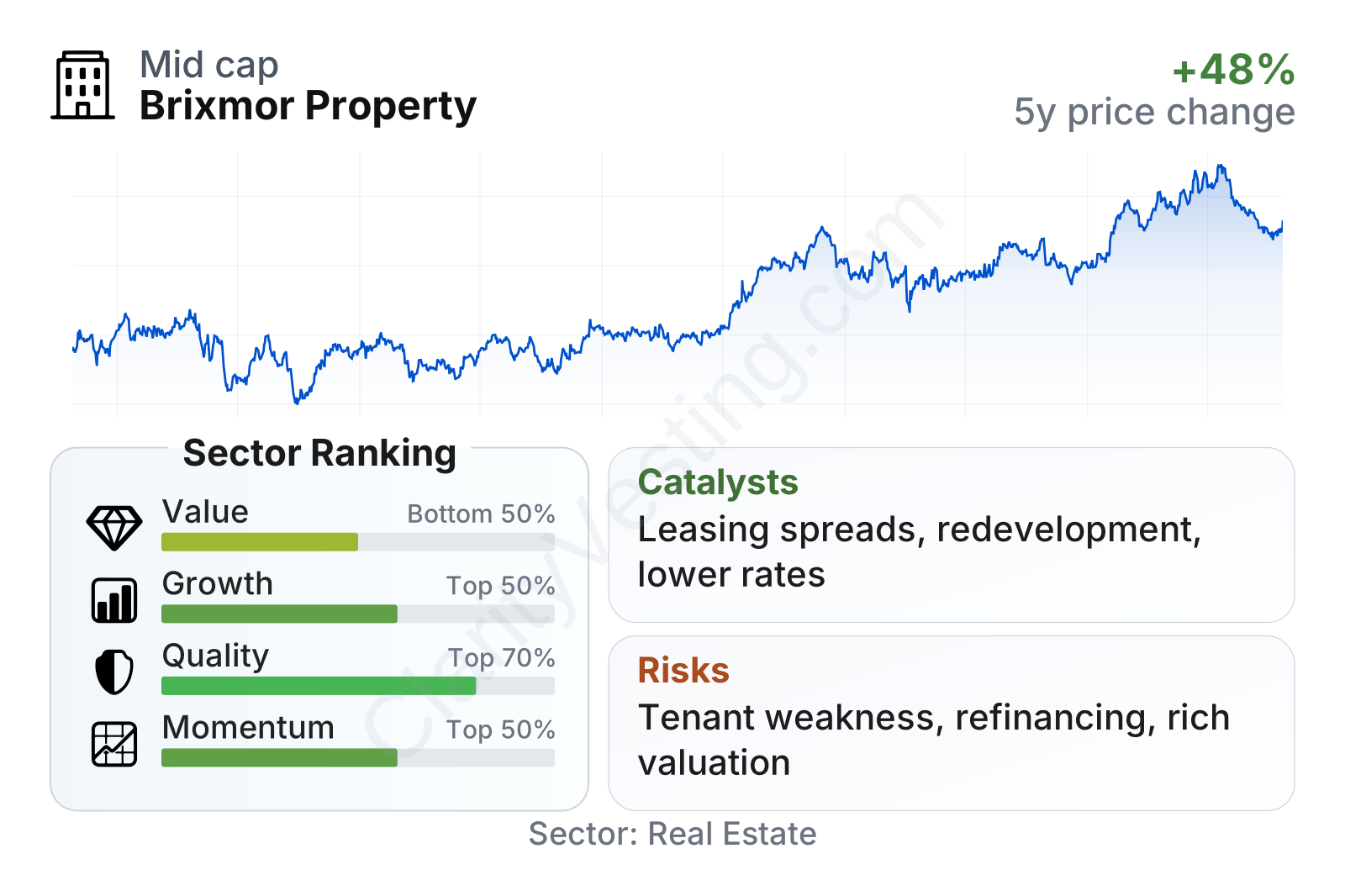
Brixmor stands out more for business quality than for deep valuation appeal. Profitability measures are stronger than many peers, with returns on assets, equity, and invested capital above sector medians, and operating margins also look solid for a retail REIT. Growth is positive but not especially fast compared with the broader real estate sector. On valuation, the stock screens as mixed: earnings and cash flow measures are not extreme, but the price-to-book multiple is clearly above sector norms. Recent price momentum has been softer than the sector even after a strong multi-year share price recovery.
Growth
Brixmor operates in a part of retail real estate that has become more attractive again: open-air neighborhood centers anchored by grocery and necessity-based tenants. This is not a high-growth industry in the technology sense, but it can be resilient. Consumers still need food, discount goods, pharmacy access, and everyday services, and those uses continue to support foot traffic even when discretionary retail is weaker. That gives Brixmor exposure to a steadier corner of brick-and-mortar real estate.
The company’s strategy appears coherent for long-term expansion. Management has been emphasizing leasing, redevelopment, and selective reinvestment into existing centers. For a landlord like Brixmor, this can be a practical growth path because it does not require constant large acquisitions. Instead, it can generate higher income from the same properties by improving tenant mix, re-leasing space at higher rates, and adding projects such as outparcels, mixed-use elements, or modernized center layouts where returns justify the spending.
Revenue per share has risen steadily over the last five years, which is a useful sign for a REIT because it suggests that growth has not been purely driven by issuing more shares. The pace has been moderate rather than rapid, but it has been consistent.
Dividend per share has also moved upward over the same period. That does not remove risk, but it does indicate that the company has been able to translate property cash generation into growing shareholder distributions while still supporting the business.
Several catalysts matter here. First, leasing spreads and occupancy gains can keep lifting cash flow as older leases reset. Second, redevelopment can create incremental returns without needing a major portfolio transformation. Third, if interest rates stabilize or decline, REIT financing conditions and property valuations could become more supportive. Recent company communications have also highlighted continued leasing activity and redevelopment progress, which fits the idea of gradual, execution-driven growth rather than one dramatic event.
Risks
This article is for informational purposes only and does not constitute financial advice. Some content is AI-generated. See Disclaimer


