Stock Analysis · Barry Callebaut AG (BRRLY)
Overview
Barry Callebaut AG is one of the world’s largest industrial chocolate manufacturers. The company supplies chocolate, cocoa products, fillings, decorations, and other specialty ingredients to food manufacturers, artisanal users, and global consumer brands. In simple terms, it is mostly a business-to-business chocolate and cocoa supplier rather than a consumer-facing candy brand owner. Its scale comes from processing cocoa beans, producing chocolate in many formats, and serving customers across Europe, the Americas, Asia-Pacific, the Middle East, and Africa.
The business is usually presented through two main operating pillars: cocoa products and chocolate products. Chocolate products include industrial chocolate sold to large food companies, gourmet and specialty products for chefs and artisans, and tailored recipes for customers. Cocoa products include cocoa powder, cocoa butter, and related ingredients used in confectionery, bakery, dairy, beverages, and other food categories. Because cocoa prices can move sharply, reported revenue can rise or fall significantly even when physical sales volumes move less.
Based on the company’s recent reporting structure, revenue is primarily generated from the following sources:
- Industrial chocolate and food manufacturers: approximately 70% to 80% of sales. This includes chocolate and compound products sold to multinational consumer goods companies and regional food producers.
- Cocoa products: approximately 15% to 25% of sales. This covers cocoa butter, cocoa powder, cocoa liquor, and other cocoa-based ingredients.
- Gourmet, specialties, and artisanal solutions: approximately 5% to 10% of sales. This includes products for chefs, bakeries, pastry professionals, and premium applications.
One important point for long-term readers is that Barry Callebaut’s sales mix makes the company less dependent on retail shelf competition than branded confectionery groups. Its performance depends more on cocoa sourcing, manufacturing efficiency, customer relationships, and the ability to pass raw-material costs through contracts.
The business flow also shows a useful pattern: revenue has expanded strongly over the last few years, but much of that increase came with a very large rise in raw-material costs. Gross profit improved only modestly compared with the jump in sales, which means higher cocoa costs have absorbed much of the top-line growth. At the same time, interest expense has risen sharply, putting additional pressure on net profit.
Key Figures
| Metric | Value | Sector ⓘ |
|---|---|---|
| Date | Oct 17, 2026 | |
| Context | ||
| Sector | Consumer Defensive | |
| Industry | Confectioners | |
| Market Cap ⓘ | $6.98B | |
| Beta ⓘ | 0.09 | |
Value (Cheapness) | ||
| P/E Ratio ⓘ | 23.15 | 17.88 |
| P/B Ratio ⓘ | 2.76 | 1.29 |
| FCF Yield ⓘ | -12.89% | 12.39% |
| Dividend Yield ⓘ | 2.85% | 2.85% |
| EBIT / EV ⓘ | N/A | 6.43% |
| PEG ⓘ | 0.49 | |
Growth (Business expansion) | ||
| Revenue Growth ⓘ | -7.30% | 4.10% |
| RPS Growth (5Y CAGR) ⓘ | 19.63% | 6.18% |
| EPS Growth (5Y CAGR) ⓘ | 0.71% | -13.59% |
| BVPS Growth (5Y CAGR) ⓘ | -0.66% | 3.20% |
| Margin Growth (5Y Trend) ⓘ | -3.45% | -0.15% |
| FCF Growth (5Y CAGR) ⓘ | N/A | 4.10% |
| DPS Growth (5Y CAGR) ⓘ | 7.09% | 6.79% |
Quality (Business durability) | ||
| ROIC (Latest) ⓘ | 10.56% | 12.34% |
| ROA (Latest) ⓘ | 2.78% | 6.30% |
| ROIC (5Y Median) ⓘ | 9.54% | 10.49% |
| ROA (5Y Median) ⓘ | 4.72% | 5.44% |
| Net Debt / EBIT (Latest) ⓘ | 2.98 | 1.96 |
| Net Debt / EBIT (5Y Median) ⓘ | 2.28 | 2.35 |
| Net Debt / EBITDA (Latest) ⓘ | 2.12 | 1.38 |
| Net Debt / Assets ⓘ | 30.02% | 21.51% |
| EBITDA / Interest ⓘ | 2.37 | 9.46 |
| Operating Margin (Latest) ⓘ | 4.51% | 8.87% |
| Operating Margin (5Y Median) ⓘ | 6.71% | 9.53% |
| Debt to Equity (Latest) ⓘ | 208.02% | 72.35% |
| Profit Margin (Latest) ⓘ | 1.71% | 5.40% |
| Free Cash Flow (Latest) ⓘ | -$899.83M | |
Momentum (Price trend) | ||
| 3Y Return ⓘ | -12.90% | +20.92% |
| 12M Return (excl. last month) ⓘ | -4.90% | +2.13% |
| 6M Return ⓘ | -23.88% | +1.26% |
| Price vs. 200-Day MA ⓘ | -17.40% | +1.39% |
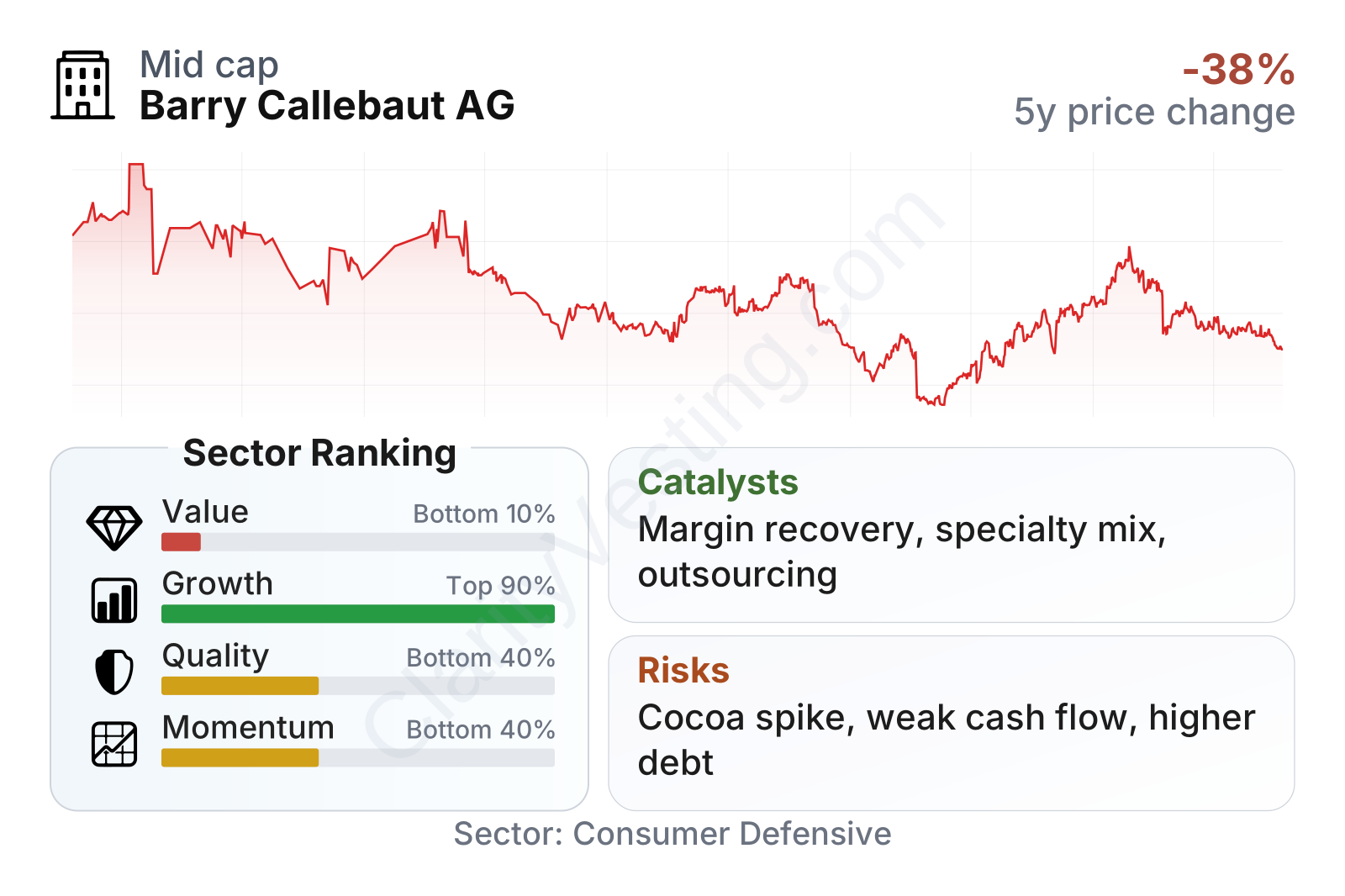
Barry Callebaut is a mid-to-large global food ingredients company with unusually low share-price volatility, as shown by its very low beta. That can make the stock less sensitive to broad market swings, but it does not mean the underlying business is low risk. The recent profile is mixed: long-term revenue per share growth has been strong, yet near-term sales growth turned negative, profitability sits below sector medians, and free cash flow is currently negative. Leverage is also elevated, with debt measures and interest coverage weaker than many peers. The stock’s recent share-price performance has lagged the broader consumer defensive group, reflecting these operating pressures.
On valuation, the picture is not obviously cheap on traditional measures. The earnings multiple and book multiple sit above sector medians, while cash generation has weakened materially. A low PEG ratio suggests the market may still be pricing in some recovery potential, but that only becomes meaningful if margins and cash flow normalize.
Growth
The chocolate and cocoa ingredients market is supported by long-term structural demand. Chocolate consumption remains broad-based globally, and emerging markets still offer room for expansion as packaged foods, bakery, desserts, and premium confectionery become more established. Beyond volume growth, there is also increasing demand for premiumization, customized recipes, cleaner ingredient sourcing, and outsourcing by consumer brands that prefer to rely on specialized manufacturers instead of running all production internally.
Barry Callebaut’s strategy broadly fits that environment. Its scale in cocoa sourcing, global factory network, product development capabilities, and deep relationships with multinational food companies create a platform that is difficult to replicate. The company has also invested in specialty offerings, outsourcing partnerships, and sustainability programs tied to traceability and responsible sourcing. Those areas matter because large food customers increasingly want reliable long-term supply, quality consistency, and documented sustainability standards.
A meaningful catalyst is the company’s ability to recover margins after the recent period of extreme cocoa price disruption. Barry Callebaut’s business model is designed to pass through many raw-material costs over time, but there can be delays and friction. If cocoa markets become less disorderly, earnings could improve faster than revenue trends suggest. Another potential growth driver is expansion in higher-value specialty products, where customer relationships and technical know-how can support better economics than standard bulk products.
Recent company updates have also centered on leadership changes, operational improvement efforts, and actions to strengthen execution after a difficult period for volumes and profitability. For a company of this scale, even a moderate recovery in utilization, pricing discipline, and working-capital management could have a visible impact on earnings quality.
Risks
This article is for informational purposes only and does not constitute financial advice. Some content is AI-generated. See Disclaimer


