Stock Analysis · Brady Corporation (BRC)
Overview
Brady Corporation is an industrial company focused on identification, workplace safety, and compliance products. In simple terms, it helps businesses label equipment, mark hazardous areas, track assets, lock out machinery during maintenance, and organize workplaces so operations are safer and easier to manage. Its products are used in factories, laboratories, data centers, healthcare settings, electrical installations, and many other professional environments where mistakes can be costly or dangerous.
The company organizes its business into two main segments. Identification Solutions is the larger business and includes products such as industrial labels, signs, safety devices, lockout/tagout systems, printer systems, software, and specialty materials. Workplace Safety is the smaller segment and includes visual workplace products, spill control, floor marking, first-response and facility safety items, and related services.
Based on the latest annual reporting, Brady’s revenue mix is approximately:
- Identification Solutions: about 79% of revenue. This includes high-performance labels and signs, safety identification systems, printing hardware, software, and materials used for traceability, compliance, and asset identification.
- Workplace Safety: about 21% of revenue. This includes facility safety products, floor marking, spill and absorbent products, lockout devices, and visual workplace solutions.
Geographically, Brady has a broad international footprint, with revenue split across the Americas, Europe, Asia, and Australia. That diversification helps reduce dependence on any single end market, although industrial demand remains the main driver of the business.
One notable operating trend is that revenue has risen steadily over the last several years, while gross profit has expanded faster than cost of revenue. That points to a business with pricing discipline, a favorable product mix, and room to reinvest in selling and product development while still producing solid earnings.
Key Figures
| Metric | Value | Sector ⓘ |
|---|---|---|
| Date | Oct 24, 2026 | |
| Context | ||
| Sector | Industrials | |
| Industry | Security & Protection Services | |
| Market Cap ⓘ | $3.90B | |
| Beta ⓘ | 0.61 | |
Value (Cheapness) | ||
| P/E Ratio ⓘ | 19.32 | 22.29 |
| P/B Ratio ⓘ | 2.90 | 1.98 |
| FCF Yield ⓘ | 4.94% | 6.26% |
| Dividend Yield ⓘ | 1.20% | 1.92% |
| EBIT / EV ⓘ | 7.03% | 4.83% |
| PEG ⓘ | 1.67 | |
Growth (Business expansion) | ||
| Revenue Growth ⓘ | 10.00% | 9.30% |
| RPS Growth (5Y CAGR) ⓘ | 8.39% | 7.76% |
| EPS Growth (5Y CAGR) ⓘ | 15.76% | -13.17% |
| BVPS Growth (5Y CAGR) ⓘ | 12.67% | 6.13% |
| Margin Growth (5Y Trend) ⓘ | 1.35% | 0.74% |
| FCF Growth (5Y CAGR) ⓘ | 26.47% | 10.79% |
| DPS Growth (5Y CAGR) ⓘ | 2.10% | 9.41% |
Quality (Business durability) | ||
| ROIC (Latest) ⓘ | 15.52% | 10.75% |
| ROA (Latest) ⓘ | 11.26% | 5.41% |
| ROIC (5Y Median) ⓘ | 15.99% | 9.37% |
| ROA (5Y Median) ⓘ | 11.65% | 4.95% |
| Net Debt / EBIT (Latest) ⓘ | -0.38 | 2.04 |
| Net Debt / EBIT (5Y Median) ⓘ | -0.31 | 2.27 |
| Net Debt / EBITDA (Latest) ⓘ | -0.33 | 1.39 |
| Net Debt / Assets ⓘ | -5.59% | 19.27% |
| EBITDA / Interest ⓘ | 32.37 | 9.58 |
| Operating Margin (Latest) ⓘ | 16.20% | 10.49% |
| Operating Margin (5Y Median) ⓘ | 16.20% | 10.30% |
| Debt to Equity (Latest) ⓘ | 6.16% | 64.82% |
| Profit Margin (Latest) ⓘ | 12.36% | 6.67% |
| Free Cash Flow (Latest) ⓘ | $192.65M | |
Momentum (Price trend) | ||
| 3Y Return ⓘ | +62.09% | +67.77% |
| 12M Return (excl. last month) ⓘ | +5.95% | +12.05% |
| 6M Return ⓘ | -1.79% | 0.00% |
| Price vs. 200-Day MA ⓘ | -4.77% | +0.67% |
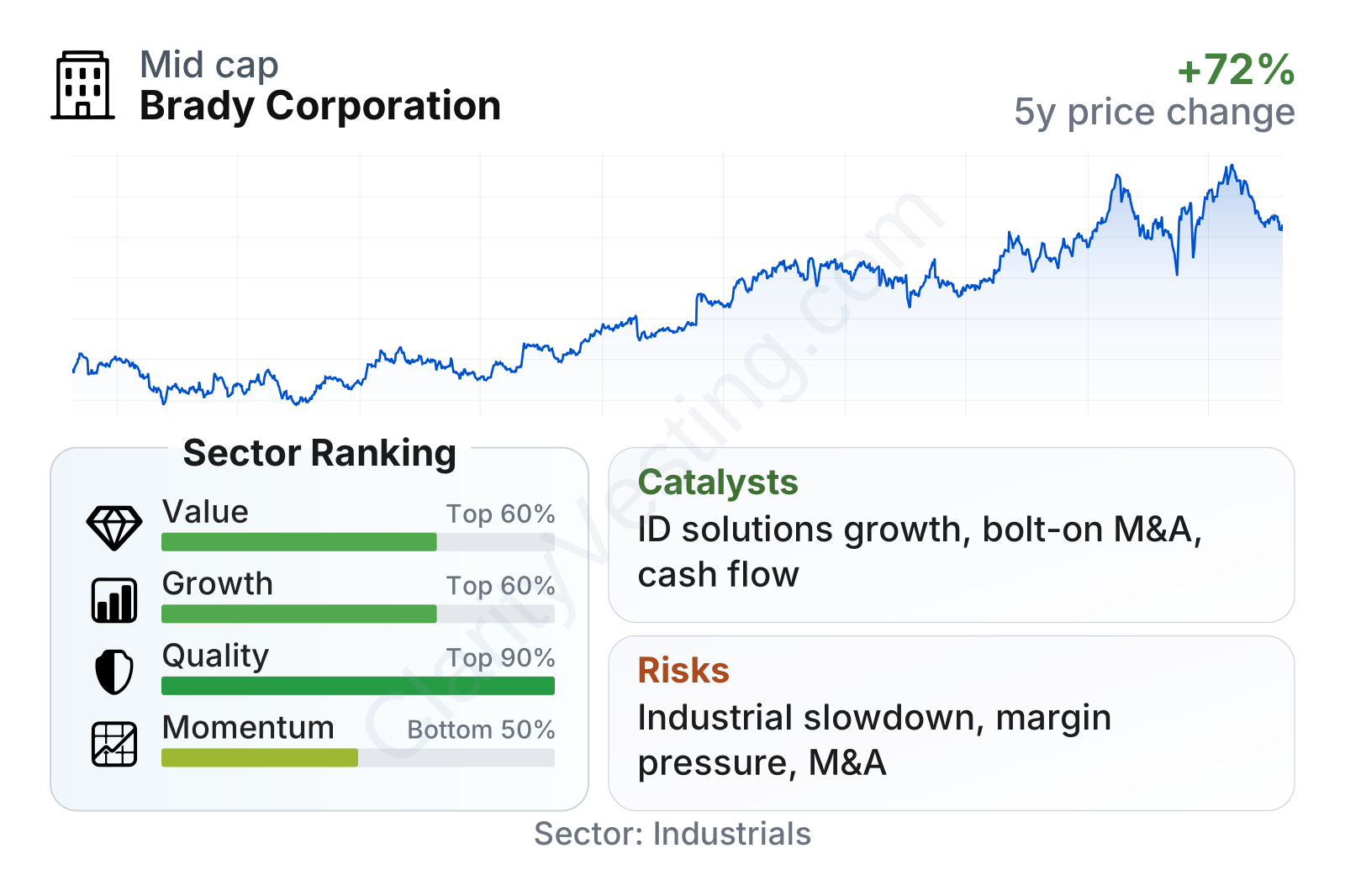
Brady is a mid-sized industrial company with a market value around $4 billion and a relatively low beta of about 0.61, which suggests the stock has historically moved less than the broader market. The quality profile stands out the most. Returns on capital and assets are well above the sector median, profit margins are meaningfully stronger than many peers, and the balance sheet is unusually conservative, with very low debt and net cash-like characteristics. Growth and valuation both look more middle-of-the-pack: the business has been expanding at a healthy pace, but the stock is no obvious bargain on every measure, especially after a strong multi-year share price increase.
Growth
Brady operates in a part of the industrial market that tends to benefit from durable long-term demand rather than short-lived trends. Safety compliance, product traceability, asset identification, and facility organization are recurring needs for manufacturers, utilities, healthcare providers, electronics producers, and logistics operators. Regulations, automation, and the rising complexity of supply chains all support continued demand for clearer labeling, better tracking, and safer work environments.
The company’s strategy also fits that backdrop. Brady has been building around specialized products that are often important to customers but represent a small part of their total cost structure. That can support pricing power and customer retention. Its mix of consumables, devices, and software also creates recurring relationships rather than one-time equipment sales only. Acquisitions have been part of the model as well, especially where they add niche technologies or strengthen distribution.
Revenue growth has not been perfectly smooth from quarter to quarter, but the broader direction has improved. After periods of slower or slightly negative growth, Brady returned to a more consistent pace, and the latest year-over-year growth is around 10%, slightly ahead of the sector median. Over a five-year view, revenue per share growth has also been solid, while earnings growth has been much stronger than many companies in the same sector.
Cash generation supports the growth case. Free cash flow has grown strongly over the last five years, even with some recent variation. That matters because it gives Brady flexibility to fund acquisitions, product development, dividends, and share repurchases without putting pressure on the balance sheet. In a business like this, steady cash conversion is an important sign that accounting profits are translating into real financial capacity.
Recent company updates have also pointed to continued interest in areas such as product identification, safety solutions, and precision labeling applications. These are not flashy markets, but they are practical and often mission-critical for customers. That makes Brady more tied to ongoing operating needs than to discretionary spending alone.
Risks
This article is for informational purposes only and does not constitute financial advice. Some content is AI-generated. See Disclaimer


