Stock Analysis · Brookfield Property Partners LP (BPYPP)
Overview
Brookfield Property Partners LP is a real estate company tied to Brookfield’s broader property platform. Its business has historically centered on owning, operating, and investing in large-scale commercial real estate, especially office towers, retail properties, logistics assets, multifamily housing, hospitality, self-storage, and development projects. In practical terms, it makes money from rent paid by tenants, fees and profits from property operations, gains or losses tied to asset sales and valuations, and income from development and other real estate-related activities.
Because the partnership structure and reported results can include several property types and valuation movements, the cleanest way to think about revenue is by operating source rather than by a simple product line. Based on recent annual reporting and Brookfield’s public disclosures around the property platform, the main sources of revenue are broadly:
- Rental and lease income: the largest component, generated from office, retail, industrial, residential, hospitality, storage, and other leased assets.
- Property operations and services: revenue connected to tenant recoveries, parking, hospitality operations, and other on-site services.
- Development, sales, and realized gains: income from selling assets, completing developments, and monetizing investments.
- Fair value and other investment-related items: accounting gains or losses linked to revaluations and investment activity, which can materially affect reported earnings from year to year.
That mix matters because Brookfield Property Partners is not a simple rent collector. Its reported performance can move significantly with financing costs, property sales, and valuation changes. Revenue rose from roughly $7.1 billion in 2021 to about $9.1 billion in 2024 before falling back near $7.1 billion in 2025, showing how cyclical and transaction-sensitive the business can be. Operating profitability has remained high at the property level, but interest expense has absorbed a very large share of that operating income in recent years.
For holders of BPYPP specifically, there is an important structural point: BPYPP represents preferred equity of Brookfield Property Partners, not the common units. That means the security sits higher than common equity in the capital structure and is mainly judged through asset coverage, cash generation, refinancing capacity, and distribution sustainability rather than headline revenue growth alone.
The long-term pattern shows a business with sizable gross profit and strong underlying property-level margins, but with financing costs taking an unusually heavy bite. That gap between property income and net income is one of the central issues in analyzing the security.
Key Figures
| Metric | Value | Sector ⓘ |
|---|---|---|
| Date | Oct 24, 2026 | |
| Context | ||
| Sector | Real Estate | |
| Industry | Real Estate Services | |
| Market Cap ⓘ | $10.66B | |
| Beta ⓘ | -0.78 | |
Value (Cheapness) | ||
| P/E Ratio ⓘ | 6.88 | 17.85 |
| P/B Ratio ⓘ | 0.72 | 0.87 |
| FCF Yield ⓘ | -38.70% | 7.30% |
| Dividend Yield ⓘ | 7.29% | 4.83% |
| EBIT / EV ⓘ | 4.61% | 3.78% |
| PEG ⓘ | N/A | |
Growth (Business expansion) | ||
| Revenue Growth ⓘ | 5.30% | 5.35% |
| RPS Growth (5Y CAGR) ⓘ | -7.47% | 6.02% |
| EPS Growth (5Y CAGR) ⓘ | -21.01% | -10.65% |
| BVPS Growth (5Y CAGR) ⓘ | -38.18% | 0.43% |
| Margin Growth (5Y Trend) ⓘ | -45.38% | -0.69% |
| FCF Growth (5Y CAGR) ⓘ | N/A | 5.40% |
| DPS Growth (5Y CAGR) ⓘ | 0.53% | 5.07% |
Quality (Business durability) | ||
| ROIC (Latest) ⓘ | 1.73% | 5.69% |
| ROE (Latest) ⓘ | -2.78% | 7.37% |
| ROA (Latest) ⓘ | -0.25% | 2.85% |
| ROIC (5Y Median) ⓘ | 4.22% | 4.26% |
| ROE (5Y Median) ⓘ | -1.75% | 6.04% |
| ROA (5Y Median) ⓘ | -0.36% | 2.45% |
| Net Debt / EBIT (Latest) ⓘ | 10.43 | 7.55 |
| Net Debt / EBIT (5Y Median) ⓘ | 14.47 | 8.26 |
| Net Debt / EBITDA (Latest) ⓘ | 9.60 | 5.26 |
| Net Debt / Assets ⓘ | 37.03% | 37.45% |
| EBITDA / Interest ⓘ | 1.15 | 4.11 |
| Operating Margin (Latest) ⓘ | 50.61% | 33.86% |
| Operating Margin (5Y Median) ⓘ | 47.32% | 37.49% |
| Debt to Equity (Latest) ⓘ | 421.07% | 88.76% |
| Profit Margin (Latest) ⓘ | -3.31% | 18.94% |
| Free Cash Flow (Latest) ⓘ | -$4.12B | |
Momentum (Price trend) | ||
| 3Y Return ⓘ | +71.65% | +36.33% |
| 12M Return (excl. last month) ⓘ | +12.51% | +4.32% |
| 6M Return ⓘ | -2.78% | -1.74% |
| Price vs. 200-Day MA ⓘ | +0.15% | -1.42% |
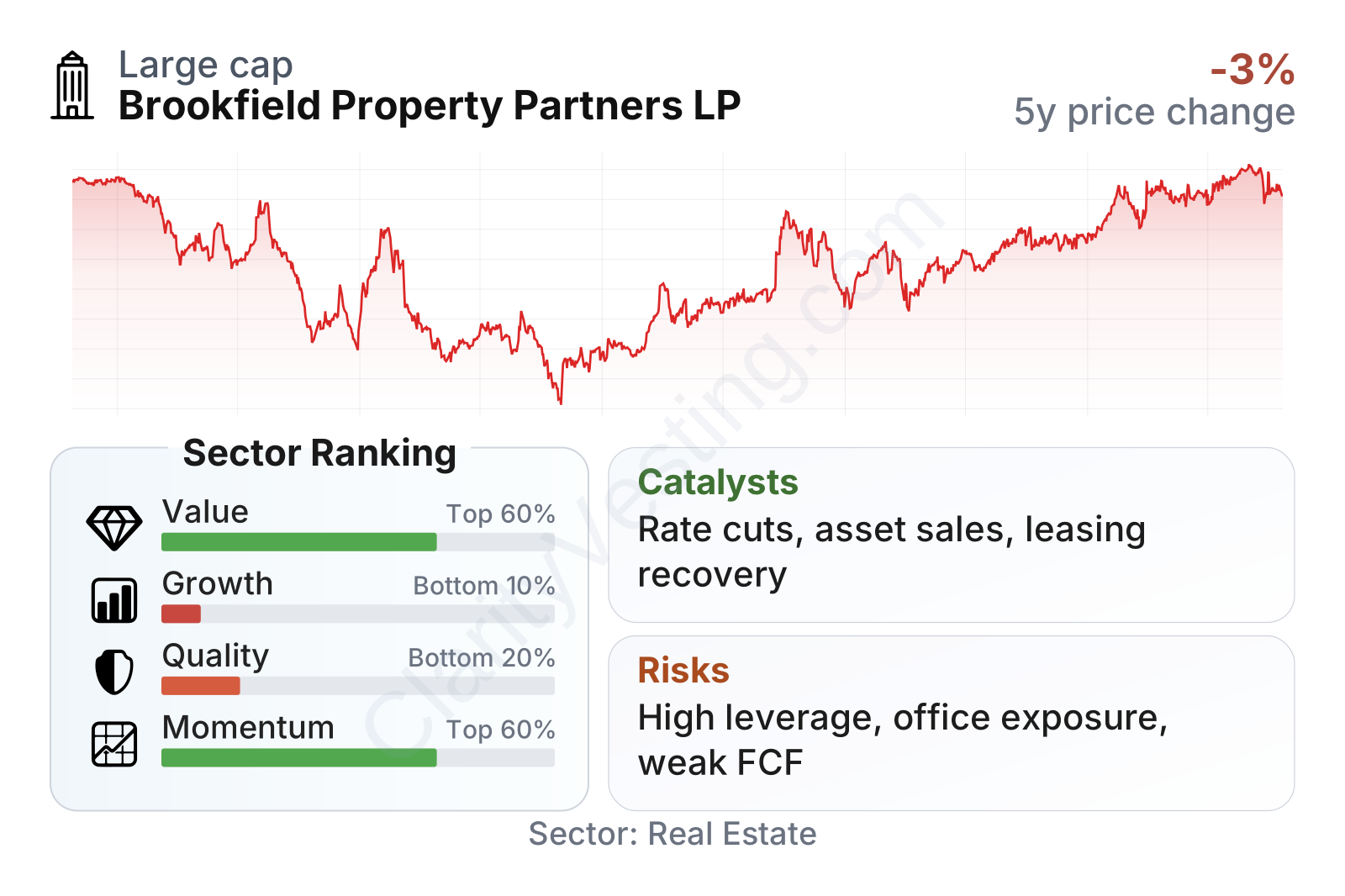
The overall picture is mixed. On valuation measures, Brookfield Property Partners screens cheaper than much of the real estate sector, with a low earnings multiple and a price-to-book ratio below the sector median. The distribution yield is also above the sector median. However, those lower valuation readings come with weak growth and weak quality rankings. Profitability on assets and equity is below sector norms, free cash flow is negative, and leverage is elevated. Market performance has recently been stronger than the sector median, but that price recovery has not yet been matched by equally strong underlying business quality.
Growth
Brookfield Property Partners operates in a sector that still has long-term relevance, but not all of its markets are growing at the same speed. Real estate linked to logistics, residential demand, storage, mixed-use development, and high-quality experiential retail has stronger structural support than traditional office real estate. Brookfield’s broader strategy of concentrating on large, high-quality assets in major cities and recycling capital from mature properties into stronger areas is logical for long-term value creation, especially when replacement costs for prime real estate remain high.
One useful positive is that Brookfield’s platform is not limited to a single property category. The wider Brookfield ecosystem has global scale, operational expertise, and access to institutional capital that many standalone landlords do not have. That can help with redevelopment projects, selective acquisitions, refinancing discussions, and asset sales. In periods when weaker owners are forced to sell, a large manager with deep relationships can sometimes improve portfolio quality.
Still, the growth record visible in recent years is not especially convincing. Revenue per share improved into 2023, then weakened notably through 2025. The latest factor rankings also place the company near the bottom of the sector on multi-year growth, with declines in earnings per share, book value per share, and operating margin trend over five years. That suggests the current investment case is less about steady compounding and more about stabilization, asset monetization, and balance-sheet management.
The distribution profile is also uneven. The payout per share has been volatile rather than steadily rising, which is important for a long-duration income-oriented security. The trailing yield remains high, but the history shows that headline yield alone does not capture the full picture. A stronger long-term setup would likely require more consistent cash coverage, less dependence on capital market conditions, and clearer evidence that property cash flows are outgrowing financing pressure.
As for near-term catalysts, the most relevant ones are not tied to a single product launch or technology cycle. Instead, they are more financial and operational: lower interest rates, successful refinancing, asset sales at acceptable values, stronger leasing in flagship properties, and a healthier transaction market for commercial real estate. If those pieces improve together, the gap between asset value and market valuation could narrow. Public disclosures from Brookfield entities in recent years have continued to emphasize capital recycling, liquidity management, and selective investment into high-conviction real estate themes, which fits that framework.
Risks
This article is for informational purposes only and does not constitute financial advice. Some content is AI-generated. See Disclaimer


