Stock Analysis · Bid Corporation Limited (BPPPF)
Overview
Bid Corporation Limited is a global foodservice distributor. In simple terms, it buys food, beverages, and related products from producers and supplies them to professional customers such as restaurants, hotels, hospitals, schools, caterers, and other institutional kitchens. The group operates across many countries, which gives it broad exposure to eating-out demand rather than dependence on one local market.
The business model is mainly based on distribution: purchasing at scale, managing warehousing and logistics, and delivering a wide range of products to customers that need reliable supply. This is typically a lower-margin business than branded consumer goods, but scale, service quality, local density, and purchasing power can create a durable competitive position.
Based on the company’s recent annual reporting, revenue is primarily generated from foodservice distribution operations spread across its geographic divisions. Public disclosures emphasize geographic segments more than narrow product splits. The broad revenue sources can be summarized as follows:
- Food and grocery distribution: the largest source of revenue, covering fresh, frozen, chilled, dry food, and pantry products sold to foodservice customers.
- Meat, seafood, produce, and other fresh categories: an important part of the offer, especially where customers need frequent deliveries and cold-chain handling.
- Beverages and complementary products: drinks and related items supplied alongside core food categories.
- Non-food catering supplies: packaging, hygiene, kitchen-related consumables, and other operational products used by hospitality and institutional clients.
Geographically, the company’s sales are diversified across developed markets, with Europe representing the largest share, followed by Australasia, the United Kingdom, and emerging or niche operations in other regions. Exact percentages can shift year to year with currency and local demand, but the company is not centered on a single-country revenue stream.
The most important takeaway for long-term readers is that Bidcorp is not a consumer brand in the usual sense. It is an infrastructure-like supplier to the food-away-from-home economy. That gives it recurring demand exposure tied to meals served outside the home, institutional catering, and hospitality activity.
The operating profile shows a classic distributor structure: a very large cost of goods base, modest but improving operating income, and steadily rising net income over recent years. Revenue has expanded strongly since 2022, while profit has also moved up, suggesting scale benefits and generally disciplined execution even in a low-margin industry.
Key Figures
| Metric | Value | Sector ⓘ |
|---|---|---|
| Date | Oct 17, 2026 | |
| Context | ||
| Sector | Consumer Defensive | |
| Industry | Food Distribution | |
| Market Cap ⓘ | $9.11B | |
| Beta ⓘ | 0.26 | |
Value (Cheapness) | ||
| P/E Ratio ⓘ | 17.36 | 17.88 |
| P/B Ratio ⓘ | 0.20 | 1.29 |
| FCF Yield ⓘ | 168.72% | 12.39% |
| Dividend Yield ⓘ | 45.50% | 2.85% |
| EBIT / EV ⓘ | N/A | 6.43% |
| PEG ⓘ | N/A | |
Growth (Business expansion) | ||
| Revenue Growth ⓘ | -1.50% | 4.10% |
| RPS Growth (5Y CAGR) ⓘ | 12.70% | 6.18% |
| EPS Growth (5Y CAGR) ⓘ | -15.94% | -13.59% |
| BVPS Growth (5Y CAGR) ⓘ | 10.49% | 3.20% |
| Margin Growth (5Y Trend) ⓘ | 0.64% | -0.15% |
| FCF Growth (5Y CAGR) ⓘ | 166.96% | 4.10% |
| DPS Growth (5Y CAGR) ⓘ | 14.33% | 6.79% |
Quality (Business durability) | ||
| ROIC (Latest) ⓘ | 30.27% | 12.34% |
| ROA (Latest) ⓘ | 15.24% | 6.30% |
| ROIC (5Y Median) ⓘ | 15.18% | 10.49% |
| ROA (5Y Median) ⓘ | 7.40% | 5.44% |
| Net Debt / EBIT (Latest) ⓘ | 0.43 | 1.96 |
| Net Debt / EBIT (5Y Median) ⓘ | 1.00 | 2.35 |
| Net Debt / EBITDA (Latest) ⓘ | 0.33 | 1.38 |
| Net Debt / Assets ⓘ | 9.69% | 21.51% |
| EBITDA / Interest ⓘ | 12.61 | 9.46 |
| Operating Margin (Latest) ⓘ | 5.45% | 8.87% |
| Operating Margin (5Y Median) ⓘ | 5.34% | 9.53% |
| Debt to Equity (Latest) ⓘ | 48.95% | 72.35% |
| Profit Margin (Latest) ⓘ | 3.70% | 5.40% |
| Free Cash Flow (Latest) ⓘ | $15.37B | |
Momentum (Price trend) | ||
| 3Y Return ⓘ | +43.29% | +20.92% |
| 12M Return (excl. last month) ⓘ | +10.83% | +2.13% |
| 6M Return ⓘ | +8.67% | +1.26% |
| Price vs. 200-Day MA ⓘ | +53.80% | +1.39% |
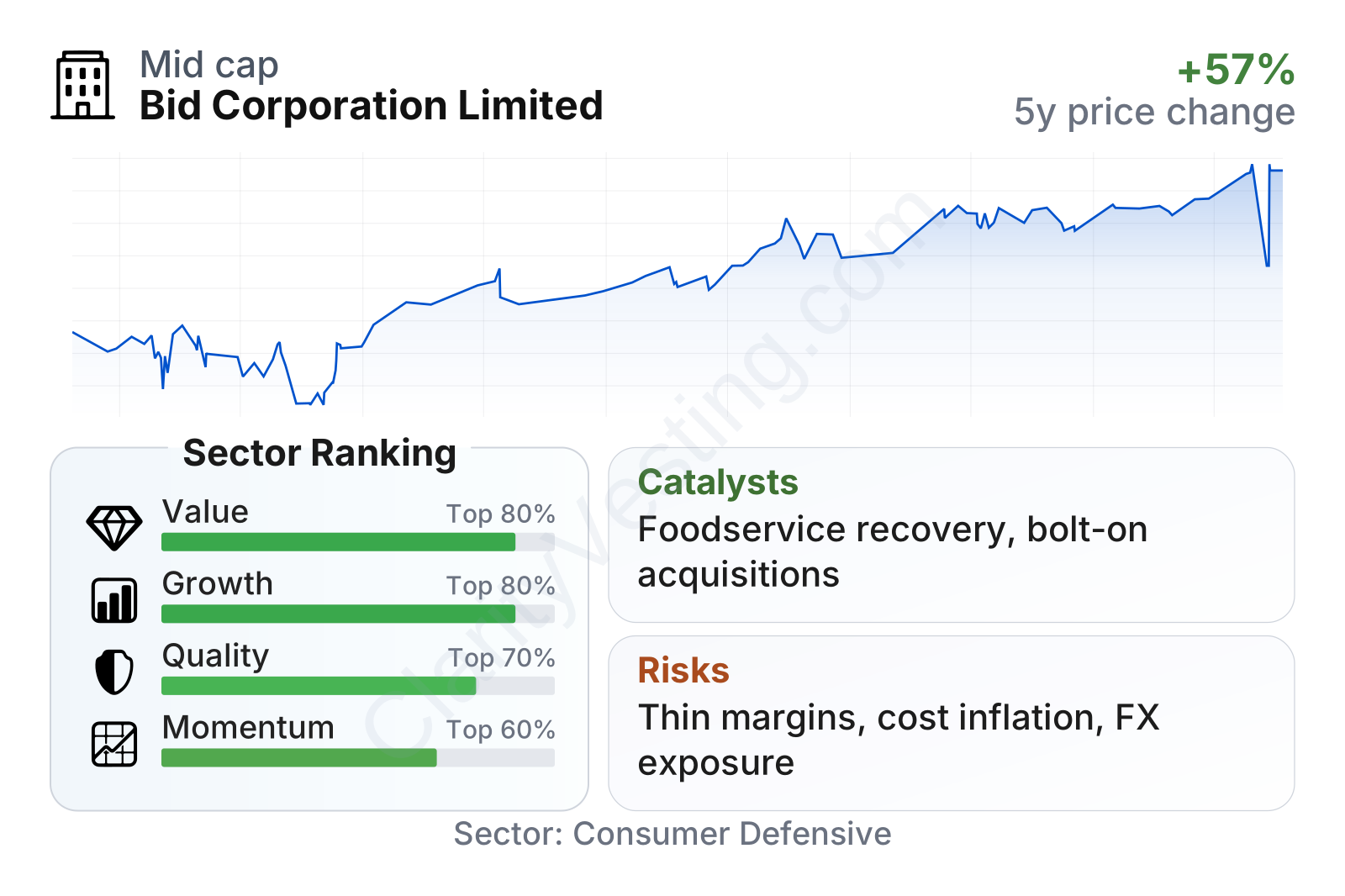
Bidcorp sits in the large-cap range and shows unusually low share-price volatility, with a beta close to 0.25. On valuation, the earnings multiple is a bit below the sector median, while the price-to-book ratio is far below typical sector levels. Profitability quality is solid in several areas: returns on invested capital and assets are clearly ahead of the sector median, and leverage is conservative, with net debt running well below many peers. The weaker points are margins, which remain thinner than the sector median, and recent year-over-year revenue growth, which has slipped slightly below zero even though the longer five-year growth record remains strong. Price momentum has also been favorable relative to the broader sector.
Growth
Bidcorp operates in a sector that tends to grow with urbanization, travel, restaurant activity, outsourced catering, and the long-term shift toward professional food preparation outside the home. Food distribution is not usually a high-growth industry in the way software or biotechnology can be, but it can offer durable expansion through market share gains, geographic rollout, acquisitions, and a broader product offering.
Its strategy makes sense for that kind of environment. The company focuses on decentralization, local execution, and route density rather than trying to force a one-size-fits-all model across every country. In foodservice distribution, this matters because customer needs are local, delivery frequency is high, and service consistency can be a stronger differentiator than price alone.
The longer-term numbers suggest a business that has compounded well even if the latest annual comparison was softer. Revenue per share has grown at roughly 13% annually over five years, book value per share by about 10%, and free cash flow has risen sharply over the same period. That combination points to a company that has expanded its operating footprint while also converting a meaningful share of earnings into cash.
A practical catalyst is continued normalization and expansion in food-away-from-home demand across hotels, leisure, corporate catering, healthcare, and education. Another is the group’s ability to keep consolidating fragmented local markets through bolt-on acquisitions. In this industry, distribution scale can improve purchasing, truck utilization, warehouse productivity, and customer retention over time.
Recent company reporting also indicates continued revenue and profit progression in the 2026 fiscal year, with sales reaching about 238.6 billion in reporting currency and net income around 8.8 billion. That does not point to explosive growth, but it does support the view of a steadily advancing operator with room to expand through execution and selective dealmaking.
Risks
This article is for informational purposes only and does not constitute financial advice. Some content is AI-generated. See Disclaimer


