Stock Analysis · Popular Inc (BPOP)
Overview
Popular, Inc. is a regional banking group centered on Puerto Rico, with additional operations in the mainland United States. Its main business is straightforward: it gathers deposits from consumers and businesses, makes loans, earns interest on those loans and securities, and also collects fees from services such as card processing, wealth management, mortgage activities, and trust services. The company operates primarily through Banco Popular de Puerto Rico and Popular Bank.
Its revenue mix is still dominated by traditional banking. Based on recent annual reporting, the largest source is net interest income, which is the spread between what the bank earns on loans and investments and what it pays on deposits and borrowings. Non-interest income is the smaller but still meaningful second pillar.
- Net interest income: about 74% to 78% of total revenue. This includes income from commercial loans, consumer loans, residential mortgages, credit cards, auto lending, and investment securities, minus interest paid on deposits and other funding.
- Non-interest income: about 22% to 26% of total revenue. This includes service charges on deposit accounts, debit and credit card fees, trust and brokerage services, mortgage banking, insurance commissions, and other customer service fees.
From a business mix standpoint, Popular is unusual among U.S.-listed regional banks because Puerto Rico is the core market. That gives it a strong local franchise and brand recognition, but it also means the company is more exposed to the island’s economy than most peers are to any single geography.
The company’s recent financial path shows a classic banking cycle: revenue expanded strongly from 2021 through 2025, while profit was more volatile because funding costs and interest expense surged after rates moved higher. By 2025, earnings had recovered materially from the 2023 dip, suggesting the bank has been able to reprice assets and stabilize profitability after a difficult transition period.
Revenue has grown clearly over the last several years, and net income recovered well after the pressure seen in 2023. The main point is that higher rates initially raised funding costs faster than earnings, but the business has since rebuilt profitability rather than remaining stuck at lower levels.
Key Figures
| Metric | Value | Sector ⓘ |
|---|---|---|
| Date | Oct 31, 2026 | |
| Context | ||
| Sector | Financial Services | |
| Industry | Banks - Regional | |
| Market Cap ⓘ | $9.96B | |
| Beta ⓘ | 0.65 | |
Value (Cheapness) | ||
| P/E Ratio ⓘ | 9.99 | 12.20 |
| P/B Ratio ⓘ | 1.60 | 1.26 |
| FCF Yield ⓘ | 8.11% | 9.87% |
| Dividend Yield ⓘ | 2.00% | 2.87% |
| EBIT / EV ⓘ | N/A | 8.17% |
| PEG ⓘ | 1.37 | |
Growth (Business expansion) | ||
| Revenue Growth ⓘ | 9.90% | 8.40% |
| RPS Growth (5Y CAGR) ⓘ | 19.18% | 12.31% |
| EPS Growth (5Y CAGR) ⓘ | 3.83% | -4.03% |
| BVPS Growth (5Y CAGR) ⓘ | 6.06% | 4.96% |
| Margin Growth (5Y Trend) ⓘ | -24.32% | -4.14% |
| FCF Growth (5Y CAGR) ⓘ | -7.53% | 4.70% |
| DPS Growth (5Y CAGR) ⓘ | 13.88% | 8.85% |
Quality (Business durability) | ||
| ROIC (Latest) ⓘ | N/A | 9.35% |
| ROE (Latest) ⓘ | 16.40% | 13.95% |
| ROA (Latest) ⓘ | 1.34% | 1.57% |
| ROIC (5Y Median) ⓘ | 11.61% | 7.78% |
| ROE (5Y Median) ⓘ | 14.05% | 12.12% |
| ROA (5Y Median) ⓘ | 1.12% | 1.28% |
| Net Debt / EBIT (Latest) ⓘ | N/A | 0.99 |
| Net Debt / EBIT (5Y Median) ⓘ | -6.89 | 0.73 |
| Net Debt / EBITDA (Latest) ⓘ | 0.77 | 0.79 |
| Operating Margin (Latest) ⓘ | N/A | 22.61% |
| Operating Margin (5Y Median) ⓘ | 22.73% | 24.52% |
| Debt to Equity (Latest) ⓘ | 21.24% | 58.76% |
| Profit Margin (Latest) ⓘ | 32.66% | 26.18% |
| Free Cash Flow (Latest) ⓘ | $807.17M | |
Momentum (Price trend) | ||
| 3Y Return ⓘ | +162.63% | +95.34% |
| 12M Return (excl. last month) ⓘ | +25.56% | +16.22% |
| 6M Return ⓘ | +8.47% | +7.41% |
| Price vs. 200-Day MA ⓘ | +4.22% | +5.48% |
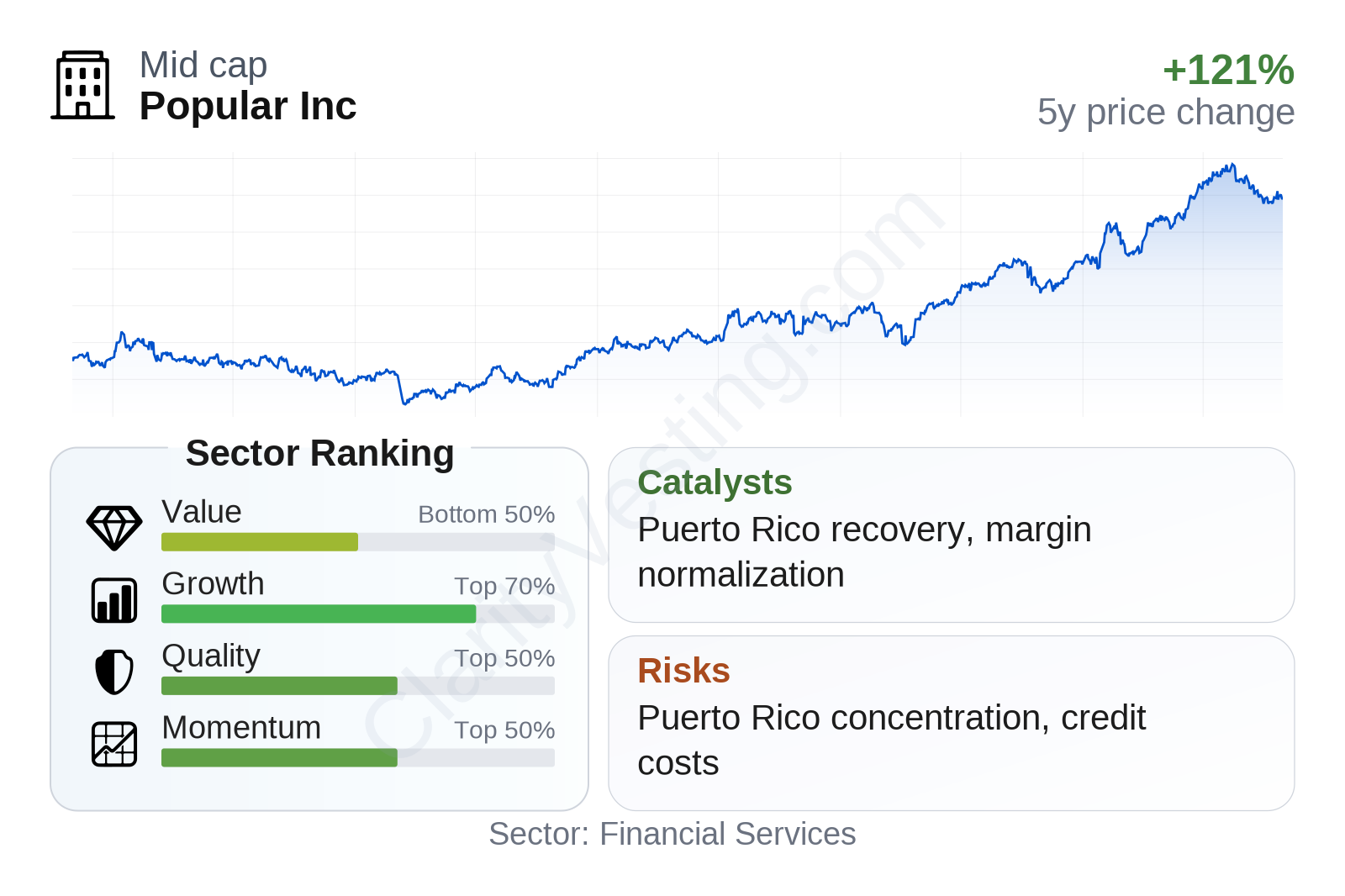
Popular sits in the large regional bank category, with a stock that has been less volatile than the broader market. The overall profile is mixed but constructive: value metrics are not especially cheap relative to banks, quality looks solid, and growth ranks above much of the sector. Share price performance has also been strong over the last three years, which suggests the market has been recognizing the company’s earnings recovery and franchise strength.
The stock’s recent rise has been significant, especially from the 2023 regional banking stress period to 2026. That move matters because it changes the discussion from recovery to execution: the market is no longer pricing Popular like a troubled regional bank, but more like a profitable institution with a defensible niche.
Growth
Banking is not usually described as a high-growth industry, but some parts of the sector can still expand steadily through market share gains, better pricing, digital adoption, and selective loan growth. Popular operates in a mature industry, yet its position in Puerto Rico gives it a practical growth angle: if the local economy, tourism activity, infrastructure spending, and business formation remain healthy, the bank has a natural channel to capture deposits, payments, mortgages, and commercial lending.
Its strategy also makes sense for durable growth because it is not built around a single product. The bank serves retail customers, small businesses, middle-market companies, and institutional clients. That diversification can reduce dependence on one lending category. In addition, fee businesses such as card services, wealth management, and mortgage-related activities provide another route for expansion when lending conditions are less favorable.
Recent growth indicators are encouraging. Revenue growth has been running somewhat above the sector median, and five-year revenue-per-share growth has been clearly stronger than many regional bank peers. Earnings per share over five years have also remained positive, which stands out in a sector where many banks had a more difficult period.
The earnings trend is important because it shows a business that absorbed a profit drop in 2023 and then regained momentum. That pattern often matters more than one weak year in isolation. If future quarters continue to show stable credit costs and a manageable deposit pricing environment, the earnings base looks stronger than it did during the regional bank scare.
Book value per share has also moved upward over time, especially after the sharp reset between 2021 and 2022. For banks, book value is a useful marker because it reflects the capital base supporting future lending and earnings. Popular’s longer-term increase suggests the company has been rebuilding shareholder value while remaining profitable.
One notable catalyst is Puerto Rico’s ongoing economic normalization after years of fiscal strain and natural disaster recovery. Federal reconstruction funding, infrastructure projects, and tourism activity can support credit demand and transaction volumes. Another is the possibility that a more stable interest-rate backdrop helps margins by reducing the abrupt funding pressure that hurt many banks in 2023. Continued digital banking and operating efficiency improvements could also support future profitability without requiring aggressive balance-sheet expansion.
Risks
This article is for informational purposes only and does not constitute financial advice. Some content is AI-generated. See Disclaimer