Stock Analysis · Banco Comercial Portugues SA (BPCGY)
Overview
Banco Comercial Português, usually known as Millennium bcp, is one of the largest banking groups in Portugal. It provides the usual services most people associate with a bank: taking deposits, making loans, processing payments, offering cards, managing savings and investments, and serving both households and businesses. The group also has meaningful operations outside Portugal, especially in Poland through Bank Millennium, and it keeps a presence in several African and international corridors that support trade, remittances, and corporate banking.
For a long-term view, the business is easiest to understand as a traditional commercial bank with three main earnings engines: net interest income from lending and deposits, fee and commission income from day-to-day banking activity, and income from international subsidiaries. Like most banks, results can change materially when interest rates move, credit losses rise, or local economies slow down.
Based on recent annual reporting, the group’s revenue mix is centered on core banking income. Exact shares can move from year to year, but the broad structure is clear.
- Net interest income: approximately 65% to 75% of banking income. This is the spread between what the bank earns on loans and securities and what it pays on deposits and wholesale funding.
- Fees and commissions: approximately 15% to 25%. This includes payment services, cards, asset management, insurance distribution, account-related charges, and transaction banking.
- Financial operations and other banking income: approximately 5% to 15%. This can include trading, hedging, capital markets activity, and valuation-related items that tend to be less stable than core lending income.
- Geographic exposure: Portugal is the main profit base, while Poland is the largest non-Portuguese contributor. Smaller international operations add diversification but are not the main driver of group earnings.
The recent earnings profile shows a business that has become much more profitable than it was a few years ago. Revenue expanded strongly from 2021 to 2025, while net income improved much faster than operating costs. That suggests a favorable mix of higher core banking income and better efficiency, even though the cost of funding also rose during the period.
Key Figures
| Metric | Value | Sector ⓘ |
|---|---|---|
| Date | Nov 21, 2026 | |
| Context | ||
| Sector | Financial Services | |
| Industry | Banks - Regional | |
| Market Cap ⓘ | $17.67B | |
| Beta ⓘ | 0.82 | |
Value (Cheapness) | ||
| P/E Ratio ⓘ | 18.80 | 12.01 |
| P/B Ratio ⓘ | N/A | 1.48 |
| FCF Yield ⓘ | 17.59% | 8.77% |
| Dividend Yield ⓘ | 3.15% | 3.01% |
| EBIT / EV ⓘ | N/A | 8.31% |
| PEG ⓘ | N/A | |
Growth (Business expansion) | ||
| Revenue Growth ⓘ | -47.50% | 6.70% |
| RPS Growth (5Y CAGR) ⓘ | 12.40% | 12.35% |
| EPS Growth (5Y CAGR) ⓘ | 58.95% | -0.27% |
| BVPS Growth (5Y CAGR) ⓘ | -1.30% | 4.83% |
| Margin Growth (5Y Trend) ⓘ | N/A | -4.16% |
| FCF Growth (5Y CAGR) ⓘ | -5.69% | 4.69% |
| DPS Growth (5Y CAGR) ⓘ | 222.59% | 8.82% |
Quality (Business durability) | ||
| ROIC (Latest) ⓘ | N/A | 9.49% |
| ROE (Latest) ⓘ | 21.17% | 14.02% |
| ROA (Latest) ⓘ | 1.19% | 1.53% |
| ROIC (5Y Median) ⓘ | N/A | 7.80% |
| ROE (5Y Median) ⓘ | 16.02% | 12.09% |
| ROA (5Y Median) ⓘ | 0.92% | 1.28% |
| Net Debt / EBIT (Latest) ⓘ | N/A | 0.88 |
| Net Debt / EBIT (5Y Median) ⓘ | N/A | 0.73 |
| Net Debt / EBITDA (Latest) ⓘ | N/A | 0.71 |
| Operating Margin (Latest) ⓘ | N/A | 23.37% |
| Operating Margin (5Y Median) ⓘ | N/A | 24.29% |
| Debt to Equity (Latest) ⓘ | N/A | 59.34% |
| Profit Margin (Latest) ⓘ | 29.88% | 26.65% |
| Free Cash Flow (Latest) ⓘ | $3.11B | |
Momentum (Price trend) | ||
| 3Y Return ⓘ | +308.49% | +73.29% |
| 12M Return (excl. last month) ⓘ | +61.39% | +18.35% |
| 6M Return ⓘ | +17.81% | +3.24% |
| Price vs. 200-Day MA ⓘ | +16.73% | +2.17% |
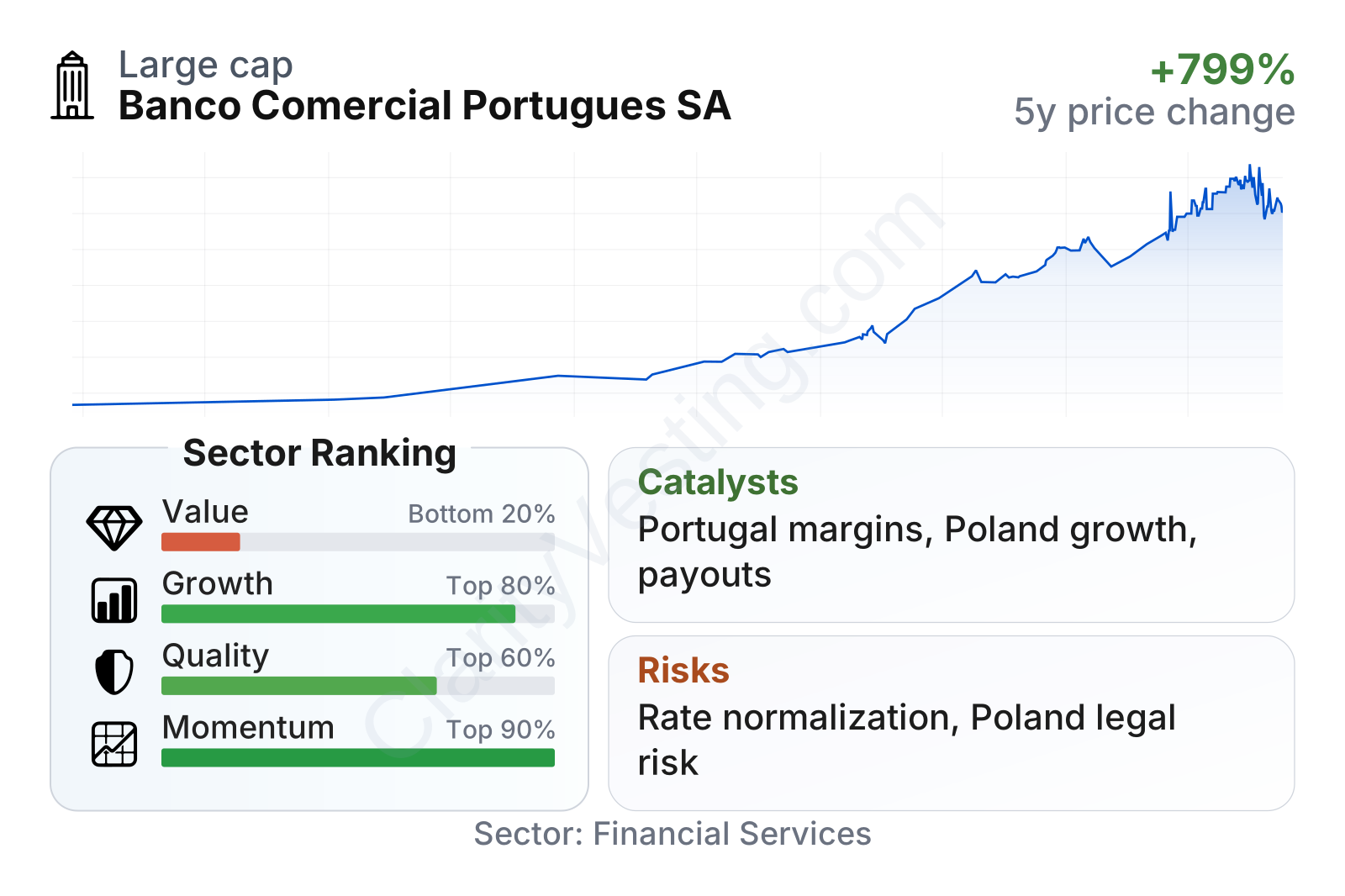
The market is currently treating Banco Comercial Português as a large regional bank with relatively strong recent share-price momentum and solid profitability, but not as a clear bargain on headline valuation. Its value ranking sits in the lower end of the sector because the earnings multiple is above the sector median. At the same time, free cash flow yield and dividend yield look supportive, and quality metrics are respectable, especially on profit margin and return on equity. Growth looks mixed: the five-year earnings trend is very strong, but more recent revenue comparisons are softer, which is common for banks coming off a peak rate environment.
The stock-price chart highlights how dramatic the rerating has been since late 2021. That sharp rise usually means the market has already recognized a large part of the bank’s turnaround and stronger profit generation, so future returns are likely to depend more on whether earnings stay durable than on simple multiple expansion.
Growth
Banco Comercial Português operates in a sector that remains essential rather than fast-growing in a classic technology sense. Long-term growth in banking usually comes from a mix of loan expansion, deposit gathering, digital customer acquisition, better efficiency, and disciplined pricing. In Portugal, the banking market is mature, so explosive organic growth is unlikely. However, banks can still improve earnings meaningfully when balance sheets become cleaner, capital becomes stronger, and customer activity shifts toward higher-value products. Poland gives the group exposure to a larger and structurally more dynamic banking market than Portugal, which matters for longer-term expansion.
The company’s strategy appears coherent for this environment. Management has focused on core retail and commercial banking, digital channels, capital discipline, and shareholder distributions after a long restructuring phase. That approach makes sense for a mature European bank: rather than pursuing risky expansion, it emphasizes stable market positions, cross-selling, cost control, and using a stronger balance sheet to improve returns.
A major catalyst over the last few years has been the change in European interest rates. Higher rates lifted lending spreads and helped sector profitability, and Banco Comercial Português was one of the visible beneficiaries. The important question now is not whether that boost happened, but how much of it can be retained if rates normalize. The group’s recent earnings path suggests it has moved beyond a fragile recovery and into a more consistently profitable phase, which is an important distinction for long-term analysis.
The earnings-per-share trend reflects that shift very clearly. Profit per share was modest in 2021 and 2022, then accelerated sharply in 2023 and remained at a much higher level afterward. That does not mean the path will be linear from here, but it does show that the bank’s operating model is producing far more income than it did earlier in the decade.
Book value per share is also important for a bank because it represents the equity base supporting lending activity. Here, the picture is more balanced. Book value per share dipped earlier in the period and then recovered steadily, but the five-year trend still looks softer than many peers. In practical terms, this means the company has improved profit generation faster than it has compounded tangible balance-sheet value per share. That can still be attractive, but it increases the need to watch capital allocation, distributions, and the quality of earnings.
Recent company communications in 2026 continued to emphasize capital strength, recurring profitability, and cash distributions to shareholders. Those are relevant because they reinforce the idea that the group is no longer being analyzed mainly as a restructuring case. Instead, the debate has shifted toward whether it can sustain above-cycle returns while continuing to return capital.
Risks
This article is for informational purposes only and does not constitute financial advice. Some content is AI-generated. See Disclaimer


