Stock Analysis · Bowhead Specialty Holdings Inc (BOW)
Overview
Bowhead Specialty Holdings Inc. is a specialty property and casualty insurance group. In simple terms, it focuses on harder-to-insure or more complex commercial risks where standard insurance products are often not a good fit. The company works through a network of wholesale brokers and offers coverage across casualty, professional liability, healthcare liability, executive liability, and surety-related areas. Its model is built around underwriting discipline, meaning it tries to be selective about the risks it accepts rather than chasing volume.
Its revenue mainly comes from insurance operations, especially premiums written and earned on specialty commercial policies, along with investment income generated from the float created by holding policyholder funds before claims are paid. Based on recent company reporting, the business is still primarily underwriting-driven rather than investment-driven.
The main revenue sources can be summarized as follows:
- Net premiums earned: approximately 85% to 90% of total revenue. This is the core insurance revenue recognized over the life of policies.
- Net investment income: approximately 8% to 12% of total revenue. This comes from investing the company’s bond-heavy portfolio and has become more meaningful as interest rates stayed higher.
- Other insurance-related income: a small remaining share, typically tied to fees or other operating items.
Over the last several years, Bowhead has expanded quickly. Total revenue rose from roughly $188 million in 2022 to about $552 million in 2025, while net income also moved higher. That combination suggests the company has been growing premium volume without losing profitability entirely in the process, which is an important signal in insurance.
The flow of the business also shows a favorable pattern: revenue has grown rapidly, operating income has scaled up, and net income has improved each year from 2022 through 2025. Costs have risen as the company expands, but profits have also increased, which is a healthier picture than growth that relies only on spending more.
Key Figures
| Metric | Value | Sector ⓘ |
|---|---|---|
| Date | Oct 10, 2026 | |
| Context | ||
| Sector | Financial Services | |
| Industry | Insurance - Property & Casualty | |
| Market Cap ⓘ | $1.12B | |
| Beta ⓘ | -0.08 | |
Value (Cheapness) | ||
| P/E Ratio ⓘ | 18.30 | 12.38 |
| P/B Ratio ⓘ | 2.42 | 1.23 |
| FCF Yield ⓘ | 29.17% | 10.23% |
| Dividend Yield ⓘ | N/A | 3.01% |
| EBIT / EV ⓘ | 7.69% | 8.08% |
| PEG ⓘ | N/A | |
Growth (Business expansion) | ||
| Revenue Growth ⓘ | 23.00% | 9.50% |
| RPS Growth (5Y CAGR) ⓘ | 40.17% | 12.21% |
| EPS Growth (5Y CAGR) ⓘ | -14.51% | -9.62% |
| BVPS Growth (5Y CAGR) ⓘ | 71.53% | 4.98% |
| Margin Growth (5Y Trend) ⓘ | 4.75% | -4.07% |
| FCF Growth (5Y CAGR) ⓘ | 22.42% | 4.76% |
| DPS Growth (5Y CAGR) ⓘ | N/A | 8.79% |
Quality (Business durability) | ||
| ROIC (Latest) ⓘ | 12.15% | 9.35% |
| ROE (Latest) ⓘ | 13.78% | 13.91% |
| ROA (Latest) ⓘ | 2.60% | 1.53% |
| ROIC (5Y Median) ⓘ | N/A | 7.86% |
| ROE (5Y Median) ⓘ | 13.60% | 12.22% |
| ROA (5Y Median) ⓘ | 2.85% | 1.29% |
| Net Debt / EBIT (Latest) ⓘ | -1.91 | 0.99 |
| Net Debt / EBIT (5Y Median) ⓘ | -2.75 | 0.73 |
| Net Debt / EBITDA (Latest) ⓘ | -1.86 | 0.93 |
| Operating Margin (Latest) ⓘ | 14.01% | 22.19% |
| Operating Margin (5Y Median) ⓘ | 11.69% | 24.30% |
| Debt to Equity (Latest) ⓘ | N/A | 60.24% |
| Profit Margin (Latest) ⓘ | 10.11% | 26.49% |
| Free Cash Flow (Latest) ⓘ | $326.97M | |
Momentum (Price trend) | ||
| 3Y Return ⓘ | N/A | +88.52% |
| 12M Return (excl. last month) ⓘ | +9.11% | +19.65% |
| 6M Return ⓘ | +42.62% | +6.00% |
| Price vs. 200-Day MA ⓘ | +21.94% | +3.61% |
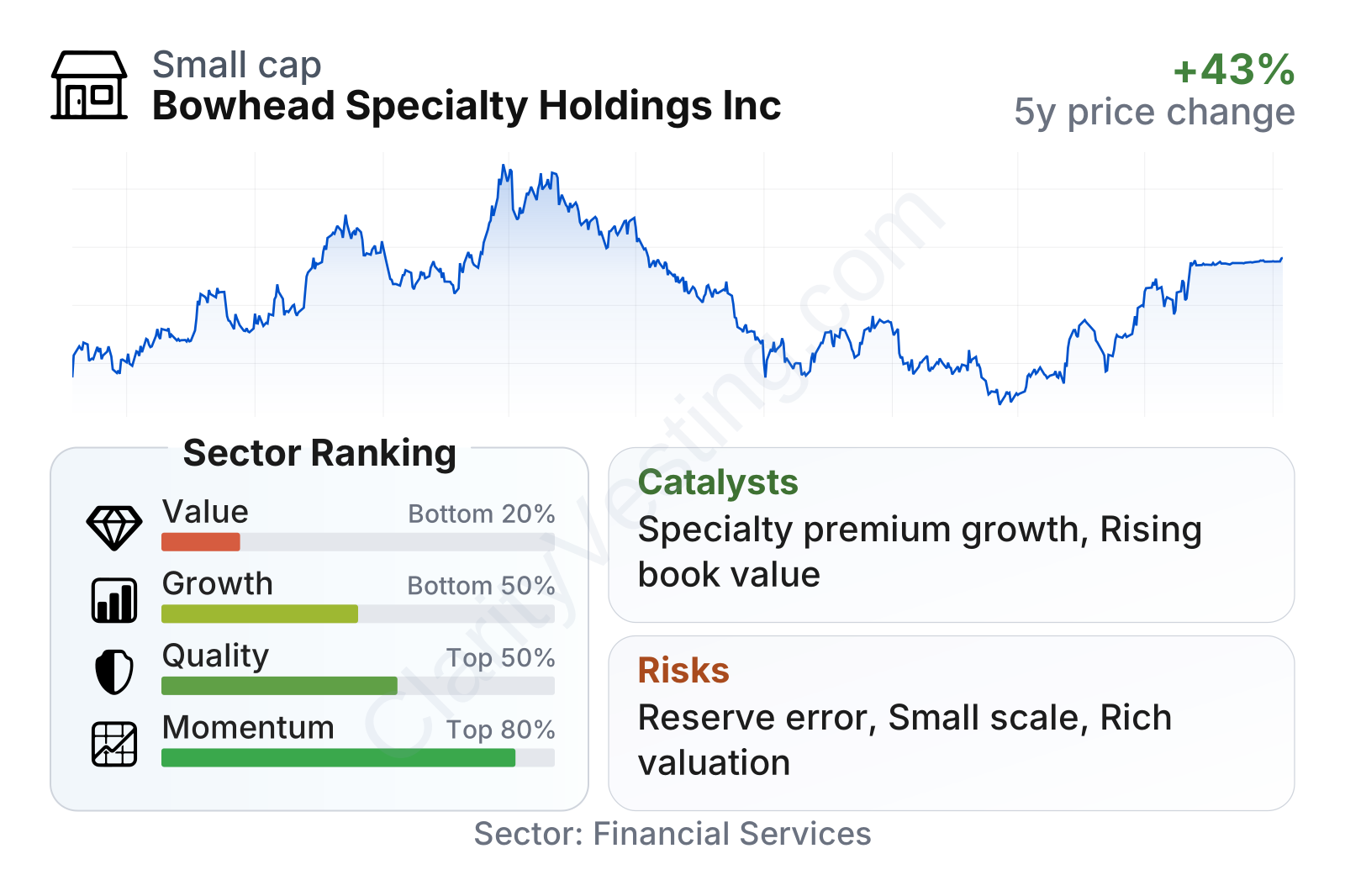
Bowhead is still a relatively small public insurer, with a market value a little above $1 billion, which makes it much smaller than the large diversified insurance groups it competes against. The stock has been volatile since listing, but the broader pattern shows that the market has been willing to assign a premium to its growth profile even after periods of pullback.
The metric mix is interesting. Growth has been strong, especially revenue per share and book value per share over the last few years, while quality metrics are generally solid relative to the sector. Return on equity is around the sector median, return on assets is clearly better than typical peers, and the balance sheet appears conservative, with net cash rather than heavy net debt. On the other hand, valuation measures sit in the weaker part of the sector ranking, which means the market is already recognizing much of that operational progress.
Growth
Bowhead operates in specialty commercial insurance, a segment that has attractive long-term characteristics. Complex and niche risks usually require underwriting expertise, broker relationships, and careful pricing. That tends to create better conditions than highly commoditized insurance lines. The sector also benefits from recurring demand because businesses need liability and specialty coverage regardless of the economic cycle, even if pricing conditions can swing.
The company’s strategy appears coherent for future expansion. It is concentrating on specialty lines where underwriting judgment matters more than sheer scale, and it distributes through wholesale brokers, which can give access to hard-to-place risks without needing a massive retail distribution footprint. For a smaller insurer, that is a sensible way to build market presence while staying focused on selected niches.
Recent operating trends support the growth case. Revenue growth of about 23% year over year is well above the sector median. Over a longer period, revenue per share growth has also been far stronger than most peers, and book value per share has increased at an exceptional pace as the business retained earnings and expanded its capital base.
Earnings per share have also been moving upward from 2024 into 2025, showing that growth has not been purely top-line expansion. That said, the earnings path in insurance is rarely smooth from quarter to quarter because claims activity, reserve development, and catastrophe events can affect results. For Bowhead, the larger point is that earnings power has been building alongside premium growth.
Book value per share has climbed dramatically since 2022. For insurers, book value is especially important because it reflects capital strength and underwriting accumulation over time. A rising book value often indicates that the company is adding value internally rather than relying only on market optimism.
A meaningful catalyst is the company’s ability to continue scaling in attractive specialty lines while maintaining underwriting discipline. Another is the interest-rate backdrop: higher reinvestment yields can lift investment income on the bond portfolio, which supports profitability even if underwriting conditions become more competitive. As a newer public company, Bowhead also has room to broaden investor awareness if it continues delivering consistent results and building a longer public track record.
Risks
This article is for informational purposes only and does not constitute financial advice. Some content is AI-generated. See Disclaimer