Stock Analysis · Borr Drilling Ltd (BORR)
Overview
Borr Drilling Ltd is an offshore drilling contractor focused on shallow-water oil and gas wells. In simple terms, it owns and operates jack-up rigs, which are mobile offshore drilling units that stand on legs fixed to the seabed while they drill wells for oil and gas producers. The company does not produce oil itself. It earns money by renting out these rigs, along with crews and related services, to exploration and production companies.
Borr’s business is relatively easy to understand because revenue mainly comes from one core activity: contracted drilling work. The company’s fleet is centered on modern premium jack-up rigs, and its customers are generally national oil companies, large international energy groups, and independent offshore operators.
The main revenue sources appear to be concentrated as follows:
- Offshore drilling contract revenue: approximately 95% to 100% — daily rig hire, drilling crews, and operational services under fixed-term contracts.
- Other operating revenue: likely less than 5% — mobilization, contract preparation, reimbursable items, and other ancillary services tied to rig operations.
This concentration means Borr is highly exposed to one market: offshore jack-up demand. That makes the company easier to analyze than a diversified energy group, but it also means business conditions in that niche have an outsized effect on results.
Over the last few years, the company moved from a weak profitability profile to a period of much stronger operating performance as dayrates improved and fleet utilization increased. Revenue expanded sharply between 2021 and 2024, while operating income turned positive. More recently, the picture has become less smooth, with pressure on free cash flow and profitability despite still sizable revenue.
The financial flow shows a major earnings recovery from 2021 to 2024, helped by much stronger revenue and operating income. At the same time, interest expense remained heavy throughout the period, which is a key feature of the investment case because a meaningful share of operating gains has been absorbed by financing costs.
Key Figures
| Metric | Value | Sector ⓘ |
|---|---|---|
| Date | Oct 17, 2026 | |
| Context | ||
| Sector | Energy | |
| Industry | Oil & Gas Drilling | |
| Market Cap ⓘ | $1.48B | |
| Beta ⓘ | 1.07 | |
Value (Cheapness) | ||
| P/E Ratio ⓘ | N/A | 15.44 |
| P/B Ratio ⓘ | 1.50 | 1.73 |
| FCF Yield ⓘ | -9.89% | 8.20% |
| Dividend Yield ⓘ | N/A | 3.59% |
| EBIT / EV ⓘ | 5.63% | 7.46% |
| PEG ⓘ | N/A | |
Growth (Business expansion) | ||
| Revenue Growth ⓘ | -13.20% | 26.90% |
| RPS Growth (5Y CAGR) ⓘ | 20.66% | 6.90% |
| EPS Growth (5Y CAGR) ⓘ | -24.30% | -15.73% |
| BVPS Growth (5Y CAGR) ⓘ | -8.54% | 6.07% |
| Margin Growth (5Y Trend) ⓘ | 67.64% | 0.58% |
| FCF Growth (5Y CAGR) ⓘ | N/A | 1.86% |
| DPS Growth (5Y CAGR) ⓘ | -59.39% | 16.79% |
Quality (Business durability) | ||
| ROIC (Latest) ⓘ | 2.74% | 11.40% |
| ROA (Latest) ⓘ | -6.67% | 6.06% |
| ROIC (5Y Median) ⓘ | 3.24% | 10.30% |
| ROA (5Y Median) ⓘ | 0.73% | 5.42% |
| Net Debt / EBIT (Latest) ⓘ | 11.13 | 1.64 |
| Net Debt / EBIT (5Y Median) ⓘ | 6.00 | 1.83 |
| Net Debt / EBITDA (Latest) ⓘ | 6.20 | 1.08 |
| Net Debt / Assets ⓘ | 61.16% | 17.29% |
| EBITDA / Interest ⓘ | 0.89 | 9.64 |
| Operating Margin (Latest) ⓘ | 19.99% | 16.27% |
| Operating Margin (5Y Median) ⓘ | 27.80% | 20.39% |
| Debt to Equity (Latest) ⓘ | 258.45% | 54.76% |
| Profit Margin (Latest) ⓘ | -23.98% | 8.82% |
| Free Cash Flow (Latest) ⓘ | -$146.43M | |
Momentum (Price trend) | ||
| 3Y Return ⓘ | -30.29% | +67.38% |
| 12M Return (excl. last month) ⓘ | +36.88% | +49.19% |
| 6M Return ⓘ | -17.89% | +7.07% |
| Price vs. 200-Day MA ⓘ | -4.25% | +9.56% |
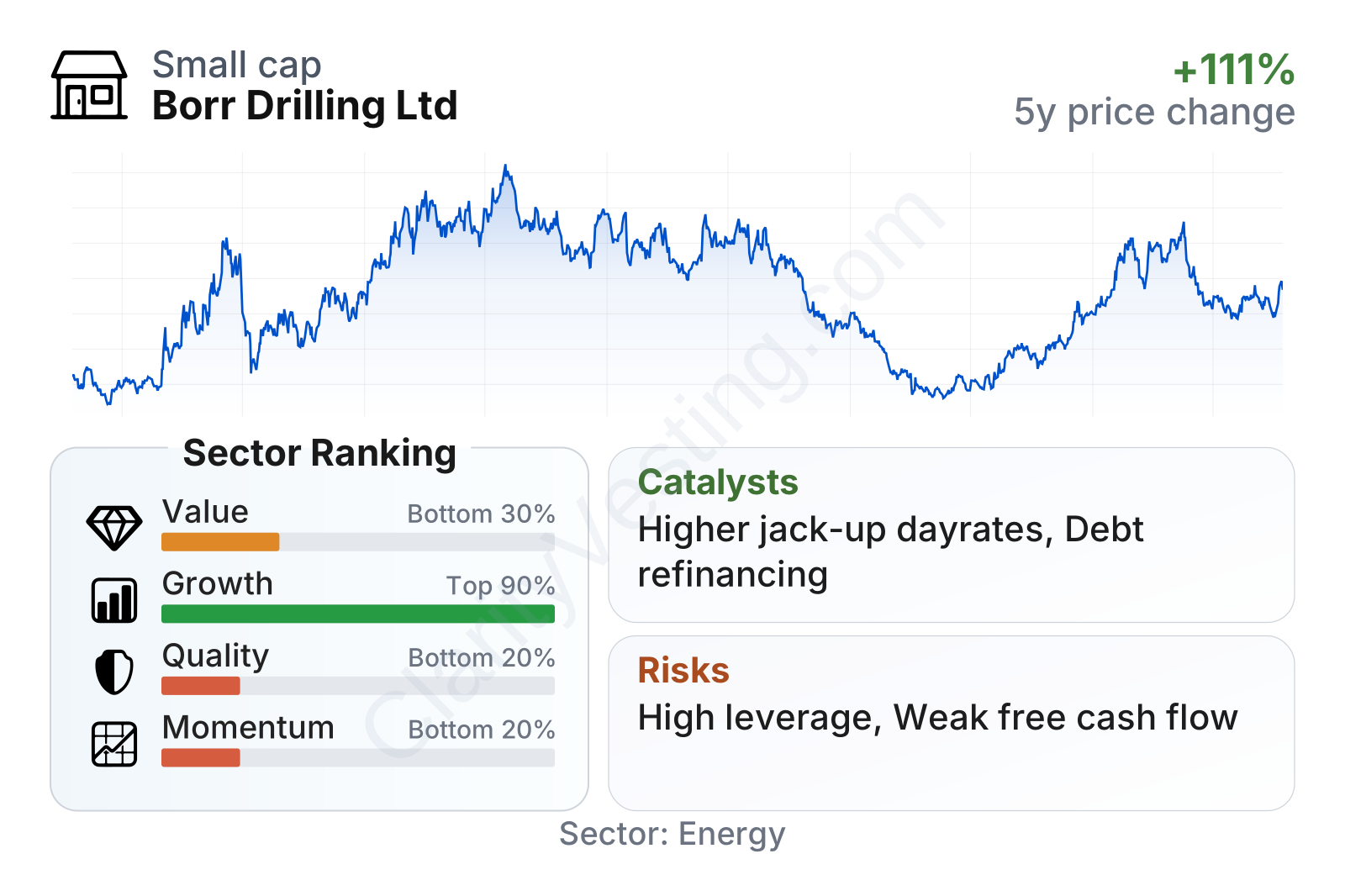
Borr is a small-cap energy company with share price behavior that has been volatile over several years. The factor profile is mixed: growth ranks very high versus the sector, but quality, momentum, and value rank much weaker. That combination usually points to a company that benefited from a strong industry rebound but still carries balance-sheet and earnings-consistency concerns. The company’s operating margin remains above the sector median, yet returns on capital, leverage metrics, and free cash flow are materially weaker than many peers.
Growth
Borr operates in a part of the energy industry that can still grow, even though it is mature and cyclical. Offshore drilling demand depends on oil and gas producers continuing to invest in new wells to replace declining production. In shallow-water regions, jack-up rigs can remain competitive because they are generally cheaper and faster to deploy than many deepwater alternatives. That gives Borr exposure to projects that can still move forward even when operators become more selective on spending.
The company’s strategy has generally been to focus on modern premium jack-up rigs, secure contracts at improved dayrates, and keep utilization high. That strategy is logical for this segment: modern rigs are more attractive to customers, and stronger contract pricing can lift profits meaningfully because a large part of the cost base is fixed once a rig is working.
The growth path has been impressive over the medium term. Year-over-year revenue growth surged in 2022 and 2023, remained positive through most of 2024, and then became uneven in 2025 and 2026. This suggests that the big recovery phase has already happened, and Borr is now entering a more normal stage where quarterly comparisons depend more on contract timing, utilization gaps, and regional demand swings.
One encouraging point is that the company’s five-year revenue per share growth is well above the sector median, showing that the fleet repositioning and market recovery translated into real top-line expansion. Operating margin improvement over five years has also been very strong, which indicates the business has significant earnings leverage when rigs are contracted at better terms.
Free cash flow is the main issue within the growth profile. Despite stronger revenue and improved operating profitability over the last cycle, trailing free cash flow has remained negative. For a capital-intensive offshore driller, that matters because growth only creates lasting value when cash generation eventually catches up with accounting profits. If contract cash inflows strengthen and capital spending moderates, this could improve, but that transition is not yet clearly established.
A practical catalyst for Borr is any continued tightening in the global jack-up market, especially if customers keep extending contracts at higher dayrates. The company’s fleet exposure to shallow-water basins means additional awards, higher utilization, and better pricing can have a visible effect on earnings. A second catalyst is debt refinancing or liability management that lowers interest burden, because financing costs have been one of the biggest drags on net results.
Risks
This article is for informational purposes only and does not constitute financial advice. Some content is AI-generated. See Disclaimer


