Stock Analysis · BOK Financial Corporation (BOKF)
Overview
BOK Financial Corporation is a regional banking company headquartered in Oklahoma and operating through a group of brands across the Midwest and Southwest. Its business is broader than a traditional community bank. In addition to taking deposits and making loans, it provides treasury and cash-management services, wealth management, brokerage and trading services, and specialized lending in areas such as commercial real estate, energy, health care, and transportation.
The company earns most of its money from the spread between what it receives on loans and securities and what it pays on deposits and other funding. It also has a meaningful fee-based business, which helps diversify results when lending conditions become less favorable. Based on recent annual reporting, the main revenue sources can be summarized as follows:
- Net interest revenue: about 68% to 72% of total revenue in recent periods. This is the core banking engine and includes income from commercial loans, consumer lending, securities, and other interest-earning assets, minus interest paid on deposits and borrowings.
- Fees and commissions: about 28% to 32% of total revenue. This includes fiduciary and asset management fees, deposit service charges, bank card revenue, brokerage and trading revenue, transaction services, mortgage banking, and other service fees.
- Within noninterest revenue, trading and brokerage, fiduciary and asset management, and service charges tend to be the largest contributors, although their exact weight can shift from year to year with client activity and market conditions.
BOK Financial’s business mix matters for long-term analysis. A bank with both spread income and fee income can be more resilient than one that depends almost entirely on loan growth. The revenue path over the last several years also shows that total revenue expanded strongly from 2021 to 2025, but a large part of that increase came with much higher interest expense as deposit and funding costs rose across the banking industry.
The operating picture shows a business that has grown its top line meaningfully since 2021, while expenses and funding costs have also climbed. Net income has remained broadly stable rather than compounding sharply, which suggests that growth has been real but not frictionless.
Key Figures
| Metric | Value | Sector ⓘ |
|---|---|---|
| Date | Oct 23, 2026 | |
| Context | ||
| Sector | Financial Services | |
| Industry | Banks - Regional | |
| Market Cap ⓘ | $7.84B | |
| Beta ⓘ | 0.82 | |
Value (Cheapness) | ||
| P/E Ratio ⓘ | 11.45 | 12.46 |
| P/B Ratio ⓘ | 1.31 | 1.25 |
| FCF Yield ⓘ | 31.92% | 9.82% |
| Dividend Yield ⓘ | N/A | 2.94% |
| EBIT / EV ⓘ | 13.27% | 8.11% |
| PEG ⓘ | 1.46 | |
Growth (Business expansion) | ||
| Revenue Growth ⓘ | 10.10% | 9.10% |
| RPS Growth (5Y CAGR) ⓘ | 19.62% | 12.31% |
| EPS Growth (5Y CAGR) ⓘ | 0.38% | -6.97% |
| BVPS Growth (5Y CAGR) ⓘ | 5.57% | 5.02% |
| Margin Growth (5Y Trend) ⓘ | -22.13% | -4.00% |
| FCF Growth (5Y CAGR) ⓘ | N/A | 4.71% |
| DPS Growth (5Y CAGR) ⓘ | 3.61% | 8.92% |
Quality (Business durability) | ||
| ROIC (Latest) ⓘ | 6.45% | 9.18% |
| ROE (Latest) ⓘ | 11.32% | 13.93% |
| ROA (Latest) ⓘ | 1.26% | 1.57% |
| ROIC (5Y Median) ⓘ | 6.52% | 7.80% |
| ROE (5Y Median) ⓘ | 10.36% | 12.15% |
| ROA (5Y Median) ⓘ | 1.09% | 1.28% |
| Net Debt / EBIT (Latest) ⓘ | 4.35 | 1.02 |
| Net Debt / EBIT (5Y Median) ⓘ | 4.53 | 0.72 |
| Net Debt / EBITDA (Latest) ⓘ | 5.11 | 0.88 |
| Operating Margin (Latest) ⓘ | 23.41% | 22.30% |
| Operating Margin (5Y Median) ⓘ | 22.44% | 24.50% |
| Debt to Equity (Latest) ⓘ | 101.52% | 59.34% |
| Profit Margin (Latest) ⓘ | 28.53% | 26.42% |
| Free Cash Flow (Latest) ⓘ | $2.50B | |
Momentum (Price trend) | ||
| 3Y Return ⓘ | +90.06% | +95.73% |
| 12M Return (excl. last month) ⓘ | +20.31% | +17.30% |
| 6M Return ⓘ | -3.52% | +6.07% |
| Price vs. 200-Day MA ⓘ | -2.19% | +5.36% |
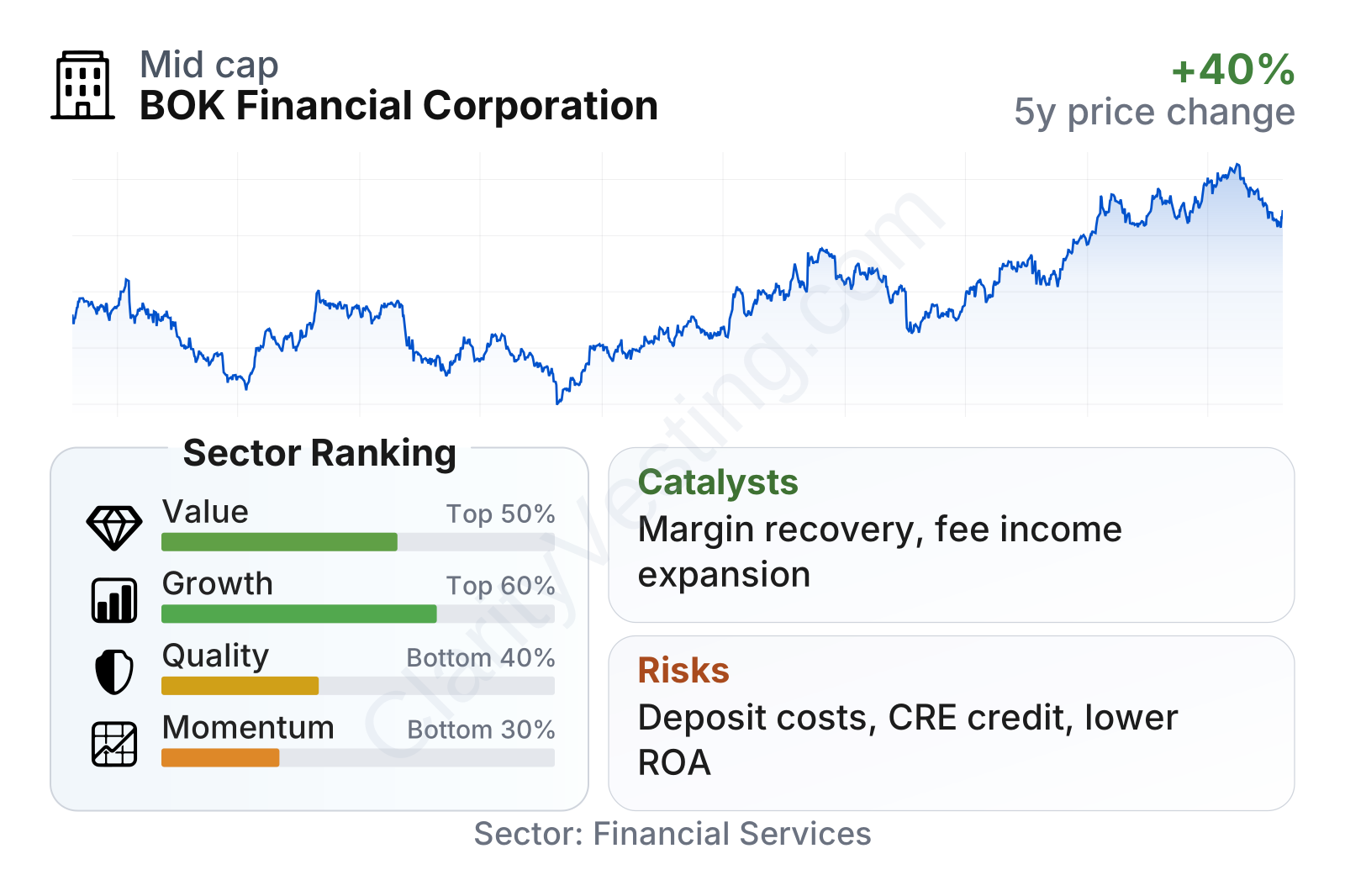
BOK Financial is a mid-sized regional bank with a market value in the single-digit billions and a stock that has historically moved somewhat less than the broader market. The factor breakdown points to a mixed profile: valuation looks roughly in line with the sector, growth is slightly above average, while quality and recent momentum trail many peers. The combination of a modest earnings multiple and a price-to-book ratio near the sector median suggests the market is recognizing the company’s stability but not assigning a premium for superior profitability.
The share-price history also reflects the operating reality of regional banks over the past few years: sharp volatility during the 2023 banking stress, followed by a substantial recovery and then a strong advance into 2026. That rebound indicates improving confidence, but it also means the stock is no longer coming from a distressed starting point.
Growth
Banking is not a fast-growth sector in the way software or semiconductors can be, but it remains an essential industry tied to population, business formation, commercial activity, and credit demand. For BOK Financial, the more relevant question is not whether banking itself is expanding quickly, but whether the company can keep growing in attractive regional markets while gaining business from commercial and wealth-management clients that want a broader service platform than a small local bank can offer.
BOK Financial’s strategy is logical for long-term expansion. It combines relationship banking with specialized capabilities in treasury services, wealth management, and niche commercial lending. That approach can support deeper customer ties, larger balances per client, and more fee income per relationship. Its footprint in energy-producing and business-oriented states can also create opportunities when those regional economies are healthy.
The company’s recent numbers show solid growth in revenue, including a roughly 10% year-over-year increase and a five-year revenue-per-share growth rate well above the sector median. Even so, earnings growth has been uneven because higher funding costs and operating expense pressure have limited the conversion of revenue growth into profit growth.
Earnings per share show that pattern clearly: profits have stayed resilient over time and recovered from weaker periods, but they have not followed a smooth upward line. That makes BOK Financial more of a steady compounder candidate than a clear high-growth bank.
Book value per share has moved in a more encouraging direction. After a decline in 2022, it rebuilt strongly through 2025, reaching materially higher levels than before. For a bank, that matters because book value reflects the capital base that supports future lending, shareholder returns, and balance-sheet resilience. Consistent book value growth is often one of the cleaner signs that a bank is expanding underlying economic value even when annual earnings fluctuate.
A meaningful catalyst is the normalization of deposit costs and loan pricing. If the industry moves into a more stable interest-rate environment, banks with established commercial franchises can sometimes defend asset yields while pressure on funding costs eases. For BOK Financial, that could help widen margins again. Another catalyst is continued growth in fee businesses such as wealth management, transaction services, and brokerage-related activities, which are less dependent on pure balance-sheet expansion.
Recent company communications have also highlighted capital management and business expansion initiatives rather than defensive restructuring. That does not guarantee faster growth, but it supports the view that management sees opportunities to keep building across its existing markets and client segments.
Risks
This article is for informational purposes only and does not constitute financial advice. Some content is AI-generated. See Disclaimer


