Stock Analysis · Bolloré SE (BOIVF)
Overview
Bolloré SE is a French holding company with a structure that is unusual for a U.S.-listed stock. Rather than operating as a single focused business, it mainly owns stakes in other companies and assets. Today, the most important exposure comes from media, entertainment, and publishing through its large interest in Vivendi, alongside residual activities and investment holdings. That makes Bolloré less like a traditional operating company and more like a listed vehicle whose value depends heavily on the performance, strategy, and market valuation of its underlying assets.
The group has changed significantly in recent years. Bolloré used to have much larger direct exposure to transport and logistics in Africa, but that business was sold. Since then, the company has become much more concentrated around financial holdings, especially listed participations. This shift is important for long-term analysis because reported revenue now says less about the full economic value of the company than the value of the assets it owns and the cash those assets can generate or distribute.
Main economic drivers appear to come from the following areas:
- Listed investments, led by Vivendi: the largest source of value. Bolloré’s stake in Vivendi gives exposure to pay TV, advertising, publishing, magazines, and other media assets through Vivendi and its subsidiaries or holdings.
- Industry and other operating activities: a smaller contribution than in the past, including legacy industrial operations such as batteries and specialized systems.
- Cash, portfolio management, and other holdings: financial income, asset disposals, and changes in the value or structure of holdings can materially affect results.
Because Bolloré is now much more of a holding company than a broad operating conglomerate, a precise revenue breakdown by economic exposure is less straightforward than it used to be. Reported revenue has fallen sharply after disposals, while net income can still remain meaningful because asset ownership and corporate actions matter as much as direct sales.
The long-term picture is therefore best understood through asset quality, capital allocation, and the discount or premium the market assigns to the holding-company structure rather than through revenue alone.
The cash flow profile has changed dramatically over the last several years. Revenue is far below earlier levels after major disposals, and operating income has turned negative in the most recent periods, yet net income remains positive. That gap suggests reported earnings are being shaped more by holdings, investment effects, and non-operating items than by the core operating businesses alone.
Key Figures
| Metric | Value | Sector ⓘ |
|---|---|---|
| Date | Oct 17, 2026 | |
| Context | ||
| Sector | Communication Services | |
| Industry | Entertainment | |
| Market Cap ⓘ | $11.52B | |
| Beta ⓘ | 0.57 | |
Value (Cheapness) | ||
| P/E Ratio ⓘ | 41.00 | 17.78 |
| FCF Yield ⓘ | -0.44% | 14.20% |
| Dividend Yield ⓘ | 1.46% | 2.74% |
| EBIT / EV ⓘ | N/A | 4.52% |
| PEG ⓘ | N/A | |
Growth (Business expansion) | ||
| Revenue Growth ⓘ | 6.30% | 5.50% |
| RPS Growth (5Y CAGR) ⓘ | -35.39% | 4.55% |
| EPS Growth (5Y CAGR) ⓘ | -18.18% | -18.24% |
| Margin Growth (5Y Trend) ⓘ | -9.39% | 1.03% |
| FCF Growth (5Y CAGR) ⓘ | -29.37% | 5.96% |
| DPS Growth (5Y CAGR) ⓘ | 5.91% | 5.00% |
Quality (Business durability) | ||
| ROIC (Latest) ⓘ | -0.92% | 8.59% |
| ROIC (5Y Median) ⓘ | 1.15% | 8.24% |
| Net Debt / EBIT (Latest) ⓘ | N/A | 1.89 |
| Net Debt / EBIT (5Y Median) ⓘ | 2.16 | 2.81 |
| Net Debt / EBITDA (Latest) ⓘ | -4.71 | 1.14 |
| Net Debt / Assets ⓘ | -5.90% | 18.62% |
| EBITDA / Interest ⓘ | N/A | 8.36 |
| Operating Margin (Latest) ⓘ | 21.00% | 15.53% |
| Operating Margin (5Y Median) ⓘ | 2.16% | 13.39% |
| Debt to Equity (Latest) ⓘ | 0.56% | 59.53% |
| Profit Margin (Latest) ⓘ | 7.94% | 8.77% |
| Free Cash Flow (Latest) ⓘ | -$50.60M | |
Momentum (Price trend) | ||
| 3Y Return ⓘ | +28.18% | +44.75% |
| 12M Return (excl. last month) ⓘ | +22.70% | +2.72% |
| 6M Return ⓘ | +17.47% | +1.84% |
| Price vs. 200-Day MA ⓘ | +6.20% | +1.21% |
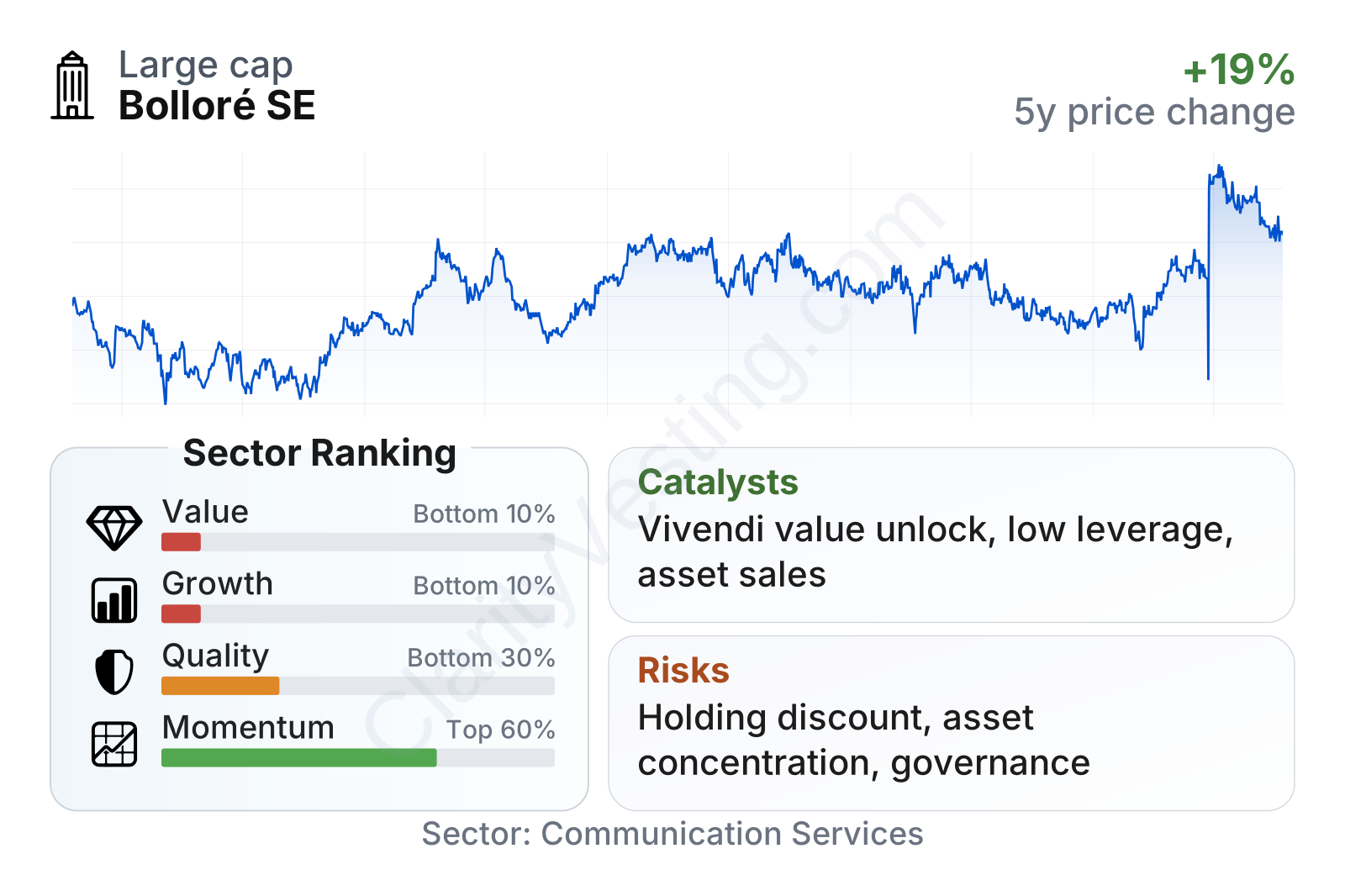
Bolloré is a mid-to-large-cap company with relatively low share-price volatility, reflected in a beta well below 1. The market has recently rewarded the stock, with stronger 6-month and 12-month performance than the sector median, but the underlying fundamental picture is less robust than the recent share move suggests.
The table points to a mixed profile. Valuation metrics sit in the weaker part of the sector, with a P/E ratio far above the median and a free-cash-flow yield that is notably lower than many peers. Growth metrics are also weak over a five-year view: revenue per share, free cash flow, and earnings trends have generally moved in the wrong direction, even though the latest year-over-year revenue change is modestly positive. On quality, the balance sheet stands out positively because debt-to-equity is extremely low, but returns on invested capital remain weak.
Growth
Bolloré’s growth outlook depends less on traditional organic expansion and more on the sectors where its major holdings operate. Media, content, advertising, publishing, and entertainment remain relevant long-term markets, supported by demand for premium content, intellectual property, streaming distribution, and advertising monetization. These are attractive areas in principle, but they are also highly competitive and often uneven from year to year.
For Bolloré specifically, the strategic logic is clearer at the asset-allocation level than at the operating level. The company has simplified its structure over time by selling major logistics assets and concentrating more capital in media-related holdings. That can make the business easier to analyze than before, but it also increases dependence on fewer major positions. If those assets appreciate, distribute cash, or unlock value through restructurings, Bolloré can benefit even without strong consolidated revenue growth.
The recent growth pattern does not yet show a strong multi-year operating expansion. The latest annual change is positive, but the longer trend remains weak because the company is much smaller in reported sales than it was before the portfolio reshaping. In practical terms, future growth is likely to come from value creation in underlying holdings, asset rotations, and possible corporate events rather than from a steady rise in consolidated turnover.
A meaningful catalyst is Bolloré’s ability to benefit from strategic moves involving Vivendi and related media assets. Spin-offs, listings, stake sales, buybacks, and simplification transactions can all influence the market’s view of the group. Another positive point is financial flexibility: very low leverage gives the company room to wait, redeploy capital, or support portfolio companies when needed.
Risks
This article is for informational purposes only and does not constitute financial advice. Some content is AI-generated. See Disclaimer


