Stock Analysis · Bob's Discount Furniture Inc (BOBS)
Overview
Bob’s Discount Furniture is a U.S. furniture and home furnishings retailer focused on value-oriented shoppers. The company sells living room, bedroom, dining room, mattress, and home office furniture through a combination of showrooms, e-commerce, and delivery services. Its positioning is straightforward: offer affordable products, keep the shopping experience simple, and support sales with financing and delivery options that make larger-ticket purchases easier for households.
The business is still primarily a retail operation rather than a brand-licensing or service company, so most revenue comes from merchandise sales. Based on company disclosures, the broad revenue mix is centered on furniture and bedding, with a smaller contribution from related services and ancillary items.
- Furniture and home furnishings: approximately 75% to 85% of revenue. This includes upholstery, casegoods, dining, bedroom, home office, and other household furniture categories sold under Bob’s formats and private-label assortments.
- Mattresses and sleep products: approximately 15% to 25% of revenue. This includes mattresses, adjustable bases, and related sleep accessories, an important category because it tends to carry distinct replacement demand.
- Other revenue: generally a small portion of total sales. This includes delivery, protection plans, and other incidental customer offerings when separately recognized.
Financially, the company has recently shown a notable improvement in scale and profitability. Revenue moved from roughly $2.1 billion in 2022 to about $2.37 billion in 2025, while net income increased from about $28 million to nearly $122 million over the same period. Gross profit also expanded, suggesting that the business did more than just add sales volume: margins improved as well. One visible change is that interest expense fell sharply from 2022 to 2024 and stayed relatively low in 2025, which helped more of operating profit reach the bottom line.
The multi-year picture shows a retailer that became materially more efficient after a weaker 2022. Sales growth in 2025 was accompanied by stronger operating income and net income, while selling and administrative costs rose more slowly than revenue. That combination matters in furniture retail, where fixed costs in stores, warehousing, and delivery can weigh heavily on results when demand softens.
Key Figures
| Metric | Value | Sector ⓘ |
|---|---|---|
| Date | Oct 24, 2026 | |
| Context | ||
| Sector | Consumer Cyclical | |
| Industry | Specialty Retail | |
| Market Cap ⓘ | $1.98B | |
| Beta ⓘ | N/A | |
Value (Cheapness) | ||
| P/E Ratio ⓘ | 15.02 | 17.09 |
| P/B Ratio ⓘ | 3.74 | 1.64 |
| FCF Yield ⓘ | 5.88% | 8.68% |
| Dividend Yield ⓘ | N/A | 2.70% |
| EBIT / EV ⓘ | 7.75% | 6.69% |
| PEG ⓘ | N/A | |
Growth (Business expansion) | ||
| Revenue Growth ⓘ | 8.80% | 5.60% |
| RPS Growth (5Y CAGR) ⓘ | 8.82% | 9.01% |
| EPS Growth (5Y CAGR) ⓘ | N/A | -17.32% |
| BVPS Growth (5Y CAGR) ⓘ | -30.52% | 5.64% |
| Margin Growth (5Y Trend) ⓘ | 4.24% | -0.17% |
| FCF Growth (5Y CAGR) ⓘ | 423.79% | 5.02% |
| DPS Growth (5Y CAGR) ⓘ | N/A | 10.19% |
Quality (Business durability) | ||
| ROIC (Latest) ⓘ | 30.80% | 12.46% |
| ROA (Latest) ⓘ | 7.08% | 5.50% |
| ROIC (5Y Median) ⓘ | N/A | 10.68% |
| ROA (5Y Median) ⓘ | N/A | 5.44% |
| Net Debt / EBIT (Latest) ⓘ | 3.87 | 2.16 |
| Net Debt / EBIT (5Y Median) ⓘ | 9.42 | 2.29 |
| Net Debt / EBITDA (Latest) ⓘ | 2.83 | 1.48 |
| Net Debt / Assets ⓘ | 41.05% | 21.74% |
| EBITDA / Interest ⓘ | 11.57 | 9.17 |
| Operating Margin (Latest) ⓘ | 8.29% | 9.08% |
| Operating Margin (5Y Median) ⓘ | 5.99% | 9.56% |
| Debt to Equity (Latest) ⓘ | 154.69% | 75.99% |
| Profit Margin (Latest) ⓘ | 5.43% | 5.30% |
| Free Cash Flow (Latest) ⓘ | $116.48M | |
Momentum (Price trend) | ||
| 3Y Return ⓘ | N/A | +19.94% |
| 12M Return (excl. last month) ⓘ | N/A | -4.14% |
| 6M Return ⓘ | +20.65% | -3.03% |
| Price vs. 200-Day MA ⓘ | N/A | -0.66% |
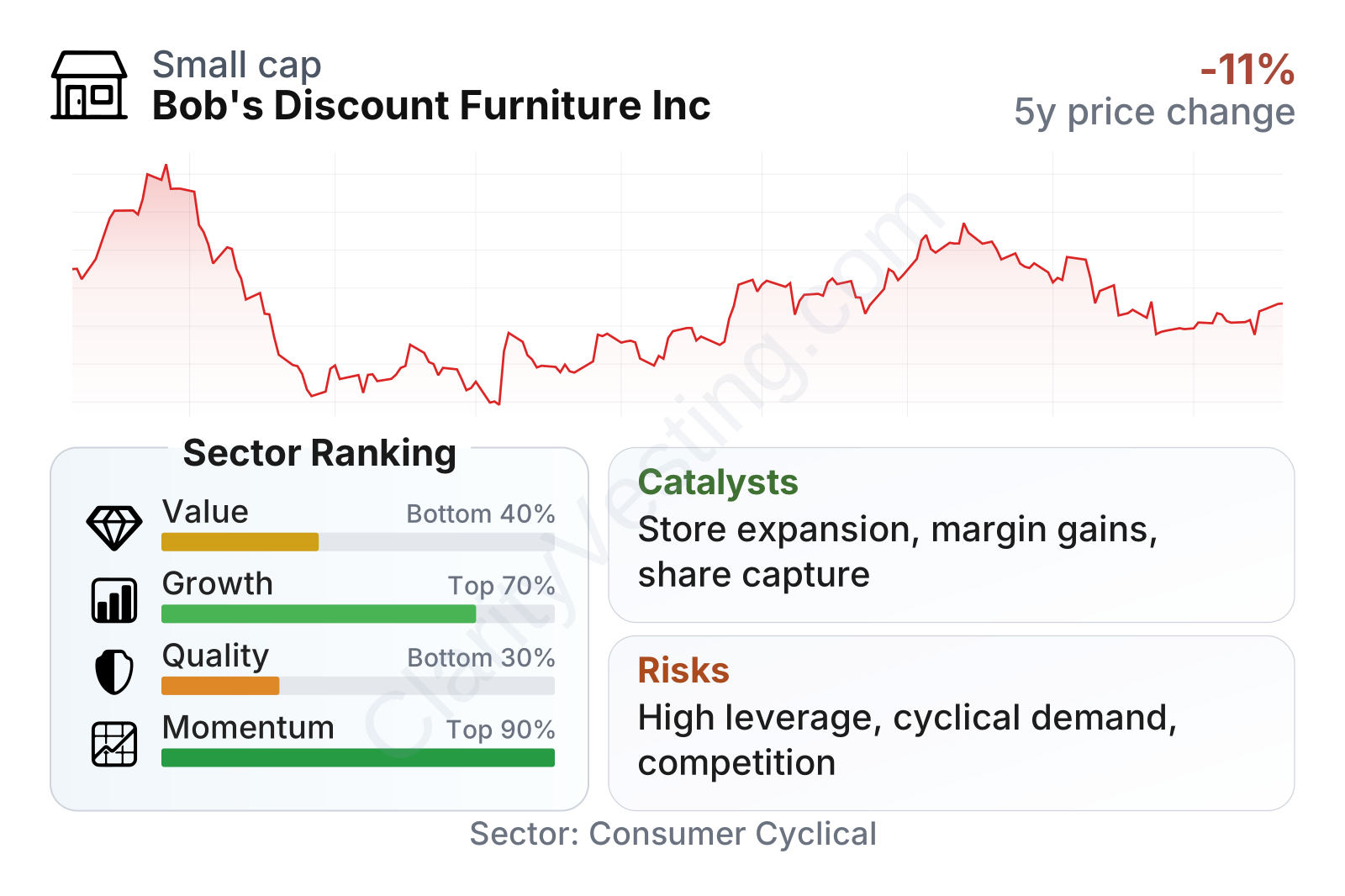
Recent market performance has been strong, with the shares rebounding sharply after a steep drop earlier in 2026. In the factor breakdown, momentum ranks near the top of the sector, while growth is above average. Valuation looks mixed rather than plainly cheap: the earnings multiple sits below the sector median, but book value and free cash flow measures are less favorable. Quality metrics are uneven too. Returns on capital and assets are strong, but leverage is clearly higher than the sector norm, which pulls down the overall quality profile.
At a high level, this is a mid-sized consumer retailer with improving profitability, healthy free cash flow generation, and a balance sheet that deserves close attention.
Growth
Bob’s operates in a furniture market that is mature, cyclical, and closely tied to housing activity, household formation, and consumer confidence. That is not a structurally fast-growing sector in the same way as software or semiconductors, but it remains a very large category with steady replacement demand. Mattresses are especially important because they are often bought on a replacement cycle rather than only during home purchases, which can give the company some support when discretionary furniture spending softens.
The company’s strategy appears coherent for long-term expansion. Management has continued to add stores in new and existing markets, build brand awareness, expand omnichannel capabilities, and improve supply chain execution. For a value-focused furniture retailer, store growth can still matter because furniture remains a tactile purchase for many consumers who want to see and test products in person before ordering. A broader footprint also supports delivery density, which can improve unit economics over time.
Recent operating trends are encouraging. Revenue growth of about 9% year over year is ahead of the sector median in the latest comparison, and the longer-term margin trend has improved. Free cash flow has also strengthened substantially over time, which gives the company more flexibility to invest in stores, logistics, and customer acquisition without relying entirely on external funding.
One of the more important potential catalysts is market share capture in a fragmented industry. Furniture retail includes national chains, regional players, and many independents. In that kind of environment, a recognizable brand with value positioning, financing options, and expanding logistics coverage can take share when smaller operators struggle with costs or demand volatility. The company’s low-price identity may also resonate if consumers remain budget-conscious.
Another growth support is execution leverage. If Bob’s continues growing sales while controlling operating expenses, incremental revenue can translate into disproportionate profit improvement, as recent years already suggest. That does not remove cyclicality, but it can make earnings growth faster than sales growth when conditions are favorable.
Risks
This article is for informational purposes only and does not constitute financial advice. Some content is AI-generated. See Disclaimer


