Stock Analysis · The Bank of New York Mellon Corporation (BNY)
Overview
The Bank of New York Mellon Corporation, known as BNY, is one of the oldest financial institutions in the United States. Today, it is not mainly a traditional consumer bank. Its core role is to help large institutions move, safeguard, administer, and invest money. Its clients include asset managers, pension funds, insurers, governments, corporations, and wealthy individuals. In practical terms, BNY sits deep in the financial system: it holds assets in custody, settles trades, services funds, supports treasury operations, and manages investments.
BNY reports its business through two main operating segments. Based on recent annual reporting, revenue is roughly split as follows:
- Securities Services: about 70% to 75% of total revenue. This includes asset servicing, issuer services, clearing, treasury services, and collateral management. These activities generate fees for custody, fund administration, settlement, payments, financing-related services, and other back-office infrastructure used by institutional clients.
- Market and Wealth Services / Pershing and related platforms: about 25% to 30% of total revenue. This area includes Pershing’s clearing and custody services for broker-dealers and registered investment advisors, as well as wealth-related and market-linked service activities.
Across the whole company, revenue is also economically driven by a mix of fee income and net interest income. Fee income is the more structural part of the model because BNY earns money for processing and safeguarding client assets. Net interest income has become more important in the higher-rate environment, as the company earns spread income on deposits and client balances.
That mix matters for long-term analysis. BNY is less dependent on credit growth than many large banks, and more tied to global market activity, client assets, transaction volumes, and short-term interest rates. This usually makes the business more operational and infrastructure-like than balance-sheet-heavy consumer banking.
The long-term pattern shows revenue and profit expanding meaningfully since 2021, with a strong rebound in net income after the 2022 pressure from higher funding costs and interest expense. Operating expenses have risen much more slowly than revenue in the last two years, which points to improving operating leverage.
Key Figures
| Metric | Value | Sector ⓘ |
|---|---|---|
| Date | Oct 10, 2026 | |
| Context | ||
| Sector | Financial Services | |
| Industry | Banks - Diversified | |
| Market Cap ⓘ | $96.84B | |
| Beta ⓘ | 1.05 | |
Value (Cheapness) | ||
| P/E Ratio ⓘ | 16.65 | 12.38 |
| P/B Ratio ⓘ | 2.24 | 1.23 |
| FCF Yield ⓘ | 1.64% | 10.23% |
| Dividend Yield ⓘ | 1.47% | 3.01% |
| EBIT / EV ⓘ | N/A | 8.08% |
| PEG ⓘ | 1.14 | |
Growth (Business expansion) | ||
| Revenue Growth ⓘ | 13.10% | 9.50% |
| RPS Growth (5Y CAGR) ⓘ | 32.67% | 12.21% |
| EPS Growth (5Y CAGR) ⓘ | 0.63% | -9.62% |
| BVPS Growth (5Y CAGR) ⓘ | 5.47% | 4.98% |
| Margin Growth (5Y Trend) ⓘ | -11.85% | -4.07% |
| FCF Growth (5Y CAGR) ⓘ | 33.64% | 4.76% |
| DPS Growth (5Y CAGR) ⓘ | 11.54% | 8.79% |
Quality (Business durability) | ||
| ROIC (Latest) ⓘ | N/A | 9.35% |
| ROE (Latest) ⓘ | 14.31% | 13.91% |
| ROA (Latest) ⓘ | 1.29% | 1.53% |
| ROIC (5Y Median) ⓘ | N/A | 7.86% |
| ROE (5Y Median) ⓘ | 8.46% | 12.22% |
| ROA (5Y Median) ⓘ | 0.82% | 1.29% |
| Net Debt / EBIT (Latest) ⓘ | 3.47 | 0.99 |
| Net Debt / EBIT (5Y Median) ⓘ | -17.88 | 0.73 |
| Net Debt / EBITDA (Latest) ⓘ | 2.83 | 0.93 |
| Operating Margin (Latest) ⓘ | 19.72% | 22.19% |
| Operating Margin (5Y Median) ⓘ | 17.45% | 24.30% |
| Debt to Equity (Latest) ⓘ | 78.77% | 60.24% |
| Profit Margin (Latest) ⓘ | 29.41% | 26.49% |
| Free Cash Flow (Latest) ⓘ | $1.59B | |
Momentum (Price trend) | ||
| 3Y Return ⓘ | +268.82% | +88.52% |
| 12M Return (excl. last month) ⓘ | +59.42% | +19.65% |
| 6M Return ⓘ | +13.14% | +6.00% |
| Price vs. 200-Day MA ⓘ | +5.06% | +3.61% |
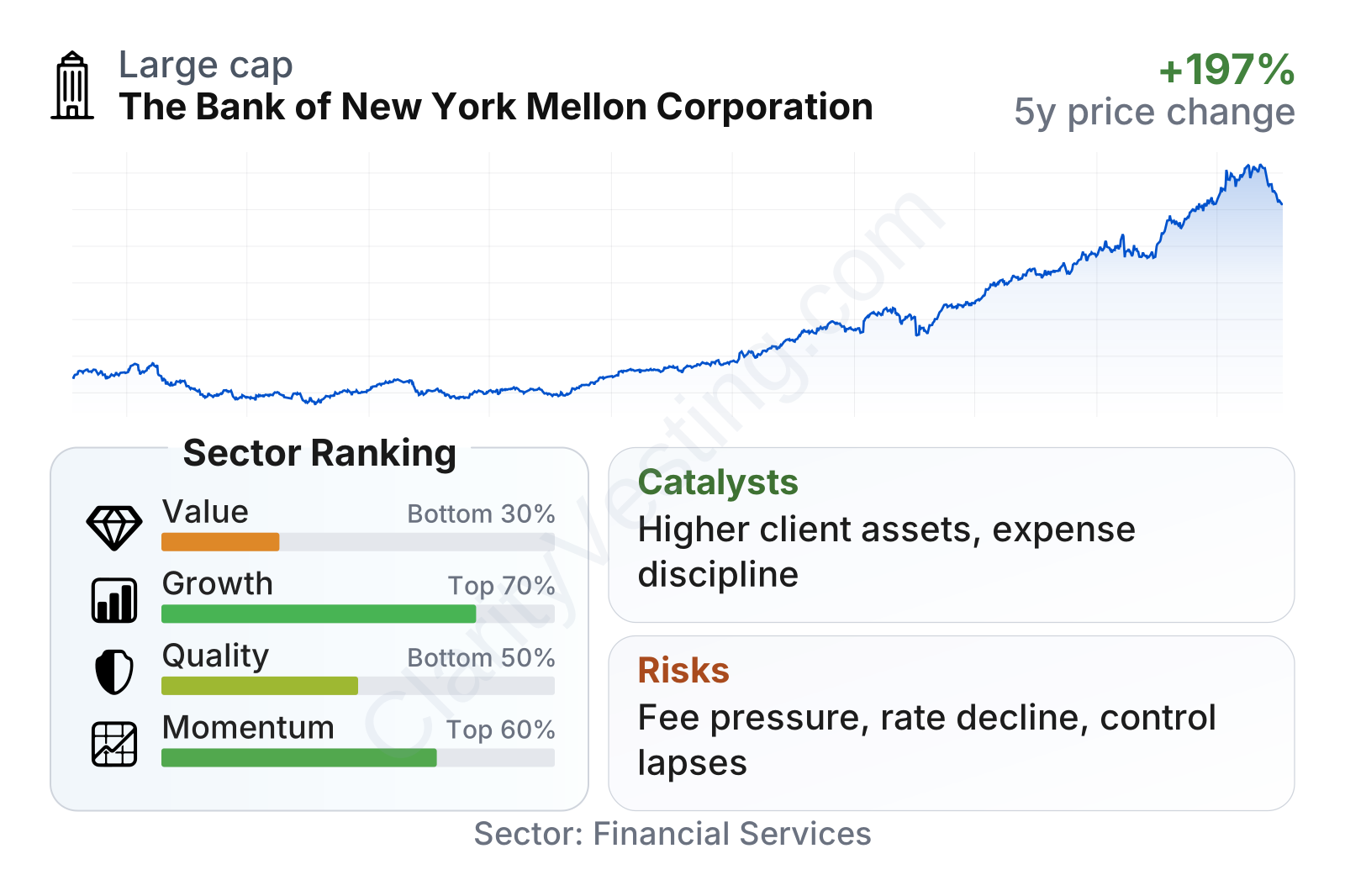
BNY is a very large financial company with share price momentum that has clearly outpaced much of the sector over the last one, three, and six-year periods. Growth metrics are generally favorable versus the sector median, especially revenue per share and free cash flow progression over five years. Profitability is mixed: trailing return on equity is slightly ahead of the sector median, but return on assets and operating margins still trail many peers. On valuation, the shares trade above sector medians on both earnings and book value, so the market is already recognizing the recent improvement.
The stock chart shows a major rerating since 2023. After trading below book value for a long period, the market has moved to value BNY much more richly as earnings, efficiency, and returns improved. That shift is important because future upside now depends more on execution than on simple multiple recovery.
Growth
BNY operates in a part of finance that benefits from durable structural trends. Global financial assets have tended to rise over time, retirement systems continue to need custody and administration, investment products keep growing in complexity, and regulation often pushes institutions toward large, trusted service providers with global scale. Those trends support long-term demand for asset servicing, clearing, collateral, treasury, and data-heavy operational services.
BNY’s strategy also makes sense in that context. Management has been focusing on platform modernization, simplification, productivity, and deeper cross-selling across large institutional relationships. Because many of BNY’s services are mission-critical and embedded in client workflows, a stronger platform can improve retention and expand revenue per client over time. The company has also been leaning into higher-value areas such as collateral services, treasury infrastructure, and digitally enabled investment operations.
Earnings per share have moved up strongly over the last several years, reflecting both revenue growth and better efficiency. This is more encouraging than the five-year EPS growth rate alone might suggest, because the latest annual run-rate shows a clear acceleration compared with the earlier post-2021 period.
Book value per share has also risen steadily, especially in the last two reported years. For a financial institution, that matters because it signals that the company has been adding shareholder equity while improving profitability. Rising book value combined with rising earnings usually supports a stronger long-term financial profile, even if the stock price can move faster than fundamentals for periods of time.
A meaningful near-term catalyst is the company’s sensitivity to client assets and transaction activity. When equity markets rise, fixed-income issuance remains active, and institutional flows stay healthy, BNY can benefit through higher servicing fees, market values, and platform usage. Another catalyst is continued expense discipline: if revenue keeps growing faster than operating costs, returns can improve further. Recent company communications have also highlighted ongoing technology investment and strategic initiatives intended to make the business more scalable.
Risks
This article is for informational purposes only and does not constitute financial advice. Some content is AI-generated. See Disclaimer