Stock Analysis · Savencia SA (BNGRF)
Overview
Savencia SA is a French food company focused mainly on specialty cheeses and dairy-based products. The group operates internationally and sells both premium branded products and items made for retail or food-service customers. Its best-known activity is cheese, with brands and product families spread across Europe, the Americas, and other international markets. The company has roots in traditional dairy production, but today it is a diversified packaged-food business serving supermarkets, restaurants, and industrial customers.
The business is organized around two main divisions. Based on recent annual reporting, revenue is concentrated as follows:
- Cheese Products: approximately 63% of revenue. This division includes specialty cheeses, branded cheeses, and broader cheese offerings sold through retail and food-service channels.
- Other Dairy Products: approximately 37% of revenue. This activity includes butter, cream, infant or nutritional dairy ingredients, and other processed dairy products depending on market and customer category.
Geographically, Savencia is not a purely domestic French company. Its sales base is spread across Europe first, then the Americas and the rest of the world, which gives it some diversification by region and customer mix. That matters in food because demand tends to be resilient, but local milk prices, currencies, and consumer habits can vary a lot from one market to another.
One notable feature of the business is that revenue has generally expanded over the past few years, but profitability has remained thin. The overall picture is therefore not one of a high-margin branded consumer giant, but of a mid-sized food producer working in a necessary category with significant exposure to input costs.
The flow of revenue and costs shows a business where most sales are absorbed by production and operating expenses before profits reach the bottom line. Revenue moved from roughly €5.6 billion in 2021 to just under €7.0 billion in 2025, while operating income and net income were far less stable. That pattern fits a food manufacturer with scale and recurring demand, but limited room for error when milk, packaging, energy, or logistics costs move against it.
Key Figures
| Metric | Value | Sector ⓘ |
|---|---|---|
| Date | Oct 03, 2026 | |
| Context | ||
| Sector | Consumer Defensive | |
| Industry | Packaged Foods | |
| Market Cap ⓘ | $1.06B | |
| Beta ⓘ | 0.27 | |
Value (Cheapness) | ||
| P/E Ratio ⓘ | 12.38 | 18.16 |
| P/B Ratio ⓘ | 0.78 | 1.27 |
| FCF Yield ⓘ | 13.03% | 12.39% |
| Dividend Yield ⓘ | 1.70% | 2.83% |
| EBIT / EV ⓘ | N/A | 6.45% |
| PEG ⓘ | N/A | |
Growth (Business expansion) | ||
| Revenue Growth ⓘ | 2.60% | 3.80% |
| RPS Growth (5Y CAGR) ⓘ | 4.99% | 6.20% |
| EPS Growth (5Y CAGR) ⓘ | -8.60% | -14.64% |
| BVPS Growth (5Y CAGR) ⓘ | -1.53% | 3.26% |
| Margin Growth (5Y Trend) ⓘ | -1.52% | -0.25% |
| FCF Growth (5Y CAGR) ⓘ | -4.80% | 4.65% |
| DPS Growth (5Y CAGR) ⓘ | 7.02% | 6.86% |
Quality (Business durability) | ||
| ROIC (Latest) ⓘ | 8.29% | 12.58% |
| ROA (Latest) ⓘ | 3.03% | 6.35% |
| ROIC (5Y Median) ⓘ | 5.38% | 10.36% |
| ROA (5Y Median) ⓘ | 1.95% | 5.44% |
| Net Debt / EBIT (Latest) ⓘ | 2.65 | 1.91 |
| Net Debt / EBIT (5Y Median) ⓘ | 2.82 | 2.32 |
| Net Debt / EBITDA (Latest) ⓘ | 1.21 | 1.36 |
| Net Debt / Assets ⓘ | 17.93% | 21.25% |
| EBITDA / Interest ⓘ | 8.17 | 9.61 |
| Operating Margin (Latest) ⓘ | 2.71% | 8.96% |
| Operating Margin (5Y Median) ⓘ | 3.10% | 9.53% |
| Debt to Equity (Latest) ⓘ | 90.05% | 71.66% |
| Profit Margin (Latest) ⓘ | 1.05% | 5.40% |
| Free Cash Flow (Latest) ⓘ | $138.41M | |
Momentum (Price trend) | ||
| 3Y Return ⓘ | +46.79% | +15.25% |
| 12M Return (excl. last month) ⓘ | +61.69% | +2.63% |
| 6M Return ⓘ | +17.14% | +2.43% |
| Price vs. 200-Day MA ⓘ | +10.73% | +0.43% |
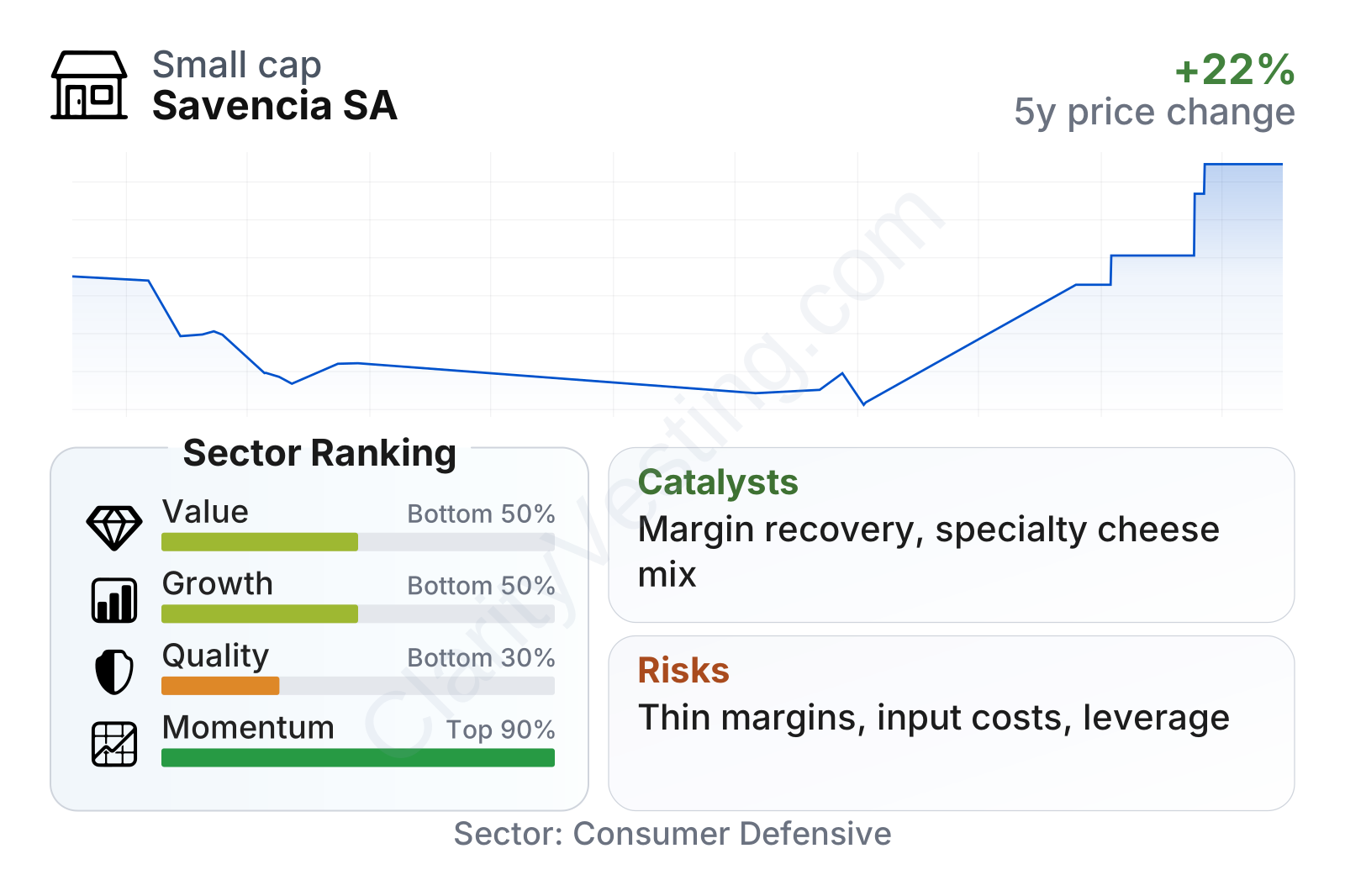
Savencia is a small-cap consumer staples company with unusually low share-price volatility, as shown by its very low beta. On valuation, the stock trades below the sector median on earnings and book value, while free cash flow yield is slightly stronger than the sector midpoint. That suggests the market is not assigning a premium multiple to the business.
The weaker area is operating quality. Profitability ratios such as return on capital, return on assets, operating margin, and net margin are all below typical packaged-food peers. Debt is not extreme, but leverage is somewhat elevated relative to earnings, and interest coverage is decent rather than especially strong.
Growth indicators are mixed. Recent revenue growth is positive but slower than the sector median, while five-year earnings and free cash flow trends have been uneven. On the other hand, dividend growth has been comparatively solid, and the stock’s recent price performance has been much stronger than most companies in the sector. In short, the market has recently rewarded the shares more than the operating profile alone would suggest.
Growth
Savencia operates in a sector that is mature rather than fast-growing, but it is also defensive. People keep buying cheese, butter, cream, and dairy ingredients through most economic environments, so long-term growth usually comes from pricing, product mix, international expansion, and premiumization rather than explosive volume increases. Specialty cheese is one of the more attractive parts of dairy because branded and differentiated products can carry better pricing power than commodity-like milk products.
The company’s strategy appears logical for this industry. Savencia emphasizes branded specialty cheeses, international distribution, and a broad portfolio that spans retail, food service, and industrial customers. That combination can help smooth demand and reduce reliance on a single category. It also gives the group room to push higher-value products where consumer demand supports premium positioning.
A practical catalyst is margin recovery. The last several years showed that revenue can rise meaningfully, but profits do not automatically follow. If milk costs, packaging, energy, and logistics become more favorable, even modest operational improvement could have a visible effect on earnings because current margins are low. In other words, Savencia does not need dramatic sales growth for results to improve; cost discipline and mix improvement could matter just as much.
Another positive factor is geographic diversification. A broad international footprint can support growth through local brand development and reduce dependence on one national market. In dairy, regional consumer tastes are important, so a portfolio of local and specialty brands can be an advantage over a one-size-fits-all approach.
Recent operating trends also show that the business remains capable of generating substantial cash despite modest accounting margins. That matters because cash generation supports debt service, dividends, brand investment, and selective expansion. The gap between acceptable cash flow and weak reported margins is one of the more interesting aspects of the company’s profile.
Risks
This article is for informational purposes only and does not constitute financial advice. Some content is AI-generated. See Disclaimer