Stock Analysis · Bristol-Myers Squibb Company (BMY)
Overview
Bristol-Myers Squibb is a large global biopharmaceutical company focused on discovering, developing, and selling prescription medicines. Its business is concentrated in serious diseases where doctors and patients often need long treatment durations and highly specialized drugs, especially in oncology, hematology, immunology, and cardiovascular care. In simple terms, the company makes branded medicines for cancers, blood disorders, immune system diseases, and certain heart-related conditions.
The company’s revenue is mainly driven by a relatively small number of blockbuster products. Based on its latest annual reporting structure, the largest sources of revenue are approximately:
- Eliquis: about 26% of total revenue. This is an anticoagulant used to reduce the risk of blood clots and stroke in eligible patients.
- Opdivo: about 19%. This is an immuno-oncology medicine used across several cancer types.
- Revlimid: about 11%. This cancer medicine has been facing generic competition, so it remains important but is no longer a growth driver.
- Pomalyst/Imnovid: about 7%. These medicines are mainly used in blood cancers.
- Yervoy: about 5%. Another cancer immunotherapy, often used in combination regimens.
- Breyanzi: about 4%. A cell therapy for certain blood cancers.
- Camzyos: about 4%. A cardiovascular medicine for obstructive hypertrophic cardiomyopathy.
- Reblozyl: about 4%. Used in certain anemia-related conditions.
- Abecma: about 2%. A cell therapy for multiple myeloma.
- Other products: about 18% combined, including a mix of mature brands and newer launches.
This mix matters because Bristol-Myers Squibb is in the middle of a transition: older products such as Revlimid are declining, while newer medicines like Camzyos, Reblozyl, Breyanzi, and other recently added assets are expected to offset that pressure over time.
The multi-year financial flow also shows a business with strong gross profit generation and consistently high spending on research and development. That is typical for large drugmakers: a significant share of revenue is reinvested into new medicines, while reported earnings can occasionally swing because of acquisition charges, impairments, and other non-cash items.
Key Figures
| Metric | Value | Sector ⓘ |
|---|---|---|
| Date | Oct 24, 2026 | |
| Context | ||
| Sector | Healthcare | |
| Industry | Drug Manufacturers - General | |
| Market Cap ⓘ | $124.85B | |
| Beta ⓘ | 0.18 | |
Value (Cheapness) | ||
| P/E Ratio ⓘ | 13.46 | 25.42 |
| P/B Ratio ⓘ | 5.78 | 3.08 |
| FCF Yield ⓘ | 9.16% | 3.12% |
| Dividend Yield ⓘ | 4.07% | 1.85% |
| EBIT / EV ⓘ | 8.58% | 0.56% |
| PEG ⓘ | 17.03 | |
Growth (Business expansion) | ||
| Revenue Growth ⓘ | 5.70% | 7.50% |
| RPS Growth (5Y CAGR) ⓘ | 3.39% | 8.60% |
| EPS Growth (5Y CAGR) ⓘ | -18.24% | -17.73% |
| BVPS Growth (5Y CAGR) ⓘ | -13.29% | 3.72% |
| Margin Growth (5Y Trend) ⓘ | 2.94% | -0.57% |
| FCF Growth (5Y CAGR) ⓘ | -4.17% | 0.96% |
| DPS Growth (5Y CAGR) ⓘ | 6.00% | 6.69% |
Quality (Business durability) | ||
| ROIC (Latest) ⓘ | 16.25% | 3.17% |
| ROA (Latest) ⓘ | 10.06% | 2.98% |
| ROIC (5Y Median) ⓘ | 9.75% | 4.56% |
| ROA (5Y Median) ⓘ | 6.14% | 1.87% |
| Net Debt / EBIT (Latest) ⓘ | 2.52 | 1.34 |
| Net Debt / EBIT (5Y Median) ⓘ | 3.32 | 1.86 |
| Net Debt / EBITDA (Latest) ⓘ | 2.05 | 1.00 |
| Net Debt / Assets ⓘ | 39.25% | 5.06% |
| EBITDA / Interest ⓘ | 9.72 | 9.55 |
| Operating Margin (Latest) ⓘ | 27.73% | 9.25% |
| Operating Margin (5Y Median) ⓘ | 20.33% | 7.33% |
| Debt to Equity (Latest) ⓘ | 193.20% | 26.68% |
| Profit Margin (Latest) ⓘ | 18.87% | 3.34% |
| Free Cash Flow (Latest) ⓘ | $11.44B | |
Momentum (Price trend) | ||
| 3Y Return ⓘ | +29.58% | +51.61% |
| 12M Return (excl. last month) ⓘ | +45.04% | +19.90% |
| 6M Return ⓘ | +9.47% | +10.10% |
| Price vs. 200-Day MA ⓘ | +7.40% | +6.44% |
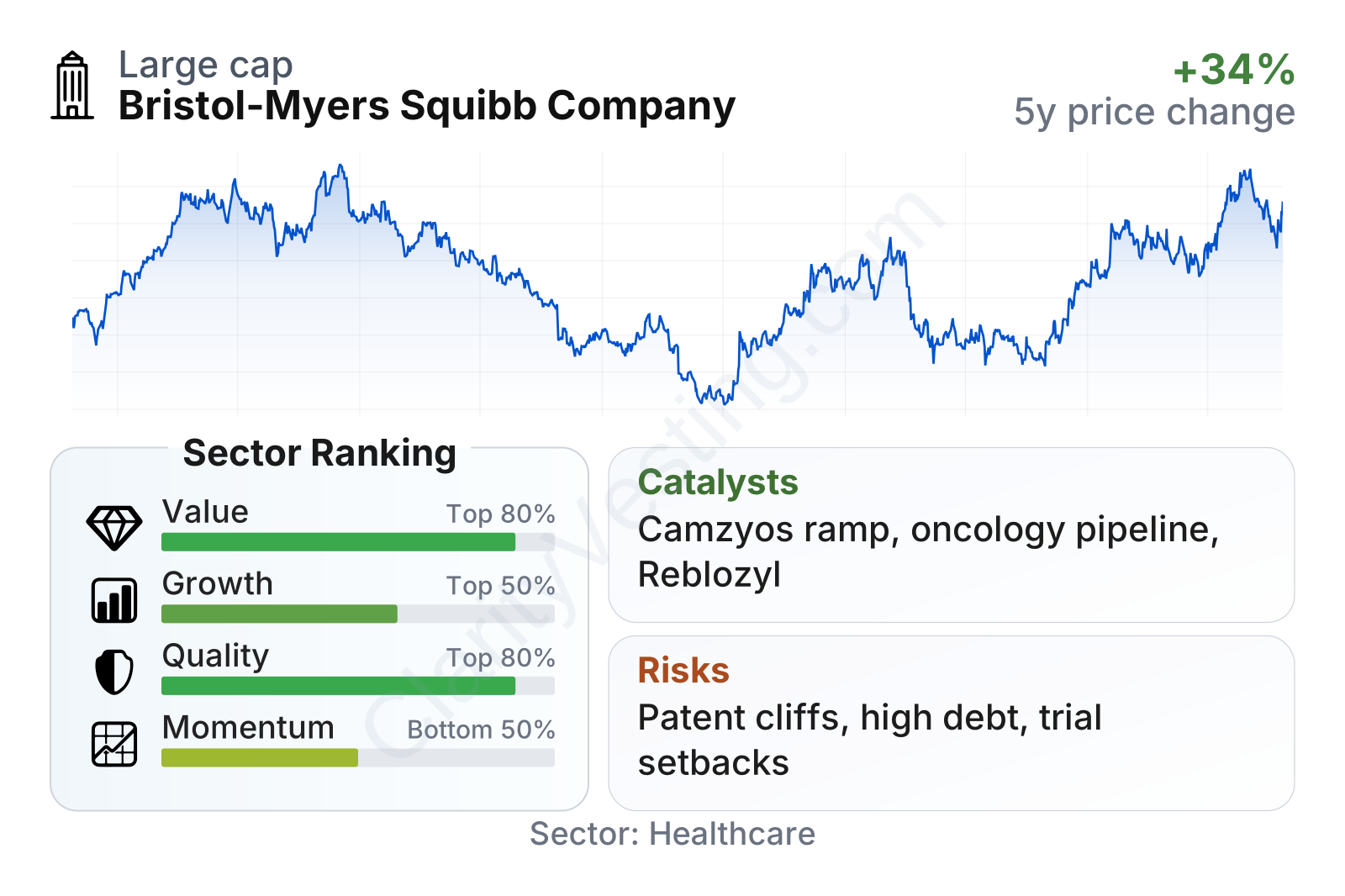
Bristol-Myers Squibb stands out as a very large healthcare company with unusually low share-price volatility, as shown by its low beta. On profitability and capital returns, it ranks well above much of the healthcare sector, with strong margins, strong returns on assets and invested capital, and free cash flow generation that is high for its size. The weaker area is growth, which has been mixed over the last several years because patent losses and deal-related accounting effects have distorted the trend. The valuation profile looks comparatively inexpensive on earnings and cash flow measures, while the balance sheet remains more leveraged than the sector norm.
Growth
The broader sector remains attractive over the long term. Demand for innovative medicines is supported by aging populations, rising cancer incidence, longer survival rates, and ongoing medical advances in targeted therapies, biologics, and cell therapy. Those are durable industry drivers, and Bristol-Myers Squibb is operating in several of the most important parts of that market.
The company’s strategy for future expansion is clear: replace declining legacy products with a larger group of newer medicines and use internal research plus acquisitions to refill the pipeline. That approach is logical for a pharmaceutical company facing patent expirations. The key question is not whether Bristol-Myers Squibb has growth assets, but whether those newer products can scale quickly enough to compensate for erosion in older franchises.
Recent revenue growth has improved again after a period of contraction. The pattern has been uneven rather than smooth, which is common when a large drugmaker loses exclusivity on one major product while launching newer therapies. The latest trend points to a return to positive year-over-year expansion, but still at a pace that is moderate compared with many faster-growing healthcare peers.
Several catalysts could support the next phase. Newer growth products such as Camzyos, Reblozyl, Breyanzi, and other recently launched medicines have been expanding from a smaller base. The company has also continued to advance its portfolio in oncology and immunology, where successful label expansions can materially increase a drug’s addressable market. In addition, Bristol-Myers Squibb has strengthened its pipeline through external deals, which can create future revenue streams if development milestones are met.
Cash generation remains one of the most important positives. Free cash flow has stayed in the multibillion-dollar range even during a period of portfolio transition. That gives the company flexibility to fund research, support manufacturing, manage debt, and continue shareholder distributions without depending on capital markets. For a long-term business analysis, that resilience is more important than one difficult earnings year caused by acquisition-related or accounting-heavy charges.
Recent company updates have also highlighted continued progress in integrating acquired assets and advancing late-stage programs. For Bristol-Myers Squibb, meaningful opportunities often come not from a single breakthrough headline, but from a series of approvals, expanded indications, and increased physician adoption across multiple products.
Risks
This article is for informational purposes only and does not constitute financial advice. Some content is AI-generated. See Disclaimer


