Stock Analysis · bioMérieux S.A (BMXMF)
Overview
bioMérieux is a French diagnostics company focused on detecting infectious diseases and providing tools that help hospitals, laboratories, and manufacturers identify biological risks. Its products are used to diagnose patient infections, detect antimicrobial resistance, monitor blood and other samples, and control contamination in food, pharmaceutical, and industrial settings. In simple terms, the company sells machines, testing kits, software, and related services that help customers find harmful microorganisms quickly and reliably.
The business is mainly organized around in vitro diagnostics, with a meaningful but smaller contribution from industrial and applied microbiology. Based on the company’s recent annual reporting, revenue is broadly split as follows:
- Clinical applications: about 80% to 85% — diagnostic testing used in hospitals and clinical labs, including microbiology, molecular biology, immunoassays, and syndromic testing. This is the core business and includes instruments plus recurring sales of reagents and consumables.
- Industry applications: about 15% to 20% — microbiological quality control for food, pharmaceutical, cosmetics, and other industrial customers. This business also benefits from recurring demand for testing supplies.
Looking at the product mix, bioMérieux also has an attractive recurring-revenue model because once an instrument is installed, customers typically continue buying the associated reagents, test panels, culture media, and service support. That tends to make the installed base important over time. Geographically, the company is diversified across Europe, the Americas, and Asia-Pacific, which reduces reliance on any single market.
Over the last several years, revenue has continued to climb overall, but profitability has been less stable. Gross profit has expanded with sales, yet operating income and net income have faced pressure as research spending and operating costs increased. That pattern suggests a company still investing for long-term positioning, even if near-term earnings have been uneven.
Key Figures
| Metric | Value | Sector ⓘ |
|---|---|---|
| Date | Oct 24, 2026 | |
| Context | ||
| Sector | Healthcare | |
| Industry | Diagnostics & Research | |
| Market Cap ⓘ | $11.84B | |
| Beta ⓘ | 0.55 | |
Value (Cheapness) | ||
| P/E Ratio ⓘ | 22.10 | 25.42 |
| P/B Ratio ⓘ | 2.75 | 3.08 |
| FCF Yield ⓘ | 8.65% | 3.12% |
| Dividend Yield ⓘ | 0.97% | 1.85% |
| EBIT / EV ⓘ | N/A | 0.56% |
| PEG ⓘ | 1.67 | |
Growth (Business expansion) | ||
| Revenue Growth ⓘ | -3.90% | 7.50% |
| RPS Growth (5Y CAGR) ⓘ | 4.75% | 8.60% |
| EPS Growth (5Y CAGR) ⓘ | -17.27% | -17.73% |
| BVPS Growth (5Y CAGR) ⓘ | 6.99% | 3.72% |
| Margin Growth (5Y Trend) ⓘ | -10.78% | -0.57% |
| FCF Growth (5Y CAGR) ⓘ | -3.45% | 0.96% |
| DPS Growth (5Y CAGR) ⓘ | 9.72% | 6.69% |
Quality (Business durability) | ||
| ROIC (Latest) ⓘ | 19.79% | 3.17% |
| ROA (Latest) ⓘ | 14.66% | 2.98% |
| ROIC (5Y Median) ⓘ | 12.28% | 4.56% |
| ROA (5Y Median) ⓘ | 7.84% | 1.87% |
| Net Debt / EBIT (Latest) ⓘ | -0.21 | 1.34 |
| Net Debt / EBIT (5Y Median) ⓘ | -0.20 | 1.86 |
| Net Debt / EBITDA (Latest) ⓘ | -0.12 | 1.00 |
| Net Debt / Assets ⓘ | -4.14% | 5.06% |
| EBITDA / Interest ⓘ | N/A | 9.55 |
| Operating Margin (Latest) ⓘ | 14.05% | 9.25% |
| Operating Margin (5Y Median) ⓘ | 15.48% | 7.33% |
| Debt to Equity (Latest) ⓘ | 9.82% | 26.68% |
| Profit Margin (Latest) ⓘ | 11.59% | 3.34% |
| Free Cash Flow (Latest) ⓘ | $1.02B | |
Momentum (Price trend) | ||
| 3Y Return ⓘ | +12.12% | +51.61% |
| 12M Return (excl. last month) ⓘ | -37.03% | +19.90% |
| 6M Return ⓘ | -4.12% | +10.10% |
| Price vs. 200-Day MA ⓘ | -2.66% | +6.44% |
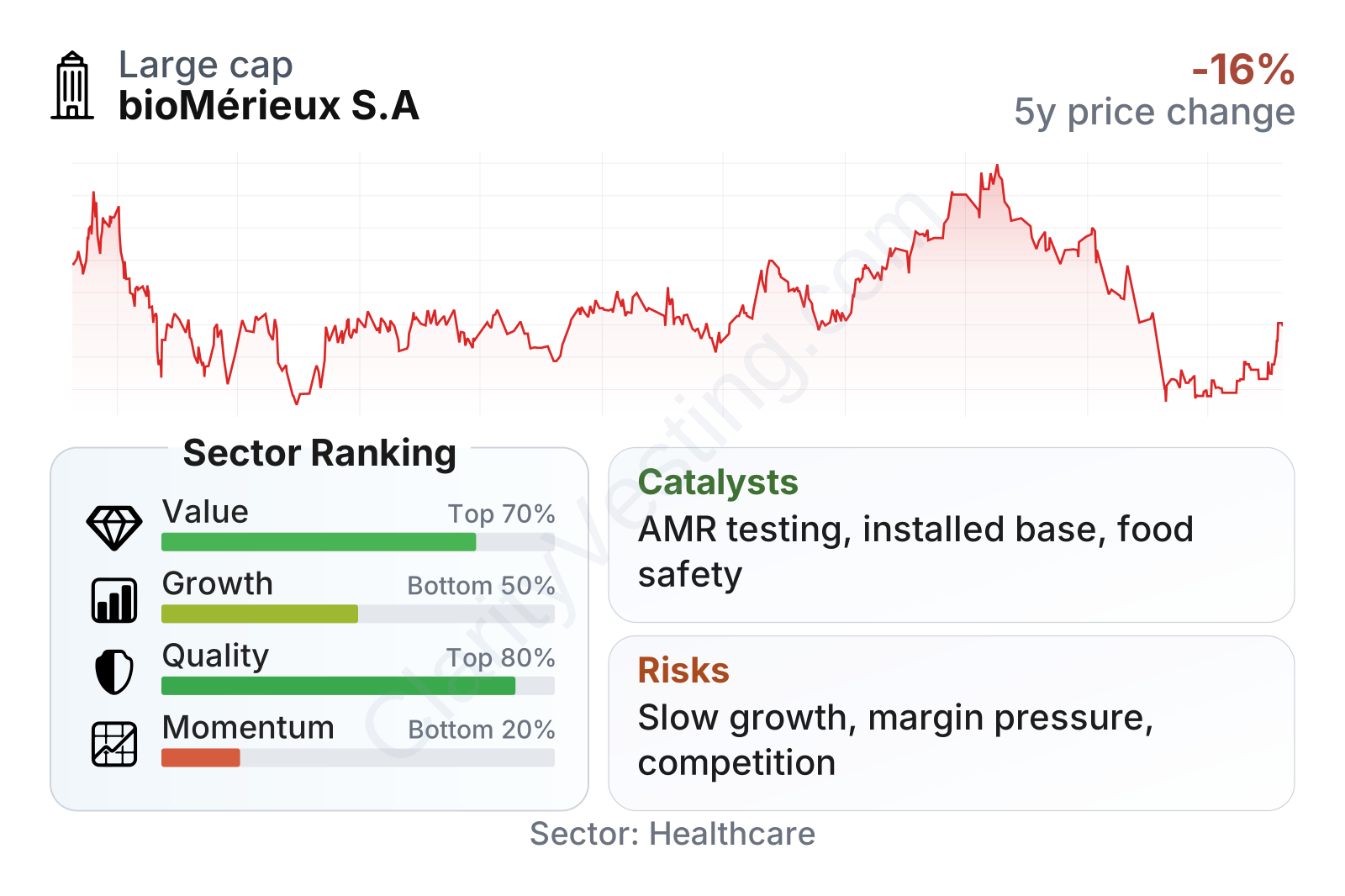
bioMérieux sits in the large mid-cap to lower large-cap range, with relatively low share-price volatility compared with many healthcare names. The quality profile stands out: profitability metrics are well above the sector median, returns on capital are strong, and leverage is low. The balance sheet is especially notable, with net cash rather than heavy debt and free cash flow that remains solid in absolute terms.
The weaker area is growth and market momentum. Recent revenue growth has been negative year over year, five-year sales expansion has been modest versus the sector, and margins have softened from earlier levels. Share-price performance has also lagged badly over the last year and over longer periods. On valuation, the stock is currently trading below the sector median on earnings and book value multiples, which suggests the market is recognizing the slower growth profile and recent execution pressures.
Growth
Diagnostics is structurally supported by long-term trends that are hard to ignore: aging populations, rising healthcare testing volumes, the need for faster diagnosis, antimicrobial resistance, and stricter quality requirements in food and pharmaceutical production. These drivers support steady demand for microbiology and molecular testing, especially where rapid answers can improve treatment decisions or reduce costly delays.
bioMérieux’s strategy broadly fits those trends. The company is strongest in specialized diagnostics rather than routine commodity testing, with exposure to microbiology, syndromic panels, sepsis-related workflows, and antimicrobial resistance. Those areas matter because hospitals increasingly want quicker and more precise identification of pathogens, while public health systems are putting more emphasis on controlling resistant bacteria.
A key point for long-term growth is the company’s installed base model. Instruments can open the door, but the recurring economics usually come from consumables, reagents, and service contracts. If bioMérieux continues placing systems in labs and expands menu adoption on existing platforms, revenue can compound even without dramatic unit growth every year.
Another important growth angle is industrial microbiology. Food safety, pharmaceutical manufacturing controls, and environmental monitoring are all becoming more regulated and more data-driven. This part of the portfolio is smaller than clinical diagnostics, but it gives the group exposure to non-hospital demand and can act as a useful diversification layer.
Recent company communications have also highlighted continued investment in innovation, automation, and data-connected laboratory workflows. That makes strategic sense: diagnostic customers increasingly value speed, workflow integration, and lower manual handling, not only test accuracy. If newer systems gain traction, they could help support both revenue growth and stickier customer relationships.
The main issue is that the recent growth profile has not fully matched the sector. Some of that reflects difficult comparisons after extraordinary pandemic-era demand patterns and portfolio mix effects, but it still means bioMérieux needs its newer platforms and menu expansion to translate into more visible acceleration.
Risks
This article is for informational purposes only and does not constitute financial advice. Some content is AI-generated. See Disclaimer


