Stock Analysis · B&M European Value Retail SA (BMRRY)
Overview
B&M European Value Retail is a discount retailer focused on selling a wide range of everyday products at low prices. The group operates mainly through the B&M chain in the United Kingdom, has a smaller business in France under B&M France, and also owns Heron Foods, a UK value grocery chain. Its stores are designed around high footfall, simple presentation, and fast-moving, low-ticket items that appeal to budget-conscious households.
The company’s revenue comes primarily from physical retail sales. Based on recent annual reporting, the business mix is approximately:
- B&M UK: about 84% to 86% of group revenue. This is the core business and includes general merchandise, home products, seasonal items, toys, health and beauty, pet care, food, and drink.
- Heron Foods: about 8% to 10% of group revenue. This division focuses on frozen, chilled, and ambient value grocery products in neighborhood locations.
- B&M France: about 5% to 7% of group revenue. This is the group’s smaller continental European business, using a similar discount variety model.
B&M’s model is straightforward: source products at attractive prices, turn inventory quickly, keep store operations efficient, and use value positioning to remain relevant in both weak and normal consumer environments. Over the last several years, revenue has continued to climb, but recent results also show that more of those sales are being absorbed by operating costs and financing expenses, which matters for long-term profitability.
The long-term pattern is encouraging on the sales line, with revenue rising steadily from roughly £4.7 billion to nearly £5.9 billion over five fiscal years. Gross profit also expanded, but operating income and net income have come under more pressure recently as selling costs and interest expense increased faster than profit.
Key Figures
| Metric | Value | Sector ⓘ |
|---|---|---|
| Date | Oct 17, 2026 | |
| Context | ||
| Sector | Consumer Defensive | |
| Industry | Discount Stores | |
| Market Cap ⓘ | $3.61B | |
| Beta ⓘ | 1.10 | |
Value (Cheapness) | ||
| P/E Ratio ⓘ | 16.51 | 17.88 |
| P/B Ratio ⓘ | 4.55 | 1.29 |
| FCF Yield ⓘ | 31.57% | 12.39% |
| Dividend Yield ⓘ | 3.59% | 2.85% |
| EBIT / EV ⓘ | N/A | 6.43% |
| PEG ⓘ | N/A | |
Growth (Business expansion) | ||
| Revenue Growth ⓘ | 3.40% | 4.10% |
| RPS Growth (5Y CAGR) ⓘ | 5.79% | 6.18% |
| EPS Growth (5Y CAGR) ⓘ | -12.19% | -13.59% |
| BVPS Growth (5Y CAGR) ⓘ | 1.63% | 3.20% |
| Margin Growth (5Y Trend) ⓘ | -6.11% | -0.15% |
| FCF Growth (5Y CAGR) ⓘ | 8.54% | 4.10% |
| DPS Growth (5Y CAGR) ⓘ | -25.17% | 6.79% |
Quality (Business durability) | ||
| ROIC (Latest) ⓘ | 43.21% | 12.34% |
| ROA (Latest) ⓘ | 11.47% | 6.30% |
| ROIC (5Y Median) ⓘ | 25.30% | 10.49% |
| ROA (5Y Median) ⓘ | 9.67% | 5.44% |
| Net Debt / EBIT (Latest) ⓘ | 2.00 | 1.96 |
| Net Debt / EBIT (5Y Median) ⓘ | 3.77 | 2.35 |
| Net Debt / EBITDA (Latest) ⓘ | 1.30 | 1.38 |
| Net Debt / Assets ⓘ | 52.96% | 21.51% |
| EBITDA / Interest ⓘ | 5.84 | 9.46 |
| Operating Margin (Latest) ⓘ | 8.55% | 8.87% |
| Operating Margin (5Y Median) ⓘ | 10.74% | 9.53% |
| Debt to Equity (Latest) ⓘ | 306.52% | 72.35% |
| Profit Margin (Latest) ⓘ | 2.84% | 5.40% |
| Free Cash Flow (Latest) ⓘ | $1.14B | |
Momentum (Price trend) | ||
| 3Y Return ⓘ | -35.48% | +20.92% |
| 12M Return (excl. last month) ⓘ | -2.97% | +2.13% |
| 6M Return ⓘ | +60.59% | +1.26% |
| Price vs. 200-Day MA ⓘ | +39.93% | +1.39% |
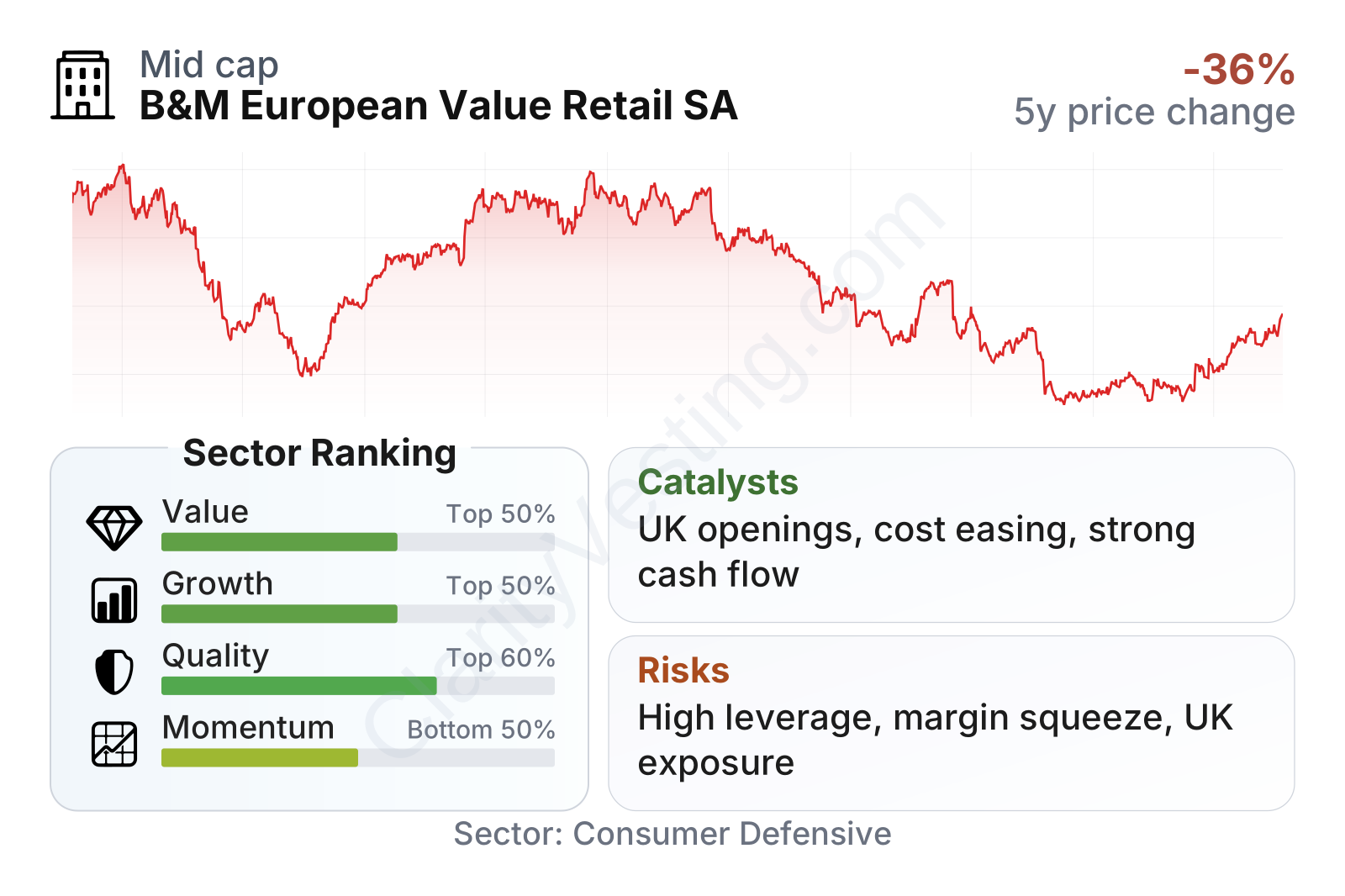
B&M sits in the middle of the pack on broad sector comparisons, but the details are mixed. Valuation metrics suggest the shares are not stretched versus the sector on earnings and cash flow, while quality indicators are stronger than they first appear because returns on capital and assets are well above typical discount retail levels. Growth is more moderate than exceptional, and the stock’s recent recovery has improved momentum after a long, volatile period.
The share price history shows a business that has gone through a major de-rating since 2021. Even after a rebound in 2026, the stock remains far below prior highs, which suggests the market is still weighing margin pressure, leverage, and execution concerns against the company’s cash-generating retail model.
Growth
Discount retail is generally considered a resilient part of consumer staples. It tends to benefit when households trade down, search for bargains, or become more selective in discretionary spending. That gives B&M exposure to a structurally relevant segment, especially in the UK, where inflation and pressure on real household budgets have helped support demand for value-focused formats in recent years.
B&M’s strategy remains logical for future growth. The company combines new store openings with regular product rotation and a broad assortment that encourages repeat visits. This is important because the chain is not only a grocery discounter; it also sells non-food categories that can lift basket size and help differentiate stores from pure food competitors. Heron Foods adds another angle through convenience-led discount grocery, while France provides an additional, though smaller, avenue for expansion.
Near-term growth is not perfectly smooth. The latest year-over-year revenue change shown here is weak, which highlights that expansion can be uneven across reporting periods. Still, over a longer horizon, revenue per share has grown at a mid-single-digit annual pace, and the business has managed to lift total sales consistently across the last several fiscal years. That points to a company still expanding, but not one currently enjoying effortless momentum.
One of the most constructive elements in the long-term picture is cash generation. Free cash flow has remained strong, reaching well above £1 billion on a trailing basis in the latest available period. That matters because cash supports store investment, balance sheet flexibility, and shareholder distributions. It also helps offset the concern created by softer accounting earnings.
A practical catalyst is the company’s continued store rollout capacity in the UK and the possibility of improving profitability if cost inflation eases. B&M’s model can benefit quickly from better freight, labor, or energy conditions because it operates at scale and turns inventory rapidly. Another positive factor is that the company’s value positioning remains relevant even if consumer spending stays cautious.
Risks
This article is for informational purposes only and does not constitute financial advice. Some content is AI-generated. See Disclaimer


