Stock Analysis · B&M European Value Retail S.A (BMRPF)
Overview
B&M European Value Retail S.A. is a discount retailer focused on selling a broad mix of everyday products at low prices. The group operates mainly through the B&M chain in the United Kingdom, the Heron Foods grocery chain, and B&M stores in France. Its model is built around value retailing: relatively simple stores, a fast-changing product mix, and a strong emphasis on low selling prices across household goods, groceries, health and beauty items, pet products, toys, DIY, and seasonal merchandise.
The business is primarily store-based, and revenue comes from selling physical products through its retail banners. Based on the company’s latest annual reporting, the revenue mix is approximately as follows:
- B&M UK: about 82% of group revenue. This is the main chain and includes general merchandise and grocery categories sold in UK discount stores.
- Heron Foods: about 11% of group revenue. This business focuses more heavily on convenience-oriented food retail in the UK.
- B&M France: about 7% of group revenue. This is the group’s smaller continental European operation.
The revenue base is diversified by product category rather than by a single item type, which can help smooth demand. At the same time, the business remains highly tied to consumer spending patterns in the UK, where the large majority of sales and profits are generated.
Over the last five fiscal years, group revenue has continued to rise, from roughly £4.7 billion to nearly £5.8 billion. However, the latest year shows that higher sales did not translate into stronger earnings, as operating costs and interest expense took a larger share of revenue than before.
The main pattern is straightforward: sales have increased steadily, gross profit has also expanded, but store operating costs have climbed faster in the most recent year. That pushed operating income and net income down meaningfully, showing that scale alone is not enough if cost inflation and financing costs keep rising.
Key Figures
| Metric | Value | Sector ⓘ |
|---|---|---|
| Date | Oct 10, 2026 | |
| Context | ||
| Sector | Consumer Defensive | |
| Industry | Discount Stores | |
| Market Cap ⓘ | $3.35B | |
| Beta ⓘ | 1.10 | |
Value (Cheapness) | ||
| P/E Ratio ⓘ | 15.14 | 17.64 |
| P/B Ratio ⓘ | 4.18 | 1.27 |
| FCF Yield ⓘ | 33.90% | 12.68% |
| Dividend Yield ⓘ | 2.88% | 2.85% |
| EBIT / EV ⓘ | N/A | 6.32% |
| PEG ⓘ | 1.35 | |
Growth (Business expansion) | ||
| Revenue Growth ⓘ | 3.40% | 3.85% |
| RPS Growth (5Y CAGR) ⓘ | 5.43% | 6.20% |
| EPS Growth (5Y CAGR) ⓘ | -8.11% | -14.31% |
| BVPS Growth (5Y CAGR) ⓘ | 1.70% | 3.33% |
| Margin Growth (5Y Trend) ⓘ | -6.11% | -0.17% |
| FCF Growth (5Y CAGR) ⓘ | 8.17% | 4.37% |
| DPS Growth (5Y CAGR) ⓘ | -25.43% | 6.68% |
Quality (Business durability) | ||
| ROIC (Latest) ⓘ | 43.09% | 12.58% |
| ROA (Latest) ⓘ | 11.43% | 6.32% |
| ROIC (5Y Median) ⓘ | 25.30% | 10.38% |
| ROA (5Y Median) ⓘ | 9.67% | 5.44% |
| Net Debt / EBIT (Latest) ⓘ | 2.01 | 1.92 |
| Net Debt / EBIT (5Y Median) ⓘ | 3.77 | 2.32 |
| Net Debt / EBITDA (Latest) ⓘ | 1.37 | 1.36 |
| Net Debt / Assets ⓘ | 52.96% | 21.29% |
| EBITDA / Interest ⓘ | 5.82 | 9.52 |
| Operating Margin (Latest) ⓘ | 8.55% | 8.88% |
| Operating Margin (5Y Median) ⓘ | 10.74% | 9.53% |
| Debt to Equity (Latest) ⓘ | 306.52% | 71.95% |
| Profit Margin (Latest) ⓘ | 2.84% | 5.37% |
| Free Cash Flow (Latest) ⓘ | $1.14B | |
Momentum (Price trend) | ||
| 3Y Return ⓘ | -43.66% | +18.12% |
| 12M Return (excl. last month) ⓘ | -0.97% | +2.64% |
| 6M Return ⓘ | +51.36% | +1.32% |
| Price vs. 200-Day MA ⓘ | +8.44% | +0.17% |
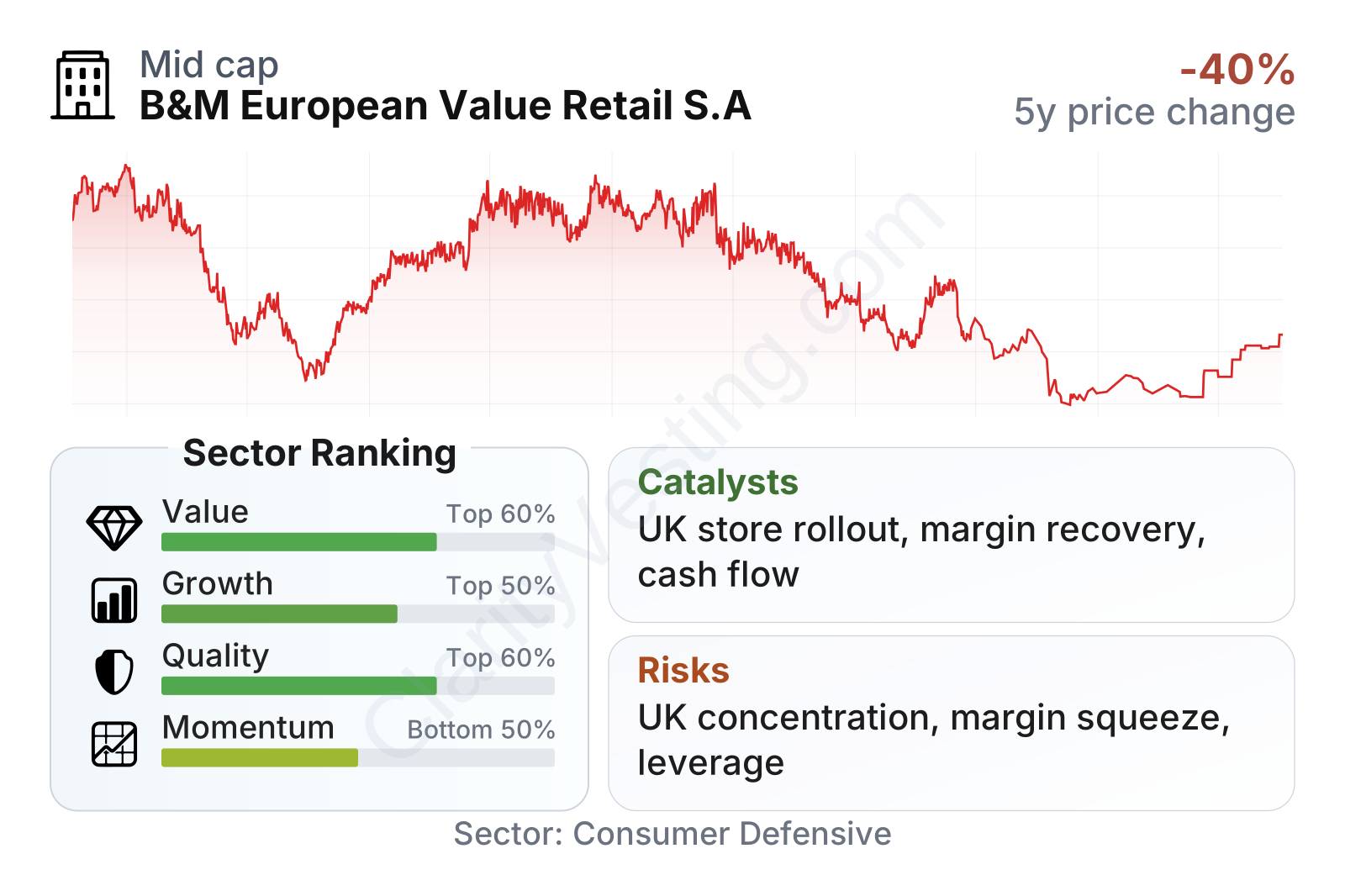
B&M currently looks mixed on a high-level screen. Profitability on invested capital remains strong relative to much of the sector, which suggests the core retail model can still generate attractive returns. Free cash flow is also notably strong, and the dividend yield is close to the sector median. On the other hand, leverage is elevated, interest coverage is weaker than the sector median, profit margin is modest, and long-term price performance has lagged badly even after a strong rebound over the last six months. Growth metrics are around the middle of the pack overall, with cash generation holding up better than earnings.
The share price history reflects that tension. The stock fell sharply from its 2022 highs, recovered during 2023 and early 2024, then weakened again before a recent bounce. That pattern is consistent with a company the market still sees as operationally solid in some areas, but exposed to margin pressure and lower confidence in near-term earnings quality.
Growth
B&M operates in discount retail, a segment that tends to be resilient when consumers become more price-sensitive. That does not make it a high-growth industry in the usual sense, but it can be a structurally relevant one for long-term demand because many households continue to trade down during periods of inflation, weak wage growth, or economic uncertainty. In that environment, discount chains can gain traffic even if the wider retail market is subdued.
The company’s strategy remains logical for this setting. It combines new store openings, a broad general merchandise assortment, seasonal flexibility, and a value-led price position. This format can work especially well when shoppers are willing to visit stores for low prices and opportunistic purchases rather than staying loyal to premium brands. B&M’s large UK footprint also gives it buying scale that smaller independent chains may struggle to match.
A meaningful catalyst is store expansion, especially in the UK, where management has for several years identified room for additional B&M locations. The group has also continued to add Heron Foods stores. If new stores keep opening at acceptable returns and mature stores remain productive, that can support sales growth even when same-store growth is moderate.
Another catalyst is cash generation. The company’s recent free cash flow profile appears stronger than many sector peers, which matters because retail is a business where cash can fund openings, logistics, shareholder distributions, and debt management. If operating pressures ease, that cash profile could become more visible in overall market perception.
Recent company updates in 2026 also point to continued emphasis on store rollout, execution in UK trading, and tighter operating discipline after a weaker earnings year. For a retailer in this category, even a modest improvement in gross margin, shrink control, freight, or overhead absorption can have an outsized effect on profit because the net margin is relatively thin to begin with.
Risks
This article is for informational purposes only and does not constitute financial advice. Some content is AI-generated. See Disclaimer


