Stock Analysis · Biomarin Pharmaceutical Inc (BMRN)
Overview
BioMarin Pharmaceutical is a biotechnology company focused on rare genetic diseases. Its business model is relatively easy to understand: it develops specialized medicines for small patient populations with serious, often lifelong conditions, and then sells those therapies through a global commercial network. Rare-disease drug makers can build durable positions because treatment options are limited, pricing is often premium, and physicians tend to stay with therapies that have proven benefits.
Revenue mainly comes from marketed therapies for enzyme deficiencies, skeletal disorders, and other inherited diseases. Based on recent company reporting, the largest sources of product revenue are concentrated in a handful of medicines.
- VOXZOGO: approximately 29% of 2025 revenue. This treatment is used for children with achondroplasia, a form of dwarfism, and has become the company’s main growth driver.
- VIMIZIM: approximately 24%. Used for Morquio A syndrome, an ultra-rare metabolic disorder.
- NAGLAZYME: approximately 13%. Used for Maroteaux-Lamy syndrome, another inherited enzyme deficiency disease.
- PALYNZIQ: approximately 11%. Used for phenylketonuria, or PKU, in adults.
- BRINEURA: approximately 10%. Treats CLN2 disease, a rare and severe neurologic disorder.
- ROCTAVIAN: approximately 9%. A gene therapy for severe hemophilia A; still meaningful, but currently smaller than the established enzyme replacement and growth-disorder franchises.
- KUVAN and other revenue: approximately 4% combined. KUVAN has been declining after loss of exclusivity.
This mix matters because BioMarin is no longer dependent on only one medicine. The company has a broader portfolio than many biotech peers, although revenue is still concentrated in rare-disease products where each program can materially affect overall results.
The operating picture has also improved over the last few years. Revenue has risen steadily from about $1.8 billion in 2021 to above $3.2 billion in 2025, while profitability moved from losses to meaningful positive earnings. At the same time, research spending remains high, which is typical for a biotech company trying to extend its pipeline and defend future growth.
The business has become much larger and more profitable than it was a few years ago, but the cost structure is also evolving. Gross profit has expanded with sales, while research and selling expenses have also climbed, especially as newer products such as VOXZOGO and ROCTAVIAN require continued global rollout and lifecycle investment.
Key Figures
| Metric | Value | Sector ⓘ |
|---|---|---|
| Date | Oct 24, 2026 | |
| Context | ||
| Sector | Healthcare | |
| Industry | Biotechnology | |
| Market Cap ⓘ | $10.69B | |
| Beta ⓘ | 0.21 | |
Value (Cheapness) | ||
| P/E Ratio ⓘ | 149.22 | 25.42 |
| P/B Ratio ⓘ | 1.74 | 3.08 |
| FCF Yield ⓘ | 6.86% | 3.12% |
| Dividend Yield ⓘ | N/A | 1.85% |
| EBIT / EV ⓘ | 1.51% | 0.56% |
| PEG ⓘ | 0.36 | |
Growth (Business expansion) | ||
| Revenue Growth ⓘ | 19.90% | 7.50% |
| RPS Growth (5Y CAGR) ⓘ | 12.75% | 8.60% |
| EPS Growth (5Y CAGR) ⓘ | 1.52% | -17.73% |
| BVPS Growth (5Y CAGR) ⓘ | 7.19% | 3.72% |
| Margin Growth (5Y Trend) ⓘ | 18.60% | -0.57% |
| FCF Growth (5Y CAGR) ⓘ | 40.64% | 0.96% |
| DPS Growth (5Y CAGR) ⓘ | N/A | 6.69% |
Quality (Business durability) | ||
| ROIC (Latest) ⓘ | 2.16% | 3.17% |
| ROA (Latest) ⓘ | 0.75% | 2.98% |
| ROIC (5Y Median) ⓘ | 3.07% | 4.56% |
| ROA (5Y Median) ⓘ | 2.54% | 1.87% |
| Net Debt / EBIT (Latest) ⓘ | 14.30 | 1.34 |
| Net Debt / EBIT (5Y Median) ⓘ | 0.58 | 1.86 |
| Net Debt / EBITDA (Latest) ⓘ | 8.63 | 1.00 |
| Net Debt / Assets ⓘ | 28.39% | 5.06% |
| EBITDA / Interest ⓘ | 4.61 | 9.55 |
| Operating Margin (Latest) ⓘ | 6.83% | 9.25% |
| Operating Margin (5Y Median) ⓘ | 8.37% | 7.33% |
| Debt to Equity (Latest) ⓘ | 66.47% | 26.68% |
| Profit Margin (Latest) ⓘ | 2.14% | 3.34% |
| Free Cash Flow (Latest) ⓘ | $732.88M | |
Momentum (Price trend) | ||
| 3Y Return ⓘ | -31.64% | +51.61% |
| 12M Return (excl. last month) ⓘ | +17.48% | +19.90% |
| 6M Return ⓘ | +4.58% | +10.10% |
| Price vs. 200-Day MA ⓘ | -3.18% | +6.44% |
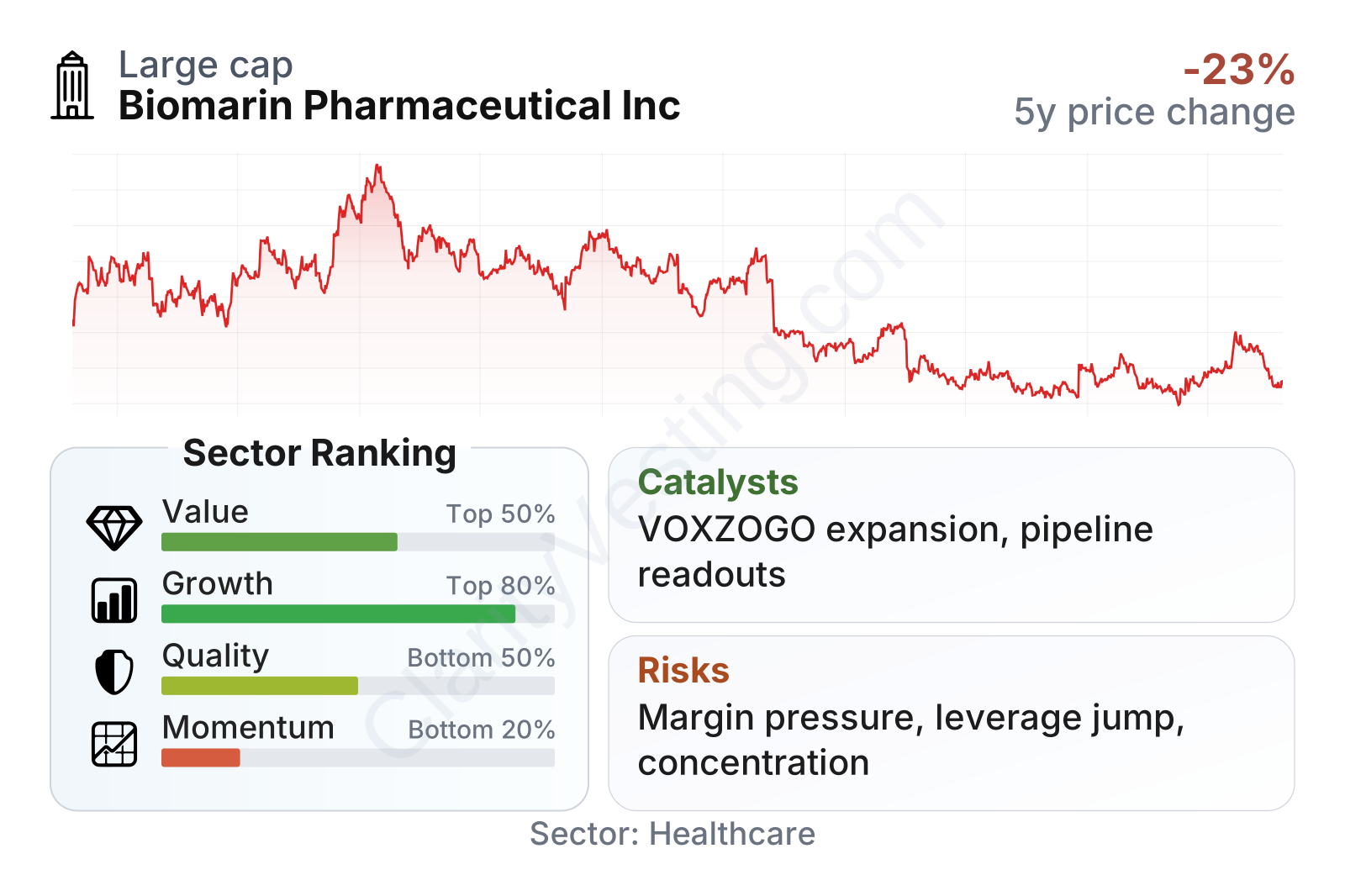
BioMarin sits in the mid-sized range within healthcare and has shown unusually low share-price volatility for a biotech stock, with a beta well below 1. The broader profile is mixed but understandable: growth metrics are strong compared with the sector, value signals are favorable in some areas such as free cash flow yield and PEG, while quality metrics are weaker because returns on capital and recent margins remain below many peers. Price momentum has also been soft, which reflects a stock that has struggled to keep pace even as the underlying business has expanded.
The share price history highlights that disconnect. After trading much higher several years ago, the stock has moved lower overall despite stronger revenue and cash generation. That often happens when the market had previously priced in very optimistic expectations for pipeline assets or future margins, then reassessed what the business is worth as execution became more important than early promise.
Growth
BioMarin operates in one of the more attractive corners of healthcare: rare diseases. This is a growing market because diagnosis rates improve over time, new therapies can address conditions with few alternatives, and successful treatments can remain relevant for many years. The company’s strategy fits that environment well. It focuses on genetically defined disorders where deep scientific specialization, regulatory expertise, and global patient identification can create a long runway after approval.
The strongest current growth engine is VOXZOGO. It has expanded beyond an initial launch phase and is increasingly important to the company’s overall revenue base. Achondroplasia is especially important because it may support both continued geographic expansion and future label development. That makes it different from mature rare-disease products that are stable but less likely to reaccelerate meaningfully.
Recent revenue trends show a business that has maintained mostly double-digit year-over-year growth, often well above the sector median. Growth has not been perfectly smooth quarter to quarter, but the overall pattern remains constructive. For a company of BioMarin’s size, sustaining revenue expansion near the high teens is a notable result, especially since it is coming from a mix of established products and newer launches rather than from one-off milestone payments.
Another positive point is cash generation. Stronger revenue has increasingly turned into free cash flow, which gives the company more flexibility to fund research, support launches, and absorb setbacks without immediately depending on external financing.
Free cash flow has improved sharply over the last few years and is now comfortably positive. That marks an important change in BioMarin’s profile. Many biotech companies can grow sales but still consume cash; BioMarin is showing that its commercial base is large enough to produce internal funding for the next stage of development.
Future catalysts are tied to both execution and pipeline progress. VOXZOGO remains the clearest commercial opportunity. ROCTAVIAN is another potential contributor, although gene therapy adoption can be slower and more uneven than standard drug launches because treatment centers, reimbursement, and long-term physician confidence all matter. Beyond marketed products, pipeline readouts and regulatory decisions can still move the long-term outlook significantly because rare-disease portfolios are naturally concentrated.
Recent company updates have continued to emphasize global commercialization, lifecycle development, and pipeline advancement. The most important opportunity is not a single dramatic event, but the possibility that BioMarin continues turning its rare-disease franchise into a broader, more consistently cash-generative platform.
Risks
This article is for informational purposes only and does not constitute financial advice. Some content is AI-generated. See Disclaimer


