Stock Analysis · BitMine Immersion Technologies Inc (BMNR)
Overview
BitMine Immersion Technologies Inc is a digital asset company whose business has shifted meaningfully over time. Historically, it focused on Bitcoin mining infrastructure and hosting, using immersion cooling systems designed to improve the performance and efficiency of mining machines. More recently, the company has also become associated with treasury-style exposure to digital assets, especially Ethereum, which has become a major part of how the market appears to evaluate the business.
That matters for long-term analysis because BMNR does not fit neatly into a traditional operating company profile. It combines a small underlying operating business with a balance sheet and strategy that can be heavily influenced by cryptocurrency prices, capital raising, and changes in digital asset market sentiment.
Based on public filings and company communications, the main economic drivers appear to be the following:
- Digital asset treasury exposure — the most important value driver recently. This includes the effect of holding cryptocurrencies on the balance sheet, especially Ethereum, and can have a much larger impact on reported book value and earnings than the operating business itself.
- Bitcoin mining revenue — revenue generated from mining activities, tied to mining output, network difficulty, energy costs, and Bitcoin prices.
- Mining equipment sales and related services — a smaller source tied to hardware, hosting, and other infrastructure-related activity when applicable.
Exact revenue percentages are difficult to state with confidence from the available public information because the company’s recent profile has been shaped not only by operating revenue but also by digital asset holdings and accounting effects that do not map cleanly into a stable segment breakdown. What is clearer is that reported revenue remains modest compared with the scale of market attention around the company, while balance sheet shifts have recently been much more significant than sales growth alone.
The multi-year financial flow also shows a business that grew revenue from a very small base, but with weak gross profit conversion and persistent operating losses in most periods. A sharp break appears in fiscal 2025, when accounting and balance sheet effects became far more important than the underlying operating model.
Key Figures
| Metric | Value | Sector ⓘ |
|---|---|---|
| Date | Nov 21, 2026 | |
| Context | ||
| Sector | Financial Services | |
| Industry | Capital Markets | |
| Market Cap ⓘ | $9.69B | |
| Beta ⓘ | 2.16 | |
Value (Cheapness) | ||
| P/E Ratio ⓘ | N/A | 12.01 |
| P/B Ratio ⓘ | 0.58 | 1.48 |
| FCF Yield ⓘ | -3.15% | 8.77% |
| Dividend Yield ⓘ | N/A | 3.01% |
| EBIT / EV ⓘ | -67.26% | 8.31% |
| PEG ⓘ | N/A | |
Growth (Business expansion) | ||
| Revenue Growth ⓘ | 4801.30% | 6.70% |
| RPS Growth (5Y CAGR) ⓘ | 237.94% | 12.35% |
| EPS Growth (5Y CAGR) ⓘ | -22.87% | -0.27% |
| BVPS Growth (5Y CAGR) ⓘ | 452.10% | 4.83% |
| Margin Growth (5Y Trend) ⓘ | N/A | -4.16% |
| FCF Growth (5Y CAGR) ⓘ | N/A | 4.69% |
| DPS Growth (5Y CAGR) ⓘ | N/A | 8.82% |
Quality (Business durability) | ||
| ROIC (Latest) ⓘ | -42.40% | 9.49% |
| ROE (Latest) ⓘ | -47.39% | 14.02% |
| ROA (Latest) ⓘ | -46.91% | 1.53% |
| ROIC (5Y Median) ⓘ | N/A | 7.80% |
| ROE (5Y Median) ⓘ | -51.65% | 12.09% |
| ROA (5Y Median) ⓘ | -42.52% | 1.28% |
| Net Debt / EBIT (Latest) ⓘ | N/A | 0.88 |
| Net Debt / EBIT (5Y Median) ⓘ | N/A | 0.73 |
| Net Debt / EBITDA (Latest) ⓘ | N/A | 0.71 |
| Operating Margin (Latest) ⓘ | -5207.58% | 23.37% |
| Operating Margin (5Y Median) ⓘ | -366.87% | 24.29% |
| Debt to Equity (Latest) ⓘ | 0.01% | 59.34% |
| Profit Margin (Latest) ⓘ | N/A | 26.65% |
| Free Cash Flow (Latest) ⓘ | -$305.72M | |
Momentum (Price trend) | ||
| 3Y Return ⓘ | +17.39% | +73.29% |
| 12M Return (excl. last month) ⓘ | -53.78% | +18.35% |
| 6M Return ⓘ | -33.81% | +3.24% |
| Price vs. 200-Day MA ⓘ | -36.00% | +2.17% |
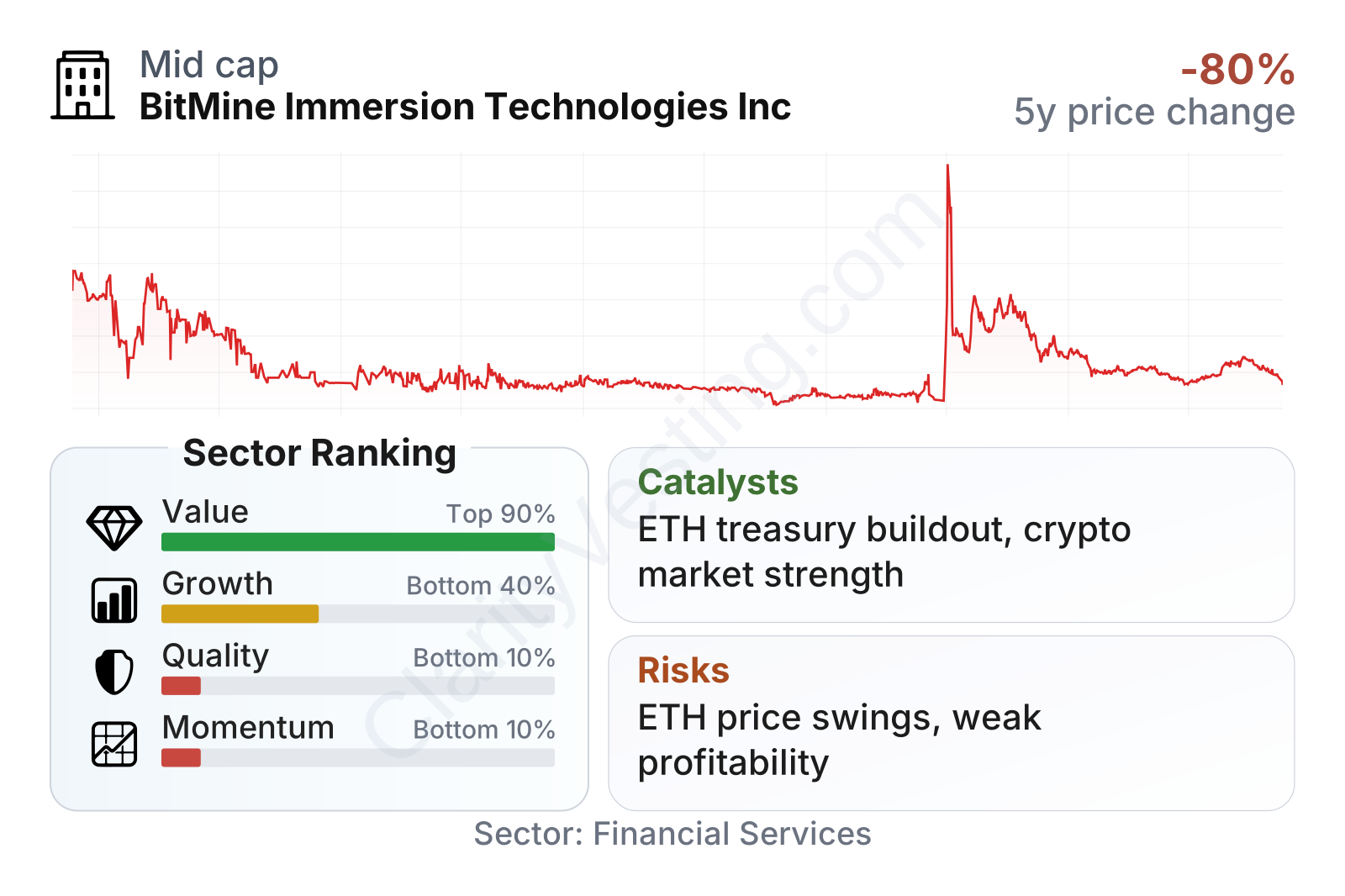
BMNR is now a large-cap company by market value, but its operating fundamentals still look much weaker than most of the financial sector. Revenue growth over the last year was extremely strong, yet that came from a very small base and does not offset the broader picture of negative free cash flow, very poor profitability, and returns well below sector norms. The stock has also been highly volatile: after a steep decline from 2021 into late 2024, it experienced a dramatic rebound in 2025 and then pulled back again in 2026. That pattern suggests market expectations have been driven more by strategic repositioning and crypto-related enthusiasm than by stable business execution.
Growth
BMNR operates in a sector with genuine long-term expansion potential: digital assets, blockchain infrastructure, and token-based financial networks remain areas of active development. If Ethereum continues gaining importance in settlement, tokenization, staking, and decentralized finance infrastructure, a company aligned with that ecosystem could benefit from strong external tailwinds.
The strategic logic is understandable. Rather than relying only on mining economics, which are cyclical and highly sensitive to energy and hardware conditions, the company has moved toward a model where digital asset ownership itself can reshape the balance sheet. That creates a faster route to scale than building a large industrial mining operation from scratch, but it also makes growth more dependent on market prices and financing access.
The recent earnings pattern highlights that contrast clearly.
Earnings moved from recurring losses to a sharp positive result in fiscal 2025, then slipped back into negative territory afterward. That kind of swing usually points to non-recurring factors, valuation changes, or one-time accounting effects rather than a smooth improvement in the core business. For long-term readers, the key takeaway is that growth exists, but it has not yet been demonstrated as consistent, operating-company growth.
Book value per share is another important signal here.
The jump in book value per share is striking and helps explain why the market became much more interested in the company. It suggests that asset accumulation or revaluation had a major impact on shareholder equity. In a digital asset-linked business, that can be a powerful catalyst because it changes the scale of the company quickly. It can also attract capital and improve strategic flexibility if management uses the stronger balance sheet to expand holdings, infrastructure, or adjacent services.
A recent and important opportunity is the company’s increasing association with Ethereum treasury positioning. If management continues building a recognizable platform around ETH exposure, BMNR could occupy a niche between an operating crypto infrastructure firm and a publicly traded digital asset vehicle. That can draw substantial attention when crypto markets are favorable, especially because public equity markets often assign premium valuations to scarce listed vehicles tied to major blockchain assets.
Risks
This article is for informational purposes only and does not constitute financial advice. Some content is AI-generated. See Disclaimer


