Stock Analysis · Brambles Limited (BMBLF)
Overview
Brambles Limited is a global supply-chain logistics company best known for CHEP, its pallet and container pooling business. Instead of selling pallets, crates, and containers to customers, Brambles keeps ownership of the equipment and rents it out through a circular reuse model. Manufacturers, retailers, and distributors use these platforms to move goods through supply chains, and Brambles collects, repairs, redistributes, and reissues them. This model is designed to lower one-way packaging waste, improve asset utilization, and make transport operations more efficient for large customers.
The business is concentrated in reusable transport assets, with CHEP representing the overwhelming majority of group activity. Based on recent annual reporting, revenue is largely derived from pallet pooling, with smaller contributions from reusable plastic containers and other container solutions.
- CHEP Pallets: approximately 80% to 85% of revenue. This includes pooled wooden pallets used heavily in consumer goods, grocery, beverage, fresh produce, and general retail logistics.
- Reusable Plastic Containers: approximately 10% to 15% of revenue. These are mainly crates and bins used for fresh food and produce distribution, especially in retail supply chains.
- Automotive, containers, and other solutions: approximately 3% to 7% of revenue. This includes specialized containers and pooling services for industrial and automotive uses.
- By geography: the largest revenue contributors are typically North America first, then Europe, followed by Asia-Pacific and Latin America combined, reflecting Brambles’ scale in mature grocery and consumer goods networks.
What makes Brambles easy to understand is that it earns money from repeat usage rather than one-time product sales. As long as customers keep moving goods through large retail and manufacturing networks, the company can keep generating recurring revenue from a very large installed asset base.
The long-term picture shows a business that has steadily expanded revenue and net income over the last several years. Even with fluctuations in input costs and transport expenses, Brambles has maintained a sizable profit stream, which is a sign that the pooling model has pricing power and operating discipline.
Key Figures
| Metric | Value | Sector ⓘ |
|---|---|---|
| Date | Oct 24, 2026 | |
| Context | ||
| Sector | Industrials | |
| Industry | Specialty Business Services | |
| Market Cap ⓘ | $19.41B | |
| Beta ⓘ | 0.42 | |
Value (Cheapness) | ||
| P/E Ratio ⓘ | 20.89 | 22.29 |
| P/B Ratio ⓘ | 6.18 | 1.98 |
| FCF Yield ⓘ | 9.24% | 6.26% |
| Dividend Yield ⓘ | 3.20% | 1.92% |
| EBIT / EV ⓘ | 12.40% | 4.83% |
| PEG ⓘ | 2.57 | |
Growth (Business expansion) | ||
| Revenue Growth ⓘ | 5.00% | 9.30% |
| RPS Growth (5Y CAGR) ⓘ | 7.75% | 7.76% |
| EPS Growth (5Y CAGR) ⓘ | 9.03% | -13.17% |
| BVPS Growth (5Y CAGR) ⓘ | 8.23% | 6.13% |
| Margin Growth (5Y Trend) ⓘ | 0.90% | 0.74% |
| FCF Growth (5Y CAGR) ⓘ | N/A | 10.79% |
| DPS Growth (5Y CAGR) ⓘ | 20.60% | 9.41% |
Quality (Business durability) | ||
| ROIC (Latest) ⓘ | N/A | 10.75% |
| ROA (Latest) ⓘ | 20.31% | 5.41% |
| ROIC (5Y Median) ⓘ | 16.80% | 9.37% |
| ROA (5Y Median) ⓘ | 8.67% | 4.95% |
| Net Debt / EBIT (Latest) ⓘ | 1.15 | 2.04 |
| Net Debt / EBIT (5Y Median) ⓘ | 2.41 | 2.27 |
| Net Debt / EBITDA (Latest) ⓘ | 0.68 | 1.39 |
| Net Debt / Assets ⓘ | 30.11% | 19.27% |
| EBITDA / Interest ⓘ | 15.55 | 9.58 |
| Operating Margin (Latest) ⓘ | 18.42% | 10.49% |
| Operating Margin (5Y Median) ⓘ | 17.25% | 10.30% |
| Debt to Equity (Latest) ⓘ | 93.71% | 64.82% |
| Profit Margin (Latest) ⓘ | 13.15% | 6.67% |
| Free Cash Flow (Latest) ⓘ | $1.79B | |
Momentum (Price trend) | ||
| 3Y Return ⓘ | +86.88% | +67.77% |
| 12M Return (excl. last month) ⓘ | -14.58% | +12.05% |
| 6M Return ⓘ | -7.57% | 0.00% |
| Price vs. 200-Day MA ⓘ | +2.43% | +0.67% |
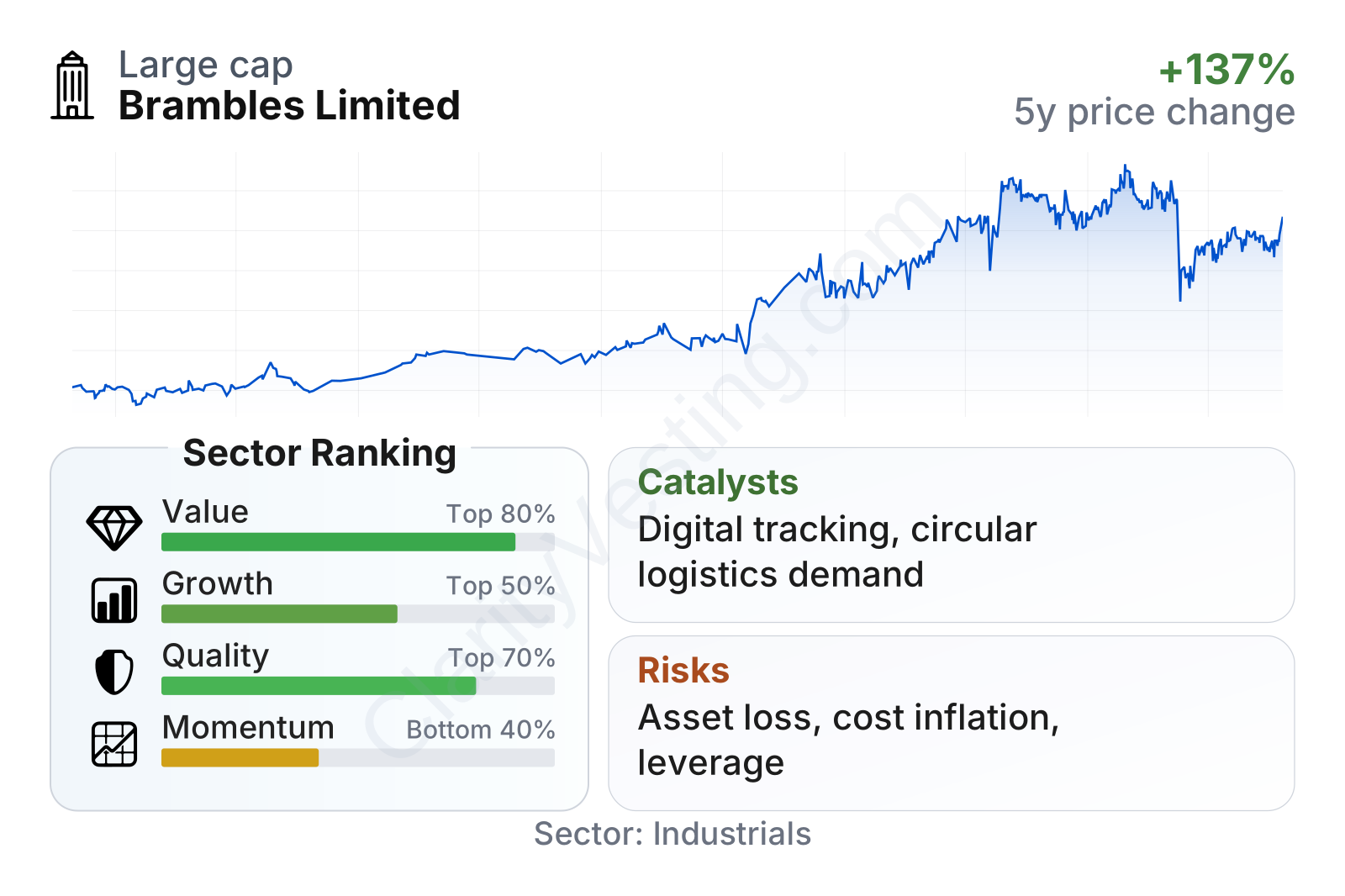
Brambles is a large industrial services company with relatively low share-price volatility, as shown by a beta well below 1. Its overall profile stands out most on cash generation and profitability. Valuation measures look mixed but not stretched relative to the broader sector: the earnings multiple is below the sector median, free cash flow yield is clearly stronger than average, and the dividend yield is also above the sector norm. Growth is more moderate than exceptional, while recent price momentum has weakened after a strong multiyear run.
Growth
Brambles operates in a part of the logistics market that benefits from several durable trends: global retail distribution, supply-chain standardization, cost control, and sustainability. Reusable pallets and containers fit well with large customers that want fewer disruptions, lower waste, and better product traceability. This is not a fashionable high-growth industry, but it is a steady one with room for expansion as more supply chains adopt shared and reusable transport platforms.
The company’s strategy is logical for long-term expansion. Brambles continues to focus on network density, asset productivity, digital tracking, customer retention, and disciplined pricing. A denser network matters because pooled assets become more efficient when collection, repair, and redistribution happen at scale. That creates a reinforcing advantage: more customers improve asset turns, and better asset turns can support margins and returns.
Revenue growth recently has been positive but not especially fast, at around 5% year over year, which is below the sector median. Over a longer period, however, per-share revenue growth has been broadly in line with the sector, and earnings growth has been notably better than many peers. That suggests Brambles has not relied only on top-line expansion; it has also improved execution and pricing.
Free cash flow is one of the more attractive features here. The business is producing roughly $1.8 billion in trailing free cash flow, and its free cash flow yield is comfortably above the sector median. For a company built on physical assets, that matters. It indicates that Brambles is not just reporting accounting profits; it is also converting a meaningful portion of its operations into cash that can support dividends, debt management, and reinvestment.
A recent and important catalyst is the company’s continued push into digitized asset management and supply-chain visibility. Better tracking can reduce loss, improve asset turns, and strengthen customer relationships. Another growth support is the broader corporate focus on circular logistics and waste reduction, areas where Brambles is already established rather than trying to enter late.
Risks
This article is for informational purposes only and does not constitute financial advice. Some content is AI-generated. See Disclaimer