Stock Analysis · Bladex Inc (BLX)
Overview
Bladex Inc., officially Banco Latinoamericano de Comercio Exterior, is a Panama-based multinational bank focused on trade finance in Latin America and the Caribbean. Its main role is to help finance cross-border commerce, working with commercial banks, corporations, and in some cases public-sector-related clients. In simple terms, it operates in a specialized corner of banking: moving capital where importers, exporters, and financial institutions need short- and medium-term funding tied to regional trade flows.
The business is more concentrated than a typical regional bank. Instead of relying mainly on consumer loans or branch banking, Bladex earns most of its money from lending and treasury activities connected to corporate and institutional clients. Based on company disclosures, its revenue mix is largely driven by net interest income, with a smaller contribution from fees and treasury-related results.
- Net interest income: approximately 75% to 90% of total revenue in recent periods. This is the spread between what Bladex earns on loans and securities and what it pays on deposits and other funding.
- Fees and commissions: approximately 5% to 15%. This includes structuring, syndication, letters of credit, and other transaction-related banking services.
- Treasury and other income: approximately 5% to 15%. This can include gains from investment securities, foreign exchange, and balance sheet management activities.
That structure matters because it makes Bladex highly sensitive to loan growth, credit quality, trade volumes, and funding conditions rather than consumer banking trends. Over the last several years, the company has expanded revenue and earnings materially, while also increasing book value per share, showing that growth has not relied only on market optimism but also on a larger earnings base.
The financial flow also shows a business that has scaled up strongly since 2021, with revenue and net income rising significantly through 2024 and 2025. For a bank, the key takeaway is not the accounting labels themselves but the direction: a much larger earnings engine than a few years ago, supported by higher activity and improved profitability.
Key Figures
| Metric | Value | Sector ⓘ |
|---|---|---|
| Date | Oct 10, 2026 | |
| Context | ||
| Sector | Financial Services | |
| Industry | Banks - Regional | |
| Market Cap ⓘ | $2.07B | |
| Beta ⓘ | 0.80 | |
Value (Cheapness) | ||
| P/E Ratio ⓘ | 8.95 | 12.38 |
| P/B Ratio ⓘ | 1.17 | 1.23 |
| FCF Yield ⓘ | 18.94% | 10.23% |
| Dividend Yield ⓘ | 4.95% | 3.01% |
| EBIT / EV ⓘ | N/A | 8.08% |
| PEG ⓘ | 1.77 | |
Growth (Business expansion) | ||
| Revenue Growth ⓘ | 6.20% | 9.50% |
| RPS Growth (5Y CAGR) ⓘ | 22.85% | 12.21% |
| EPS Growth (5Y CAGR) ⓘ | 5.36% | -9.62% |
| BVPS Growth (5Y CAGR) ⓘ | 15.32% | 4.98% |
| Margin Growth (5Y Trend) ⓘ | -14.86% | -4.07% |
| FCF Growth (5Y CAGR) ⓘ | N/A | 4.76% |
| DPS Growth (5Y CAGR) ⓘ | 25.58% | 8.79% |
Quality (Business durability) | ||
| ROIC (Latest) ⓘ | N/A | 9.35% |
| ROE (Latest) ⓘ | 13.74% | 13.91% |
| ROA (Latest) ⓘ | 1.74% | 1.53% |
| ROIC (5Y Median) ⓘ | 1.43% | 7.86% |
| ROE (5Y Median) ⓘ | 14.62% | 12.22% |
| ROA (5Y Median) ⓘ | 1.66% | 1.29% |
| Net Debt / EBIT (Latest) ⓘ | N/A | 0.99 |
| Net Debt / EBIT (5Y Median) ⓘ | 24.42 | 0.73 |
| Net Debt / EBITDA (Latest) ⓘ | 10.92 | 0.93 |
| Operating Margin (Latest) ⓘ | N/A | 22.19% |
| Operating Margin (5Y Median) ⓘ | 26.61% | 24.30% |
| Debt to Equity (Latest) ⓘ | 252.86% | 60.24% |
| Profit Margin (Latest) ⓘ | 71.19% | 26.49% |
| Free Cash Flow (Latest) ⓘ | $391.39M | |
Momentum (Price trend) | ||
| 3Y Return ⓘ | +198.63% | +88.52% |
| 12M Return (excl. last month) ⓘ | +28.48% | +19.65% |
| 6M Return ⓘ | +5.25% | +6.00% |
| Price vs. 200-Day MA ⓘ | +4.52% | +3.61% |
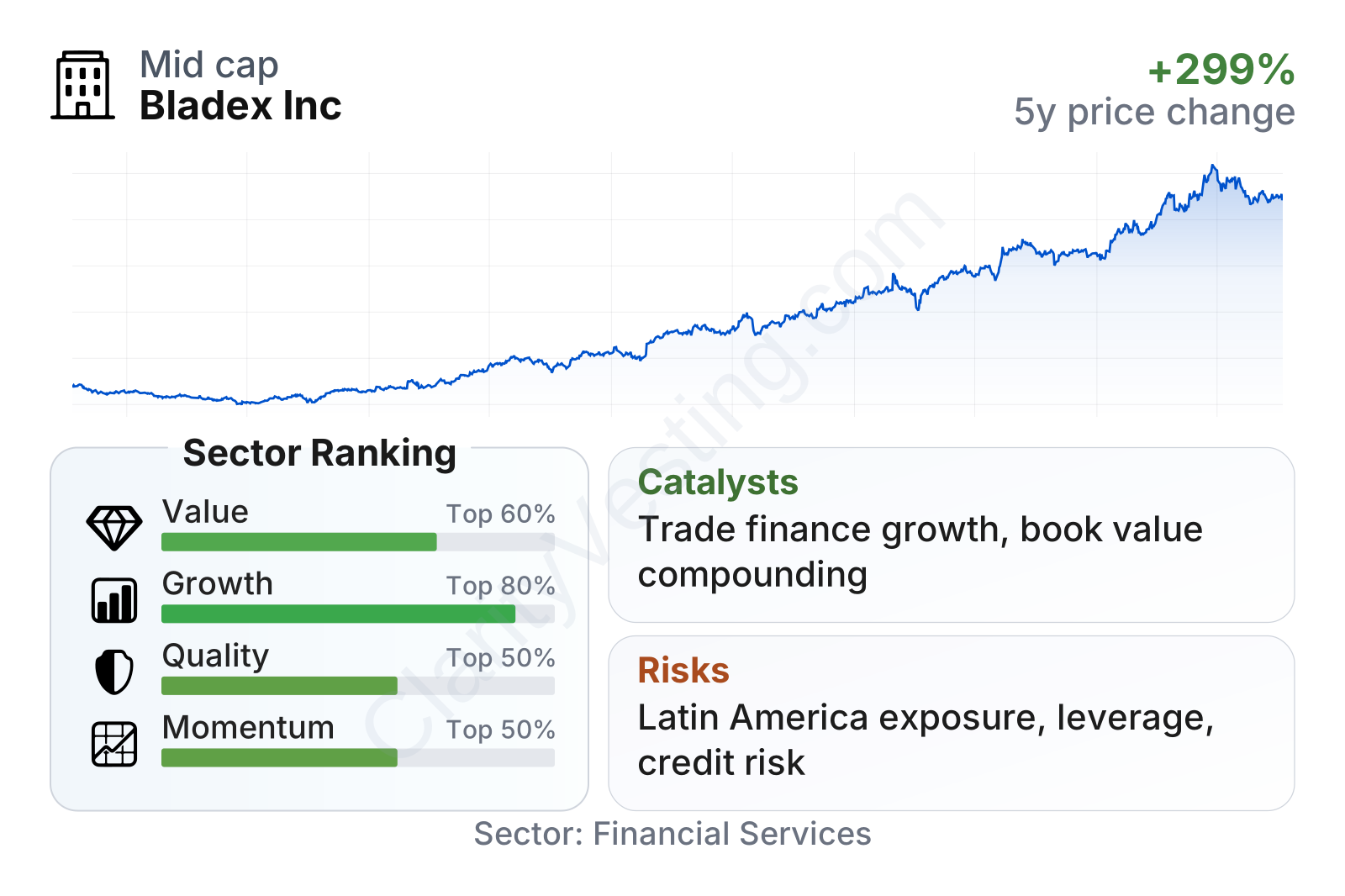
Bladex is a mid-sized bank by market value, with a relatively low beta of about 0.78, which suggests the stock has historically moved less sharply than the broader market. On valuation, the shares trade at roughly 9 times earnings and about 1.2 times book value, both close to or below sector norms. The dividend yield near 5% is also above the sector median, while free cash flow generation appears notably strong relative to the peer group.
The broader picture from the metrics table is mixed but constructive. Growth indicators are among the stronger parts of the profile, especially over a five-year period, with revenue per share, earnings per share, book value per share, and dividends all advancing faster than many peers. Quality is more balanced: profitability is solid, but leverage is clearly higher than the sector median, which is not unusual for a bank but still deserves attention. Momentum has also been favorable, as the stock has delivered a strong multi-year price increase and remains above its long-term average.
Growth
Bladex operates in a niche that can benefit from several long-term trends. Latin America remains heavily dependent on commodity exports, manufactured imports, and cross-border financing. That creates ongoing demand for trade credit, working capital, letters of credit, and syndicated loans. The company does not need explosive regional GDP growth to expand; it needs steady trade flows, disciplined underwriting, and the ability to capture more wallet share from corporate and financial-institution clients.
Its strategy is fairly easy to understand: grow the commercial portfolio, diversify funding, deepen client relationships, and keep a strong position in trade-related banking where specialized knowledge matters. This makes strategic sense because trade finance tends to be relationship-driven and operationally specialized. Scale helps, but expertise, regional reach, and credit discipline can be just as important as sheer size.
Earnings progression has been strong in recent years. Annual earnings per share moved from roughly $1.6 in 2021 to just above $6.1 in 2025, a substantial improvement even after allowing for the fact that banking earnings can fluctuate with rates and credit conditions. That kind of expansion is one reason the stock has rerated over time.
Book value per share has also risen steadily, from about $25.6 in 2021 to more than $45 by 2025. For banks, this is an important sign because book value reflects the growth of the capital base that supports future lending. Rising book value alongside rising earnings usually points to a healthier underlying franchise than price appreciation alone.
A notable catalyst is Bladex’s ability to keep compounding value while remaining focused on a profitable niche. Over five years, book value per share growth and revenue per share growth have been well ahead of the sector median, and dividend growth has also been particularly strong. If management continues to expand earning assets while preserving credit quality, the company could continue building intrinsic value even without a dramatic change in valuation multiples.
Another favorable element is recent operating momentum. The stock price has climbed sharply since 2022, but that move has been backed by a real improvement in earnings and balance sheet value rather than by a purely speculative narrative. In a financial institution, that distinction matters.
Risks
This article is for informational purposes only and does not constitute financial advice. Some content is AI-generated. See Disclaimer