Stock Analysis · Blue Moon Group Holdings Limited (BLUMY)
Overview
Blue Moon Group Holdings Limited is a Chinese household products company best known for laundry care. Its business is centered on cleaning products used in everyday home routines, with a strong presence in liquid laundry detergent, laundry pods, hand soap, and kitchen and bathroom cleaners. The company built its brand around premium liquid detergent earlier than many local rivals, which helped it become a recognized name in China’s mass household cleaning market.
Revenue is mainly generated from the sale of household cleaning products through online channels, direct sales arrangements, and traditional retail distribution. Based on company reporting in recent annual disclosures, the revenue mix is broadly concentrated in three product groups:
- Laundry care: approximately 80% to 85% of revenue. This includes liquid laundry detergent, laundry pods, laundry sanitizer, and related fabric-cleaning products.
- Personal hygiene: approximately 10% to 15% of revenue. This mainly covers hand wash and related hygiene products.
- Home care: approximately 5% to 10% of revenue. This includes kitchen cleaners, bleach-based products, and general household surface cleaning items.
Geographically, Blue Moon is overwhelmingly tied to mainland China, which means its results largely depend on Chinese consumer demand, retail competition, and e-commerce dynamics rather than international expansion.
The business model is fairly straightforward: develop branded cleaning products, promote them heavily through digital and retail channels, and try to defend premium pricing through product formulation, brand awareness, and convenience-focused formats such as concentrated liquids and pods.
The profit structure shows a business that still generates solid gross profit, but operating earnings have deteriorated sharply since 2021. Revenue recovered into 2024 before easing slightly in 2025, yet total operating expenses remained too high for that sales base, pushing the company into operating losses. In other words, the issue recently has not been demand alone; it has been the company’s ability to convert sales into profits.
Key Figures
| Metric | Value | Sector ⓘ |
|---|---|---|
| Date | Oct 17, 2026 | |
| Context | ||
| Sector | Consumer Defensive | |
| Industry | Household & Personal Products | |
| Market Cap ⓘ | $1.68B | |
| Beta ⓘ | 0.47 | |
Value (Cheapness) | ||
| P/E Ratio ⓘ | N/A | 17.88 |
| P/B Ratio ⓘ | 0.23 | 1.29 |
| FCF Yield ⓘ | -55.01% | 12.39% |
| Dividend Yield ⓘ | 7.91% | 2.85% |
| EBIT / EV ⓘ | N/A | 6.43% |
| PEG ⓘ | 1.75 | |
Growth (Business expansion) | ||
| Revenue Growth ⓘ | -5.10% | 4.10% |
| RPS Growth (5Y CAGR) ⓘ | 5.11% | 6.18% |
| EPS Growth (5Y CAGR) ⓘ | N/A | -13.59% |
| BVPS Growth (5Y CAGR) ⓘ | -9.44% | 3.20% |
| Margin Growth (5Y Trend) ⓘ | -21.95% | -0.15% |
| FCF Growth (5Y CAGR) ⓘ | N/A | 4.10% |
| DPS Growth (5Y CAGR) ⓘ | -24.88% | 6.79% |
Quality (Business durability) | ||
| ROIC (Latest) ⓘ | N/A | 12.34% |
| ROA (Latest) ⓘ | -6.57% | 6.30% |
| ROIC (5Y Median) ⓘ | 3.08% | 10.49% |
| ROA (5Y Median) ⓘ | 2.63% | 5.44% |
| Net Debt / EBIT (Latest) ⓘ | N/A | 1.96 |
| Net Debt / EBIT (5Y Median) ⓘ | -8.85 | 2.35 |
| Net Debt / EBITDA (Latest) ⓘ | N/A | 1.38 |
| Net Debt / Assets ⓘ | -33.68% | 21.51% |
| EBITDA / Interest ⓘ | N/A | 9.46 |
| Operating Margin (Latest) ⓘ | -3.55% | 8.87% |
| Operating Margin (5Y Median) ⓘ | 5.50% | 9.53% |
| Debt to Equity (Latest) ⓘ | 1.17% | 72.35% |
| Profit Margin (Latest) ⓘ | -1.04% | 5.40% |
| Free Cash Flow (Latest) ⓘ | -$925.03M | |
Momentum (Price trend) | ||
| 3Y Return ⓘ | -17.75% | +20.92% |
| 12M Return (excl. last month) ⓘ | -6.35% | +2.13% |
| 6M Return ⓘ | -13.81% | +1.26% |
| Price vs. 200-Day MA ⓘ | -13.60% | +1.39% |
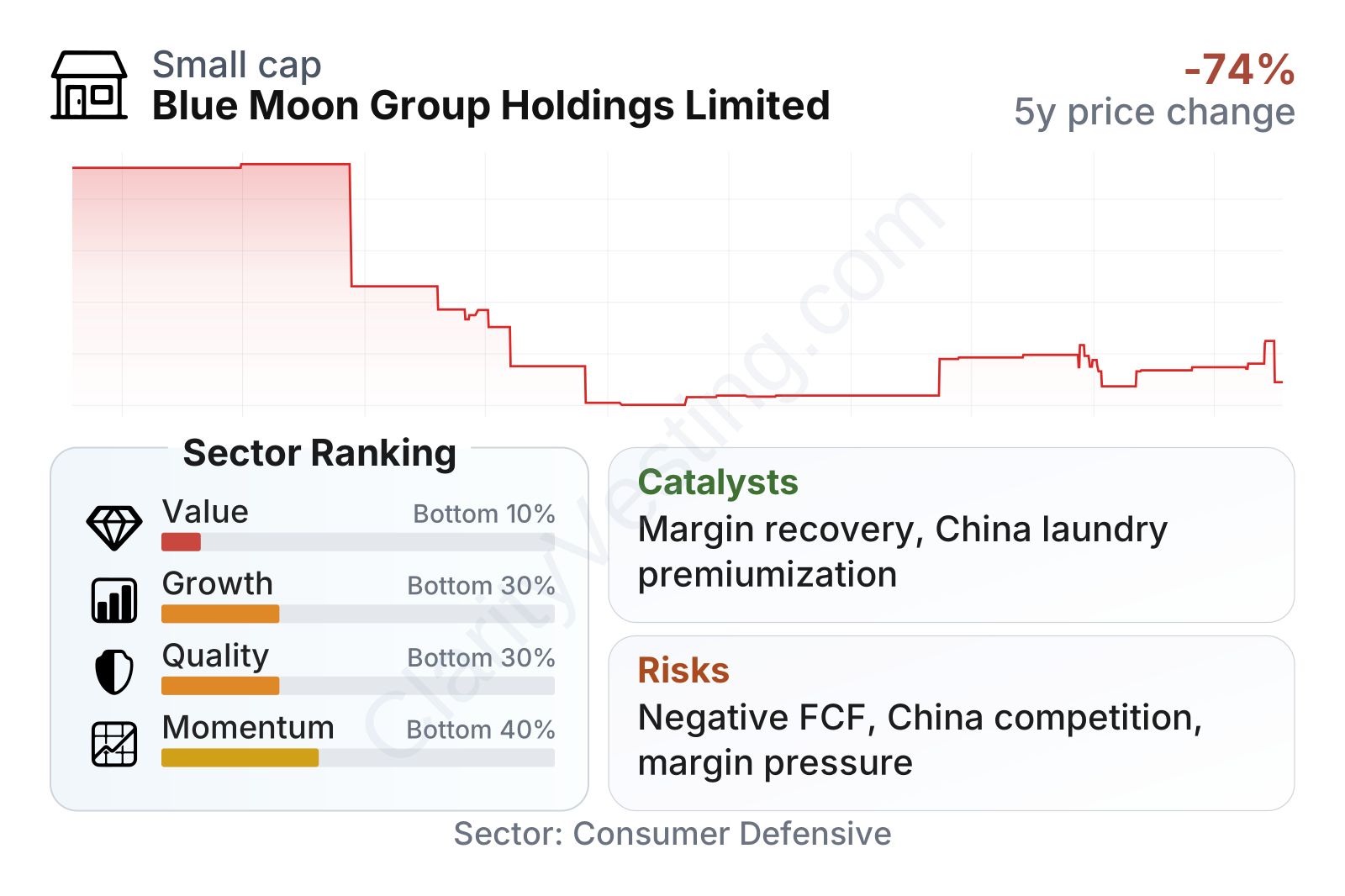
Blue Moon is a mid-sized consumer staples company with relatively low share-price volatility, reflected by a beta well below 1. The balance sheet is a notable bright spot: debt is very low, debt-to-equity is close to 1%, and net cash appears to exceed borrowings by a wide margin. That financial cushion reduces refinancing pressure and gives the company more time to work through operating issues.
At the same time, several core operating indicators remain weak. Profitability has turned negative, free cash flow is negative, and returns on assets are below the sector median by a wide margin. Growth metrics also look soft: recent revenue declined year over year, longer-term book value per share has contracted, and operating margins have deteriorated meaningfully over the past five years.
Valuation signals are mixed rather than clearly cheap. The price-to-book ratio is far below the sector median, which usually suggests the market has low expectations. However, the company does not screen well on broader value measures because losses and negative cash generation reduce the usefulness of simple low-multiple arguments. The dividend yield is above the sector median, but with profits and free cash flow under pressure, that yield should be viewed in the context of operating recovery rather than as a stand-alone strength.
The stock chart also reflects this tension. After a steep decline from 2022 into early 2024, the shares have recovered meaningfully over the last six to twelve months, and recent momentum has outpaced much of the sector. That suggests sentiment has improved, but it also means the market is already recognizing some possibility of stabilization.
Growth
Blue Moon operates in a sector with long-term defensive characteristics. Household cleaning is not a discretionary category in the same way as consumer electronics or luxury goods. Demand for detergent, hand wash, and surface cleaners tends to be more stable over time, and in China there is still room for consumers to trade up toward more specialized and premium cleaning products. That creates a reasonable long-term backdrop, even if short-term growth can be uneven.
The company’s strategy also has logic. Blue Moon has historically pushed liquid detergent and concentrated formats rather than competing only in lower-priced traditional powder products. It has also leaned heavily into e-commerce, where branded household products can benefit from repeat purchases, direct consumer engagement, and product bundles. If management can control promotion spending and improve channel efficiency, the company could potentially return to more durable margins without needing extraordinary top-line growth.
One important catalyst is operating normalization. The company’s recent losses came despite still-large revenue and healthy gross profit generation. That means a recovery does not necessarily require a complete reinvention of the business; it depends more on restoring cost discipline, improving sales mix, and translating brand scale into better operating leverage.
Another support factor is balance sheet flexibility. Because leverage is very low and net cash is strong, Blue Moon has more room than many weaker consumer brands to invest in product development, marketing refinement, and channel optimization while absorbing a difficult period.
Recent market performance may also indicate that expectations had become extremely depressed and are now being reassessed. The rebound in the shares over the past several months points to growing interest in a turnaround scenario, although that is not yet the same as confirmed fundamental recovery.
Risks
This article is for informational purposes only and does not constitute financial advice. Some content is AI-generated. See Disclaimer


