Stock Analysis · BlueScope Steel Ltd (BLSFY)
Overview
BlueScope Steel Ltd is an Australia-based steel producer and metal-coating company with operations in Australia, New Zealand, North America, and Asia. Its business is broader than simply making raw steel. The group produces flat steel products, coated and painted steel used in construction, and engineered building solutions, while also owning an important stake in a major North American steelmaker. That mix gives BlueScope exposure to residential, non-residential, industrial, and infrastructure demand across several regions.
The company’s revenue base is spread across operating segments rather than one single end market. Based on the latest annual reporting structure, the largest sources of sales are approximately:
- Australian Steel Products: about 35% to 40% of group revenue. This includes slab, hot rolled coil, cold rolled coil, plate, and coated and painted steel sold mainly into building, manufacturing, and distribution channels in Australia.
- North Star BlueScope Steel: about 20% to 25%. This is BlueScope’s share of the U.S.-based electric arc furnace steel business in Ohio, focused on hot rolled coil and benefiting from North American manufacturing demand.
- Buildings and Coated Products North America: about 15% to 20%. This segment includes coated and painted steel plus engineered building solutions serving construction markets in the United States.
- Coated Products Asia: about 10% to 15%. This business supplies coated and painted steel products across several Asian markets, with a large presence in branded building materials.
- New Zealand and Pacific Steel: about 10%. This includes steel products for construction, manufacturing, and distribution in New Zealand and nearby markets.
- Other activities: the balance comes from smaller building-products and corporate items.
One useful point for long-term analysis is that BlueScope earns money from both steelmaking and downstream value-added products such as COLORBOND and ZINCALUME branded materials. Those branded and coated products tend to be less commodity-like than basic steel, even though the group is still heavily exposed to steel price cycles.
The business flow over recent years shows how cyclical the company can be. Revenue stayed around the mid-teen billions in U.S. dollar terms, but earnings moved much more sharply. Profit was exceptionally strong in 2022, then fell as spreads normalized. By 2026, earnings recovered from the weak 2025 level, but margins remained far below the peak cycle. That pattern matters because BlueScope is not a steady compounding software company; it is a capital-intensive industrial group whose results can swing with steel spreads, construction demand, and regional supply conditions.
The operating picture suggests resilience in scale, but also shows that changes in cost of goods sold and selling expenses can move profit materially even when revenue changes only modestly.
Key Figures
| Metric | Value | Sector ⓘ |
|---|---|---|
| Date | Oct 24, 2026 | |
| Context | ||
| Sector | Basic Materials | |
| Industry | Steel | |
| Market Cap ⓘ | $9.59B | |
| Beta ⓘ | 1.17 | |
Value (Cheapness) | ||
| P/E Ratio ⓘ | 17.88 | 16.92 |
| P/B Ratio ⓘ | 0.99 | 1.66 |
| FCF Yield ⓘ | 4.81% | 5.83% |
| Dividend Yield ⓘ | 4.13% | 2.07% |
| EBIT / EV ⓘ | N/A | 6.38% |
| PEG ⓘ | N/A | |
Growth (Business expansion) | ||
| Revenue Growth ⓘ | 0.60% | 11.25% |
| RPS Growth (5Y CAGR) ⓘ | -0.93% | 4.49% |
| EPS Growth (5Y CAGR) ⓘ | 6.81% | -15.24% |
| BVPS Growth (5Y CAGR) ⓘ | 2.77% | 5.49% |
| Margin Growth (5Y Trend) ⓘ | -14.16% | -1.54% |
| FCF Growth (5Y CAGR) ⓘ | -37.98% | 0.37% |
| DPS Growth (5Y CAGR) ⓘ | 22.75% | 5.91% |
Quality (Business durability) | ||
| ROIC (Latest) ⓘ | N/A | 9.59% |
| ROA (Latest) ⓘ | 5.46% | 4.92% |
| ROIC (5Y Median) ⓘ | 8.99% | 7.91% |
| ROA (5Y Median) ⓘ | 5.10% | 3.92% |
| Net Debt / EBIT (Latest) ⓘ | 0.46 | 1.36 |
| Net Debt / EBIT (5Y Median) ⓘ | -0.10 | 1.69 |
| Net Debt / EBITDA (Latest) ⓘ | 0.22 | 0.93 |
| Net Debt / Assets ⓘ | 3.66% | 13.69% |
| EBITDA / Interest ⓘ | 20.45 | 12.38 |
| Operating Margin (Latest) ⓘ | 3.94% | 13.24% |
| Operating Margin (5Y Median) ⓘ | 7.44% | 11.82% |
| Debt to Equity (Latest) ⓘ | 17.14% | 40.30% |
| Profit Margin (Latest) ⓘ | 4.81% | 6.38% |
| Free Cash Flow (Latest) ⓘ | $460.86M | |
Momentum (Price trend) | ||
| 3Y Return ⓘ | +114.47% | +73.47% |
| 12M Return (excl. last month) ⓘ | +60.81% | +27.59% |
| 6M Return ⓘ | +6.27% | -4.02% |
| Price vs. 200-Day MA ⓘ | +27.18% | -0.65% |
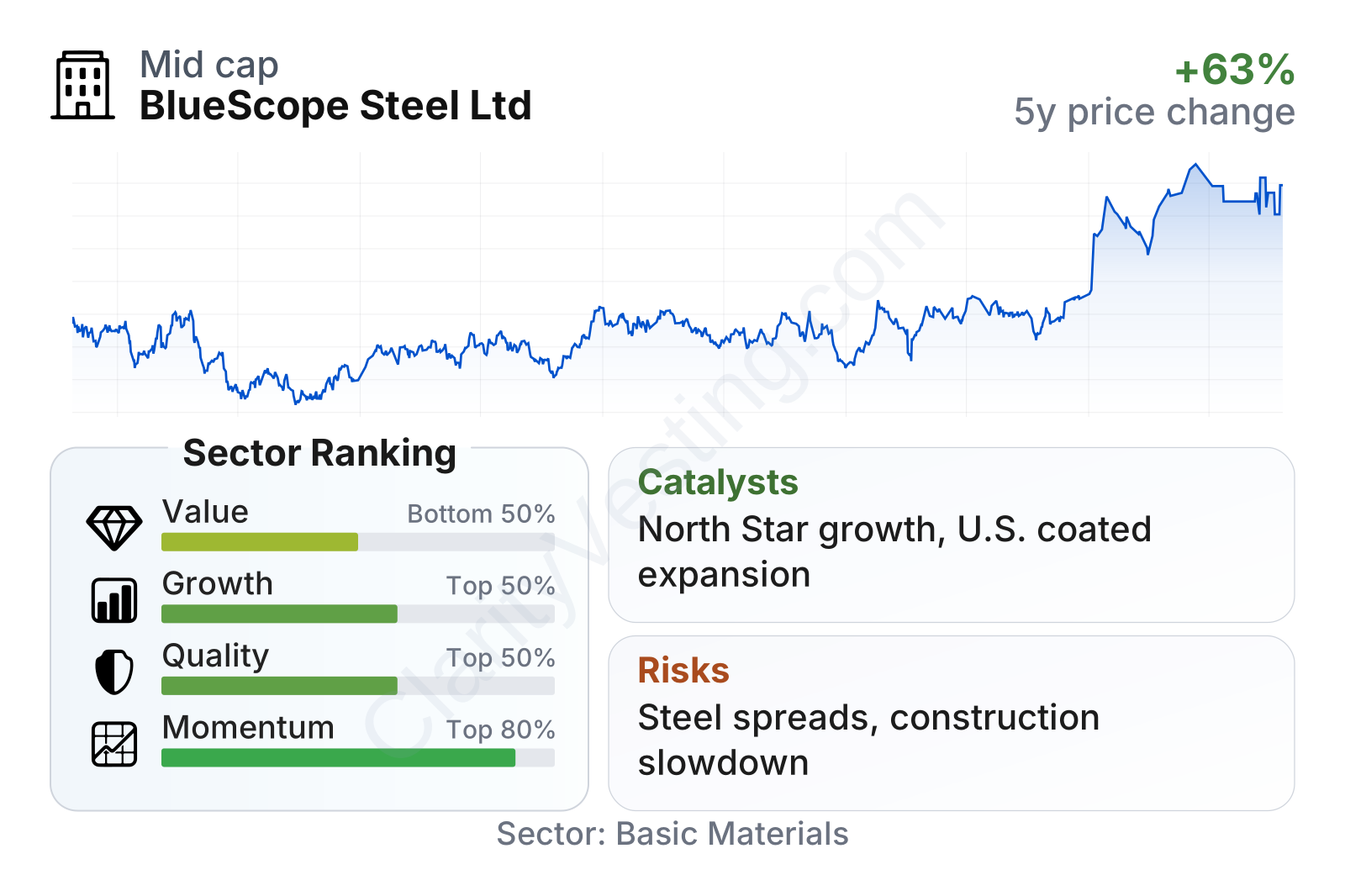
BlueScope is a large steel company by industry standards, with a market value around the mid-single-digit billions in U.S. dollars and a share price history that has been volatile but strong over the last three years. The stock’s beta above 1 indicates that market moves can be amplified, which fits the cyclical nature of steel. On valuation, the earnings multiple sits a little below the sector median, while the price-to-book ratio is clearly lower than the sector norm. Income generation remains notable, with a trailing dividend yield around 4%, roughly double the sector median.
On operating quality, the balance sheet stands out more positively than margins do. Debt levels are low relative to equity, assets, EBITDA, and EBIT, while interest coverage is strong. Profitability, however, is more mixed: return on assets is slightly ahead of the sector median, but operating and profit margins are below many peers. Growth indicators also show a split picture. Earnings per share have compounded well over five years, yet revenue per share and free cash flow have been less consistent, reflecting the ups and downs typical of the steel cycle.
Growth
BlueScope operates in a sector that is mature rather than structurally high-growth, but parts of its end markets can still expand for long periods. Steel demand is tied to construction, manufacturing, energy, and infrastructure. In developed markets, growth usually comes less from volume explosions and more from product mix, regional positioning, efficiency, and disciplined capital allocation. That makes BlueScope’s strategy important: the company has been emphasizing higher-value coated and painted products, expanding its U.S. footprint, and investing in lower-cost, more flexible production assets.
A major growth pillar is North America. The company’s exposure to the U.S. market through North Star and downstream coated-products operations gives it access to a region where manufacturing reshoring, infrastructure work, and commercial building investment can support demand over time. North Star is especially important because electric arc furnace steelmaking is typically more flexible and often structurally better positioned than older blast furnace assets. BlueScope has also pointed to further expansion initiatives tied to coated steel and building systems in North America, which could improve mix and reduce reliance on Australia alone.
Another medium-term catalyst is decarbonization. Steel customers are increasingly focused on lower-emission supply chains, and electric arc furnace production generally has an advantage over more carbon-intensive routes. BlueScope is not a pure green-steel company, but its asset mix gives it a more credible pathway than many traditional integrated producers. Over time, that could matter for customer relationships, regulation, and capital spending choices.
Recent top-line growth has been modest rather than exciting. The company’s latest year-over-year revenue change is close to flat, well below the sector median. That does not necessarily mean the business is stagnating; in steel, revenue can be heavily affected by pricing, not only by shipment volume. It does, however, show that current growth is being driven more by cycle normalization and project execution than by broad-based demand acceleration.
Free cash flow remains an important support for the long-term picture. Even with uneven earnings, BlueScope has still been producing meaningful cash generation in recent periods. That gives management room for dividends, buybacks, and capital investment without leaning heavily on debt. For a cyclical manufacturer, that flexibility is a genuine advantage because it allows the company to keep investing when weaker competitors may have to retreat.
Recent company updates have also highlighted ongoing capital projects and portfolio moves centered on North American coated products and steelmaking efficiency. Those initiatives do not transform BlueScope into a fast-growing company overnight, but they do fit a sensible long-term strategy: build where demand is relatively attractive, shift mix toward branded and processed products, and preserve balance sheet strength through the cycle.
Risks
This article is for informational purposes only and does not constitute financial advice. Some content is AI-generated. See Disclaimer


