Stock Analysis · BlueScope Steel Limited (BLSFF)
Overview
BlueScope Steel Limited is an Australia-based steel producer with operations in Australia, North America, New Zealand, and parts of Asia. The company makes flat steel products used in construction, manufacturing, infrastructure, and industrial applications. It also sells coated and painted steel for roofing, walling, sheds, and other building products. For U.S. investors looking at BLSFF, the business is best understood as a diversified steel and coated-products group with a meaningful downstream presence rather than only a commodity steel mill.
Its revenue comes from several operating segments, with the largest contributions typically coming from Australian steelmaking and U.S. steel operations. Based on the company’s latest annual reporting structure, the mix is approximately as follows:
- Australian Steel Products: about 34% of group revenue. This includes slab, hot rolled coil, cold rolled coil, metallic-coated and painted steel products, plus feed for domestic and export customers.
- North Star BlueScope Steel: about 23%. This is the company’s U.S. electric arc furnace steel business in Ohio, producing hot rolled coil, with earnings influenced by steel spreads and shipment volumes.
- Building Products Asia & North America: about 19%. This includes engineered building solutions, coated steel, insulated panels, and pre-engineered metal buildings sold into construction markets.
- New Zealand & Pacific Steel: about 11%. This covers steel products serving New Zealand and nearby Pacific markets.
- Coated Products Asia: about 8%. This segment focuses on metallic-coated and painted steel products in Asian markets.
- Other activities: about 5%. This generally includes unallocated items and smaller operations.
That mix matters because BlueScope is not relying on one single geography or product line. It combines upstream steelmaking with higher-value downstream products, which can soften the impact of weak pricing in one area when another market is stronger.
The business has also shown how cyclical steel can be. Revenue has generally stayed in a large range over the last several years, but earnings have swung much more sharply. The broad pattern is clear: sales remained substantial, while profits moved from exceptional levels in 2022 to much thinner levels afterward, then partly recovered in the latest year. That reflects changing steel spreads, input costs, and demand conditions rather than a simple volume collapse.
Key Figures
| Metric | Value | Sector ⓘ |
|---|---|---|
| Date | Oct 03, 2026 | |
| Context | ||
| Sector | Basic Materials | |
| Industry | Steel | |
| Market Cap ⓘ | $9.92B | |
| Beta ⓘ | 1.22 | |
Value (Cheapness) | ||
| P/E Ratio ⓘ | 17.83 | 17.61 |
| P/B Ratio ⓘ | 1.03 | 1.77 |
| FCF Yield ⓘ | 4.58% | 5.87% |
| Dividend Yield ⓘ | 5.74% | 2.06% |
| EBIT / EV ⓘ | N/A | 6.43% |
| PEG ⓘ | N/A | |
Growth (Business expansion) | ||
| Revenue Growth ⓘ | 0.60% | 11.30% |
| RPS Growth (5Y CAGR) ⓘ | -0.42% | 4.46% |
| EPS Growth (5Y CAGR) ⓘ | 12.06% | -13.11% |
| BVPS Growth (5Y CAGR) ⓘ | 2.73% | 5.51% |
| Margin Growth (5Y Trend) ⓘ | -14.16% | -1.57% |
| FCF Growth (5Y CAGR) ⓘ | N/A | 0.55% |
| DPS Growth (5Y CAGR) ⓘ | 23.39% | 6.02% |
Quality (Business durability) | ||
| ROIC (Latest) ⓘ | N/A | 9.31% |
| ROA (Latest) ⓘ | 5.46% | 4.94% |
| ROIC (5Y Median) ⓘ | 8.32% | 7.91% |
| ROA (5Y Median) ⓘ | 5.10% | 3.93% |
| Net Debt / EBIT (Latest) ⓘ | 0.46 | 1.40 |
| Net Debt / EBIT (5Y Median) ⓘ | 0.00 | 1.70 |
| Net Debt / EBITDA (Latest) ⓘ | 0.22 | 0.91 |
| Net Debt / Assets ⓘ | 3.66% | 13.69% |
| EBITDA / Interest ⓘ | 20.49 | 11.93 |
| Operating Margin (Latest) ⓘ | 3.94% | 13.07% |
| Operating Margin (5Y Median) ⓘ | 7.44% | 11.86% |
| Debt to Equity (Latest) ⓘ | 17.14% | 40.43% |
| Profit Margin (Latest) ⓘ | 4.81% | 6.57% |
| Free Cash Flow (Latest) ⓘ | $454.70M | |
Momentum (Price trend) | ||
| 3Y Return ⓘ | +108.09% | +65.06% |
| 12M Return (excl. last month) ⓘ | +53.78% | +36.05% |
| 6M Return ⓘ | +37.36% | +1.89% |
| Price vs. 200-Day MA ⓘ | +65.85% | +1.03% |
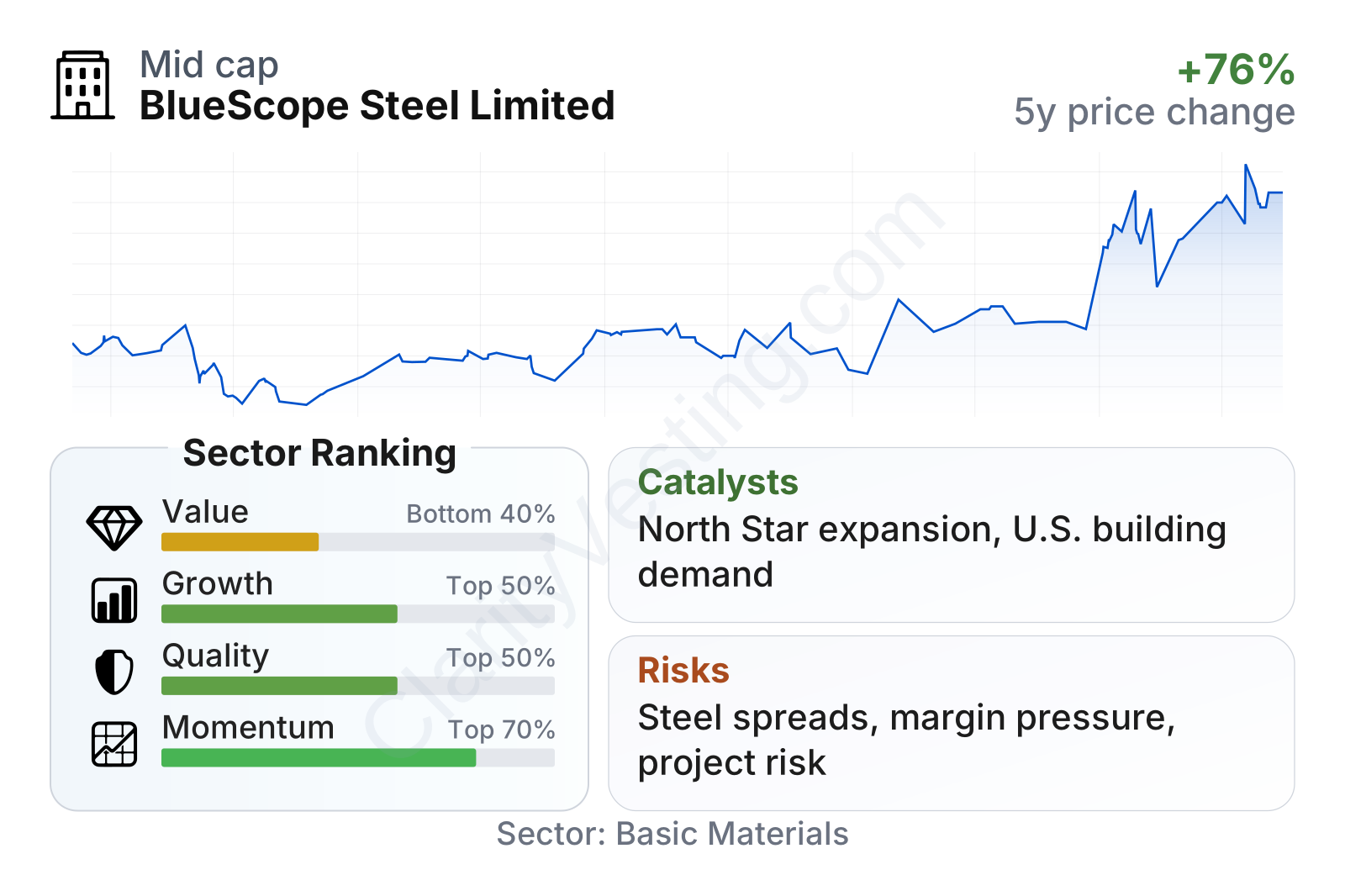
BlueScope is a large steel company by market value, but not one of the global giants. The share price has been strong over the last one, three, and six-month periods, clearly outperforming the sector median over those windows. On valuation, the picture is mixed: the earnings multiple is close to the sector median, price-to-book is lower than the sector median, free cash flow yield is somewhat lighter than average, and the dividend yield is notably higher. Financial quality stands out more than headline growth. Balance-sheet leverage is low, interest coverage is strong, and returns on assets are slightly above sector norms, although operating margins remain below the industry median.
Growth
Steel is not a high-growth industry in the way software or semiconductors can be, but it remains deeply tied to long-duration demand drivers such as construction, infrastructure, logistics facilities, manufacturing, and energy investment. BlueScope’s niche is more attractive than undifferentiated bulk steel because a sizable part of the portfolio is linked to coated, painted, engineered, and building-system products, where customer relationships and product specifications matter more.
The company’s strategy for future growth is centered on three practical levers: increasing value-added downstream exposure, strengthening its U.S. platform, and investing in lower-emissions steelmaking over time. The U.S. market is especially important. BlueScope has continued to emphasize North Star and North American building products, where demand can benefit from industrial reshoring, warehouse construction, and manufacturing investment. In relative terms, this gives the group exposure to a market that has often had better industry structure than many export-heavy steel regions.
Recent growth metrics show a business that has not expanded smoothly at the top line. Year-over-year revenue growth is close to flat, and five-year revenue-per-share growth has been slightly negative. Even so, five-year earnings-per-share growth remains solidly positive, which suggests management has created value through cycle management, product mix, and capital discipline rather than pure sales expansion. Dividend growth over five years has also been strong, pointing to a period of robust cash generation even if recent margins have normalized.
A major catalyst is the company’s planned expansion of the North Star mill in the United States. That project is intended to lift production capacity and deepen BlueScope’s exposure to a strategically important market. Another important theme is decarbonization. Steel customers, regulators, and investors are paying closer attention to emissions intensity, and BlueScope has outlined investments and planning around lower-carbon steelmaking. That does not create immediate earnings by itself, but it can matter for customer access and long-term competitiveness.
Recent company updates have also highlighted ongoing capital spending across growth and resilience projects. For a cyclical company, this is meaningful: management is trying to use a relatively strong balance sheet to invest through the cycle instead of simply reacting to spot conditions.
Risks
This article is for informational purposes only and does not constitute financial advice. Some content is AI-generated. See Disclaimer