Stock Analysis · Builders FirstSource Inc (BLDR)
Overview
Builders FirstSource is a large U.S. supplier of building materials, manufactured components, and construction services used mainly in residential construction. The company sells to professional homebuilders, contractors, remodelers, and, to a lesser extent, individual consumers. Its network includes distribution yards, manufacturing facilities, component plants, millwork shops, and value-added installation and digital service capabilities. In simple terms, it helps builders source many of the products needed to construct a home, from framing lumber and windows to roof trusses and prefabricated wall panels.
The business is broad, but revenue is still closely tied to U.S. housing activity. Based on the company’s recent annual disclosures, sales are mainly generated from building materials and manufactured products sold into single-family construction, repair and remodeling, and some multi-family activity. Builders FirstSource does not report a highly granular public revenue split across every product line, but its main revenue sources can be summarized as follows:
- Lumber, lumber sheet goods, and other building products: roughly 40% to 50% of sales. This includes framing lumber, plywood, oriented strand board, siding, insulation, roofing, and other core structural materials.
- Manufactured products: roughly 20% to 30% of sales. This category includes roof and floor trusses, wall panels, engineered wood products, and other factory-assembled structural components.
- Windows, doors, and millwork: roughly 15% to 25% of sales. These are finished or semi-finished housing products used later in the construction cycle.
- Value-added services and installation, including digital and design-related services: a smaller share, likely in the single-digit to low-teens percentage range depending on classification. This includes installation, drafting, estimating, and software-enabled workflow tools.
The key point for long-term readers is that Builders FirstSource is not just a commodity distributor. It combines distribution scale with manufacturing and service offerings that can make customer relationships deeper and potentially more efficient than a simple materials reseller.
Over the last several years, the business has remained strongly cash generative, but profitability has normalized from the exceptional housing and pricing environment seen in 2021 and 2022. Revenue and earnings have stepped down from those peak levels, while operating costs and interest expense have taken a bigger share of the business than they did during the boom period.
Key Figures
| Metric | Value | Sector ⓘ |
|---|---|---|
| Date | Oct 24, 2026 | |
| Context | ||
| Sector | Industrials | |
| Industry | Building Products & Equipment | |
| Market Cap ⓘ | $5.80B | |
| Beta ⓘ | 1.45 | |
Value (Cheapness) | ||
| P/E Ratio ⓘ | 58.61 | 22.29 |
| P/B Ratio ⓘ | 1.45 | 1.98 |
| FCF Yield ⓘ | 11.02% | 6.26% |
| Dividend Yield ⓘ | N/A | 1.92% |
| EBIT / EV ⓘ | 3.78% | 4.83% |
| PEG ⓘ | 2.02 | |
Growth (Business expansion) | ||
| Revenue Growth ⓘ | -8.80% | 9.30% |
| RPS Growth (5Y CAGR) ⓘ | 8.57% | 7.76% |
| EPS Growth (5Y CAGR) ⓘ | -49.45% | -13.17% |
| BVPS Growth (5Y CAGR) ⓘ | 13.32% | 6.13% |
| Margin Growth (5Y Trend) ⓘ | -6.79% | 0.74% |
| FCF Growth (5Y CAGR) ⓘ | -13.38% | 10.79% |
| DPS Growth (5Y CAGR) ⓘ | 145.32% | 9.41% |
Quality (Business durability) | ||
| ROIC (Latest) ⓘ | 2.61% | 10.75% |
| ROA (Latest) ⓘ | 0.90% | 5.41% |
| ROIC (5Y Median) ⓘ | 21.31% | 9.37% |
| ROA (5Y Median) ⓘ | 14.61% | 4.95% |
| Net Debt / EBIT (Latest) ⓘ | 11.87 | 2.04 |
| Net Debt / EBIT (5Y Median) ⓘ | 1.68 | 2.27 |
| Net Debt / EBITDA (Latest) ⓘ | 5.01 | 1.39 |
| Net Debt / Assets ⓘ | 45.68% | 19.27% |
| EBITDA / Interest ⓘ | 3.59 | 9.58 |
| Operating Margin (Latest) ⓘ | 3.01% | 10.49% |
| Operating Margin (5Y Median) ⓘ | 11.97% | 10.30% |
| Debt to Equity (Latest) ⓘ | 130.79% | 64.82% |
| Profit Margin (Latest) ⓘ | 0.71% | 6.67% |
| Free Cash Flow (Latest) ⓘ | $639.32M | |
Momentum (Price trend) | ||
| 3Y Return ⓘ | -51.03% | +67.77% |
| 12M Return (excl. last month) ⓘ | -52.86% | +12.05% |
| 6M Return ⓘ | -40.39% | 0.00% |
| Price vs. 200-Day MA ⓘ | -34.97% | +0.67% |
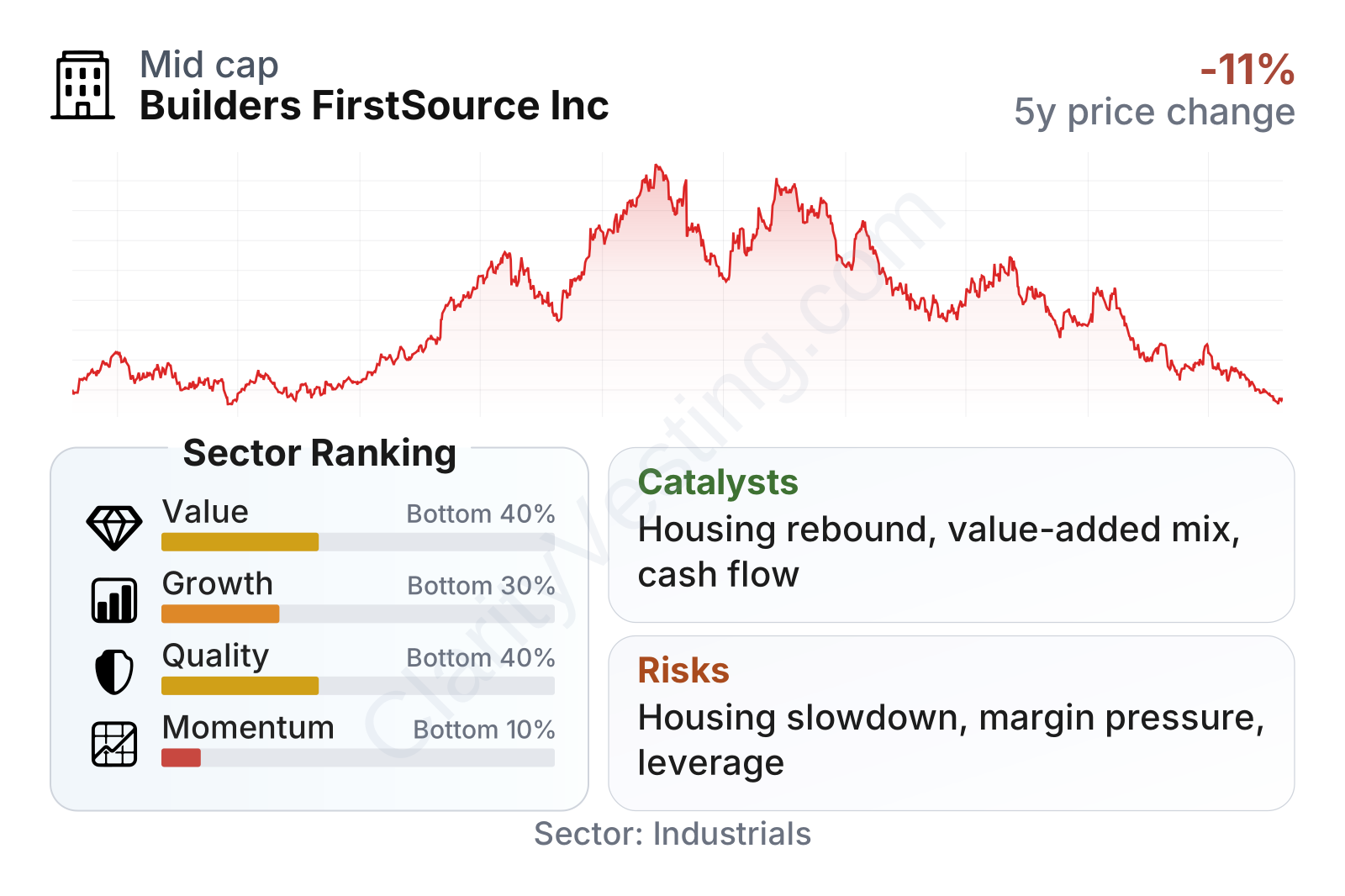
Builders FirstSource is a mid-to-large-sized company in its sector, but the market’s recent view has weakened sharply. Share price momentum sits near the bottom of the sector, reflecting a difficult period for earnings expectations and housing-sensitive stocks. The table also shows a mixed profile: free cash flow yield looks comparatively strong, but growth, current profitability, and balance-sheet leverage are weaker than many sector peers. That combination often signals a business that looks inexpensive on cash generation in isolation, yet harder to judge when earnings are under pressure.
Growth
Builders FirstSource operates in a sector with real long-term demand drivers, even though the path is rarely smooth. U.S. housing still benefits from structural needs such as population growth, aging housing stock, and a shortage of homes in many markets. Repair and remodeling also adds support because existing homes continue to require upgrades and maintenance regardless of the new-home cycle. That gives the company exposure to a market with long-duration relevance, even if annual results can move up and down meaningfully.
The company’s strategy is logical for that environment. Rather than relying only on commodity product resale, it has spent years building a more integrated model around manufactured components, millwork, installation, and digital tools. This matters because factory-built components can improve job-site efficiency for builders, reduce labor friction, and strengthen customer stickiness. If construction labor remains constrained over time, these value-added offerings could become more important than pure material supply.
Near-term growth, however, has clearly been under pressure. Revenue growth turned negative after the unusually strong housing and pricing cycle faded, and recent year-over-year comparisons remain below sector norms. Some of that reflects normalization in lumber pricing and softer housing affordability conditions rather than a broken business model. Even so, the slowdown shows how exposed results remain to residential construction volumes and product price swings.
Cash generation is an important offset. Free cash flow has come down significantly from earlier highs, but it remains positive and meaningful in absolute terms. That gives the company room to keep investing in operations, pursue selective acquisitions, and continue capital returns when conditions allow. One of the clearer long-term catalysts is that a recovery in single-family construction can have an amplified effect on a business with large existing infrastructure and manufacturing capacity already in place.
Recent company communications have also highlighted continued expansion of value-added products and digital capabilities. Those initiatives are important because they can support share gains even in a slower housing market. If Builders FirstSource can keep increasing the mix of manufactured and service-based offerings, future growth could become somewhat less dependent on raw commodity price inflation than in the past.
Risks
This article is for informational purposes only and does not constitute financial advice. Some content is AI-generated. See Disclaimer


