Stock Analysis · Bausch + Lomb Corp (BLCO)
Overview
Bausch + Lomb is a global eye health company focused on products used by consumers, eye care professionals, and surgeons. Its business covers a wide range of needs: contact lenses, lens care solutions, dry eye and allergy treatments, prescription eye medicines, and surgical products used in cataract and retina procedures. That broad positioning makes the company more diversified than a single-product medical device business, but it also means results depend on execution across consumer products, pharmaceuticals, and surgery.
Based on the company’s latest annual reporting structure, revenue is mainly generated from three segments.
- Vision Care — about 47% of revenue: contact lenses, contact lens solutions, eye drops, and over-the-counter eye health products sold through retail, e-commerce, and eye care channels.
- Surgical — about 30% of revenue: intraocular lenses, equipment, and consumables used mainly in cataract surgery and other ophthalmic procedures.
- Pharmaceuticals — about 23% of revenue: prescription therapies for eye conditions such as dry eye, glaucoma, ocular inflammation, and allergy-related issues.
This mix matters for long-term analysis. Vision Care can provide recurring demand, Surgical is linked to procedure volumes and installed equipment relationships, and Pharmaceuticals can add higher-margin growth when launches and prescriptions go well. Over the last several years, revenue has expanded from roughly $3.8 billion to above $5.0 billion, but the path to profit has been much less smooth. Sales growth has been real, yet operating costs, integration pressure, and especially interest expense have limited earnings conversion.
The business flow also shows that gross profit has grown meaningfully, but selling, general, and administrative expenses have risen sharply as well, while interest costs have become a heavier burden. In simple terms, Bausch + Lomb has been able to sell more, but it has not yet translated that scale into consistent bottom-line profitability.
Key Figures
| Metric | Value | Sector ⓘ |
|---|---|---|
| Date | Oct 24, 2026 | |
| Context | ||
| Sector | Healthcare | |
| Industry | Medical Instruments & Supplies | |
| Market Cap ⓘ | $6.14B | |
| Beta ⓘ | 0.56 | |
Value (Cheapness) | ||
| P/E Ratio ⓘ | N/A | 25.42 |
| P/B Ratio ⓘ | 0.99 | 3.08 |
| FCF Yield ⓘ | 2.29% | 3.12% |
| Dividend Yield ⓘ | N/A | 1.85% |
| EBIT / EV ⓘ | 3.04% | 0.56% |
| PEG ⓘ | 0.89 | |
Growth (Business expansion) | ||
| Revenue Growth ⓘ | 9.10% | 7.50% |
| RPS Growth (5Y CAGR) ⓘ | 7.60% | 8.60% |
| EPS Growth (5Y CAGR) ⓘ | -31.30% | -17.73% |
| BVPS Growth (5Y CAGR) ⓘ | -9.32% | 3.72% |
| Margin Growth (5Y Trend) ⓘ | -6.21% | -0.57% |
| FCF Growth (5Y CAGR) ⓘ | N/A | 0.96% |
| DPS Growth (5Y CAGR) ⓘ | N/A | 6.69% |
Quality (Business durability) | ||
| ROIC (Latest) ⓘ | -2.91% | 3.17% |
| ROA (Latest) ⓘ | -1.24% | 2.98% |
| ROIC (5Y Median) ⓘ | 0.83% | 4.56% |
| ROA (5Y Median) ⓘ | -2.12% | 1.87% |
| Net Debt / EBIT (Latest) ⓘ | 14.34 | 1.34 |
| Net Debt / EBIT (5Y Median) ⓘ | 28.07 | 1.86 |
| Net Debt / EBITDA (Latest) ⓘ | 6.40 | 1.00 |
| Net Debt / Assets ⓘ | 34.26% | 5.06% |
| EBITDA / Interest ⓘ | 1.87 | 9.55 |
| Operating Margin (Latest) ⓘ | 6.22% | 9.25% |
| Operating Margin (5Y Median) ⓘ | 3.44% | 7.33% |
| Debt to Equity (Latest) ⓘ | 80.22% | 26.68% |
| Profit Margin (Latest) ⓘ | -3.21% | 3.34% |
| Free Cash Flow (Latest) ⓘ | $140.33M | |
Momentum (Price trend) | ||
| 3Y Return ⓘ | +6.61% | +51.61% |
| 12M Return (excl. last month) ⓘ | +13.57% | +19.90% |
| 6M Return ⓘ | +8.60% | +10.10% |
| Price vs. 200-Day MA ⓘ | +4.83% | +6.44% |
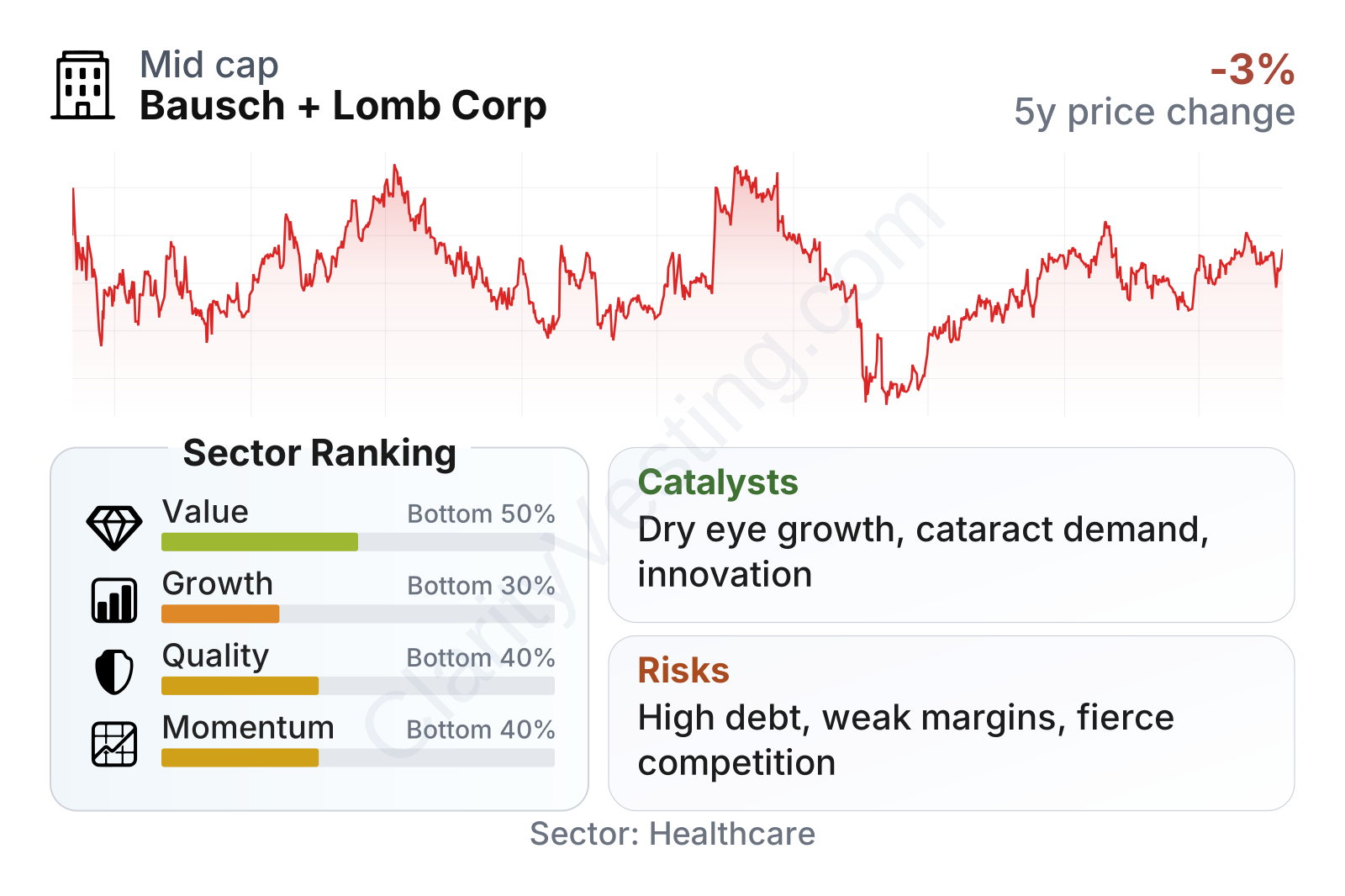
Bausch + Lomb is a mid-sized healthcare company with a relatively low beta, meaning its stock has historically moved less violently than the broader market. The factor profile is mixed. On valuation, the company screens better than many healthcare peers, helped by a price-to-book ratio below sector norms and an enterprise-value-based earnings measure above the sector median. However, growth, quality, and momentum are weaker relative to peers. Revenue growth has recently been solid, but returns on capital remain negative, leverage is high, and share-price performance has lagged the sector over multi-year periods.
Growth
Eye health is structurally attractive for long-term growth. Demand is supported by aging populations, rising prevalence of myopia, more screen-related eye strain, greater awareness of dry eye disease, and steady global demand for cataract surgery. These are not short-lived themes. They create a broad and durable backdrop for companies with strong ophthalmology portfolios.
Bausch + Lomb’s strategy is sensible on paper because it spans the full eye care ecosystem rather than relying on one niche. A company with contact lenses, consumer eye care brands, prescription products, and surgical tools can cross-sell through doctor relationships and participate in multiple sources of demand. That can be especially helpful in eye care, where physicians, clinics, and patients often interact across several product categories.
Recent revenue growth has generally remained positive, with 2024 showing a particularly strong stretch and 2025-2026 settling into high-single-digit to low-double-digit growth. That is a constructive signal: the company is still expanding even after the earlier boost from acquisitions and portfolio changes has started to normalize. Recent annual growth around 9% is also modestly ahead of the sector median, which suggests that Bausch + Lomb still has commercial momentum despite profitability issues.
The weaker part of the growth picture is cash conversion. Free cash flow has been inconsistent, moving from positive territory into negative levels and then only narrowly back above break-even on a trailing basis by early 2026. For a company trying to improve financial flexibility, that matters. Growth is more compelling when revenue gains are paired with durable cash generation; here, that second piece still looks unfinished.
A major long-term catalyst is the company’s exposure to premium and specialty eye care categories, including newer contact lens offerings, dry eye treatments, and surgical technology upgrades. Another important opportunity is the continued increase in cataract procedures as populations age. If Bausch + Lomb can improve execution in its surgical and pharmaceutical lines while maintaining growth in Vision Care, the company has a credible path to better scale economics. Recent company communications have also emphasized portfolio innovation and commercial expansion, which supports the idea that management is still pursuing organic growth rather than relying only on financial engineering.
Risks
This article is for informational purposes only and does not constitute financial advice. Some content is AI-generated. See Disclaimer


