Stock Analysis · Blue Bird Corp (BLBD)
Overview
Blue Bird Corp designs and manufactures school buses and related transportation solutions. The company is best known for its Type C and Type D school buses used by school districts, contractors, and government customers across the United States and Canada. In recent years, Blue Bird has also pushed into alternative-power vehicles, especially propane, compressed natural gas, and electric school buses, while continuing to serve the large traditional diesel market.
Its business is still centered on bus manufacturing, but revenue comes from a few distinct streams. Based on recent company filings and disclosures, the revenue mix can be summarized approximately as follows.
- Bus sales: about 90% to 94% of revenue. This is the core activity and includes complete school buses sold through a dealer network and directly to fleet operators.
- Parts sales: about 5% to 8% of revenue. This includes replacement parts and aftermarket support, an important source of recurring business once vehicles are in service.
- Extended warranties and other: about 1% to 3% of revenue. This includes warranty-related programs and smaller ancillary items.
Geographically, Blue Bird is overwhelmingly tied to North America, with the United States representing the clear majority of sales. The company’s business model is relatively easy to understand: build school buses, supply replacement parts, and increasingly offer cleaner-fuel and electric models that can help customers lower emissions and fuel costs.
The recent financial progression has been notable. Revenue has climbed strongly since fiscal 2022, while profitability improved even faster. Gross profit, operating income, and net income all expanded materially as pricing, production efficiency, and product mix moved in a more favorable direction. Interest expense also declined over that period, showing a much healthier balance sheet than the company had a few years ago.
The broad pattern shows a company that has moved from very thin economics and losses to meaningfully stronger earnings power. Revenue growth has helped, but the bigger change has been margin improvement and lower financing pressure.
Key Figures
| Metric | Value | Sector ⓘ |
|---|---|---|
| Date | Oct 17, 2026 | |
| Context | ||
| Sector | Industrials | |
| Industry | Farm & Heavy Construction Machinery | |
| Market Cap ⓘ | $1.92B | |
| Beta ⓘ | 1.36 | |
Value (Cheapness) | ||
| P/E Ratio ⓘ | 6.68 | 22.10 |
| P/B Ratio ⓘ | 3.05 | 1.97 |
| FCF Yield ⓘ | 7.97% | 6.38% |
| Dividend Yield ⓘ | N/A | 1.94% |
| EBIT / EV ⓘ | 3.22% | 4.79% |
| PEG ⓘ | 1.13 | |
Growth (Business expansion) | ||
| Revenue Growth ⓘ | 29.90% | 9.30% |
| RPS Growth (5Y CAGR) ⓘ | 15.60% | 7.81% |
| EPS Growth (5Y CAGR) ⓘ | N/A | -13.06% |
| BVPS Growth (5Y CAGR) ⓘ | N/A | 6.14% |
| Margin Growth (5Y Trend) ⓘ | 10.82% | 0.88% |
| FCF Growth (5Y CAGR) ⓘ | N/A | 11.01% |
| DPS Growth (5Y CAGR) ⓘ | -23.37% | 9.48% |
Quality (Business durability) | ||
| ROIC (Latest) ⓘ | 6.69% | 10.84% |
| ROA (Latest) ⓘ | 31.46% | 5.41% |
| ROIC (5Y Median) ⓘ | 18.63% | 9.38% |
| ROA (5Y Median) ⓘ | 6.08% | 4.95% |
| Net Debt / EBIT (Latest) ⓘ | -0.02 | 2.08 |
| Net Debt / EBIT (5Y Median) ⓘ | 0.49 | 2.27 |
| Net Debt / EBITDA (Latest) ⓘ | -0.01 | 1.39 |
| Net Debt / Assets ⓘ | -0.09% | 19.28% |
| EBITDA / Interest ⓘ | 11.74 | 9.58 |
| Operating Margin (Latest) ⓘ | 3.67% | 10.50% |
| Operating Margin (5Y Median) ⓘ | 3.87% | 10.29% |
| Debt to Equity (Latest) ⓘ | 17.67% | 65.48% |
| Profit Margin (Latest) ⓘ | 17.48% | 6.67% |
| Free Cash Flow (Latest) ⓘ | $153.14M | |
Momentum (Price trend) | ||
| 3Y Return ⓘ | +215.86% | +61.68% |
| 12M Return (excl. last month) ⓘ | +7.68% | +12.58% |
| 6M Return ⓘ | -12.56% | 0.00% |
| Price vs. 200-Day MA ⓘ | -9.39% | +0.02% |
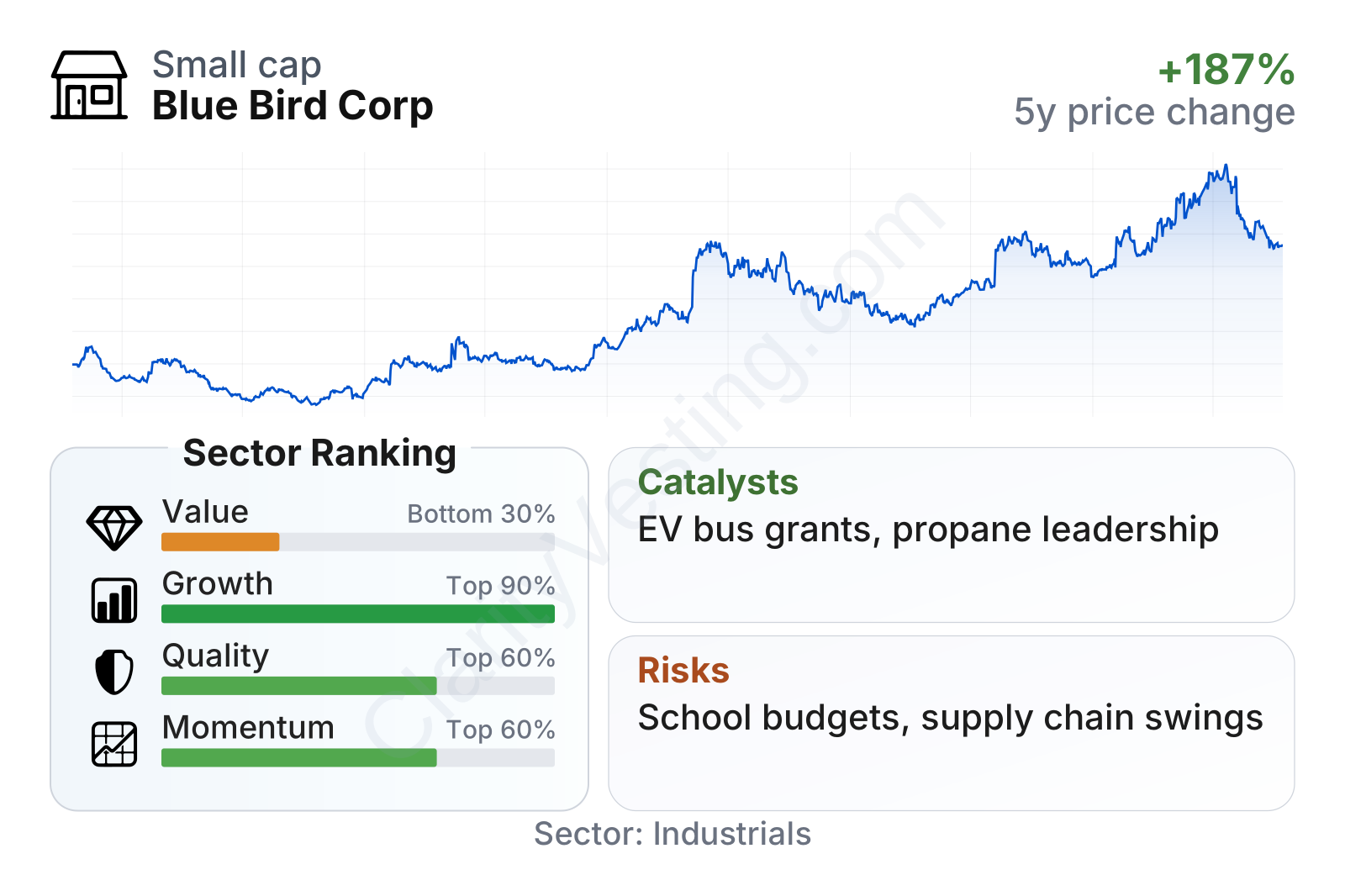
Blue Bird is now a mid-sized industrial company with a share price history that has been volatile but exceptionally strong over the last three years. In the latest factor snapshot, growth ranks near the top of its sector, quality is above average, and momentum is still positive over the longer run even though the shorter-term trading pattern has been less consistent. Value looks mixed: the earnings multiple is low versus the sector, but that discount sits alongside a higher price-to-book ratio and a business that still operates with lower operating margins than many industrial peers.
Growth
Blue Bird operates in a niche that has attractive long-term support. School buses are not a discretionary product in the same way as many other vehicles. The installed fleet ages over time, safety standards keep evolving, and replacement demand remains necessary even when local budgets are tight. On top of that, the industry is benefiting from a second layer of demand tied to lower-emission vehicles, especially propane and electric buses.
That positioning makes the company’s strategy logical. Blue Bird has already built a meaningful presence in alternative-fuel school buses, particularly propane, where it has often highlighted leadership. This matters because schools and contractors are looking for practical ways to reduce operating costs and emissions without taking on the complexity of completely redesigning transportation fleets. Propane buses are generally easier to adopt than fully electric buses, while electric models can benefit from state and federal incentive programs.
Revenue growth has not been perfectly smooth quarter to quarter, but the bigger picture remains favorable. After a powerful rebound from the weak 2022 base, growth moderated, then reaccelerated recently, with the latest year-over-year pace well above the broader sector median. Over a five-year view, revenue per share has also grown at roughly double the sector median, which supports the view that this is more than a short one-quarter spike.
Cash generation also strengthened substantially. Blue Bird moved from negative free cash flow a few years ago to solid positive levels, and the recent trailing twelve-month figure is strong for a company of this size. That gives management more flexibility to invest in production, product development, and balance-sheet improvement without relying heavily on external financing.
A meaningful catalyst remains the continued electrification and decarbonization of school transportation. Blue Bird has cited demand supported by grant programs and public funding initiatives aimed at replacing older diesel buses. Another useful tailwind is the age of the North American school bus fleet, which supports replacement demand regardless of whether customers choose diesel, propane, gas, or electric. In addition, if supply chains remain stable, the company has room to benefit from better factory utilization and a more favorable pricing mix than in the past.
Recent company updates have also pointed to continuing order activity, expanding production capability, and confidence in the alternative-power lineup. For a manufacturer in a specialized category, this combination of replacement demand plus cleaner-energy adoption is a meaningful opportunity.
Risks
This article is for informational purposes only and does not constitute financial advice. Some content is AI-generated. See Disclaimer


