Stock Analysis · Santander Bank Polska S.A (BKZHY)
Overview
Santander Bank Polska S.A. is one of the largest banks in Poland. It serves retail customers, small and medium-sized businesses, large corporates, and public-sector clients. Its activities cover everyday banking such as deposits and payments, mortgage and consumer lending, business financing, asset management, leasing, factoring, brokerage, and insurance distribution. It is controlled by Banco Santander, which gives it access to a large international banking group while remaining focused on the Polish market.
For a simple long-term view, this is primarily a domestic Polish banking franchise. That means its results are driven mostly by interest earned on loans and securities, fees collected from customer activity, loan quality, operating discipline, and the broader health of the Polish economy.
The bank’s revenue mix is usually centered on classic banking income streams. Based on recent annual disclosures and the structure typical of the group’s reporting, the main sources of revenue can be summarized as follows:
- Net interest income: approximately 70% to 80% — the spread between interest earned on loans and securities and interest paid on deposits and funding.
- Net fee and commission income: approximately 15% to 25% — account fees, card and payment services, asset management, brokerage, lending-related fees, insurance distribution, and transaction services.
- Other income: approximately 5% to 10% — trading income, foreign exchange, hedge accounting effects, gains on financial instruments, and other banking income.
This revenue profile matters because it shows that Santander Bank Polska is not a niche financial company. It is a broad, full-service bank whose earnings depend first on balance-sheet economics and customer activity, not on a single product line.
The recent revenue and profit flow suggests a bank that has materially expanded earnings since 2021. Revenue rose strongly through 2023, remained elevated in 2024 and 2025, and net income continued climbing. Costs have increased much more slowly than revenue, which points to stronger operating leverage over this period.
Key Figures
| Metric | Value | Sector ⓘ |
|---|---|---|
| Date | Nov 21, 2026 | |
| Context | ||
| Sector | Real Estate | |
| Industry | REIT - Residential | |
| Market Cap ⓘ | $20.37B | |
| Beta ⓘ | 1.19 | |
Value (Cheapness) | ||
| P/E Ratio ⓘ | 14.24 | 17.59 |
| P/B Ratio ⓘ | N/A | 1.58 |
| FCF Yield ⓘ | 23.82% | 5.76% |
| Dividend Yield ⓘ | N/A | 4.81% |
| EBIT / EV ⓘ | N/A | 4.97% |
| PEG ⓘ | N/A | |
Growth (Business expansion) | ||
| Revenue Growth ⓘ | 32.90% | 5.70% |
| RPS Growth (5Y CAGR) ⓘ | 15.29% | 5.96% |
| EPS Growth (5Y CAGR) ⓘ | -28.60% | -3.46% |
| BVPS Growth (5Y CAGR) ⓘ | 6.76% | 0.32% |
| Margin Growth (5Y Trend) ⓘ | N/A | -0.65% |
| FCF Growth (5Y CAGR) ⓘ | 1.15% | 5.08% |
| DPS Growth (5Y CAGR) ⓘ | 100.55% | 5.00% |
Quality (Business durability) | ||
| ROIC (Latest) ⓘ | N/A | 5.13% |
| ROE (Latest) ⓘ | 16.20% | 7.64% |
| ROA (Latest) ⓘ | 1.73% | 3.05% |
| ROIC (5Y Median) ⓘ | N/A | 4.20% |
| ROE (5Y Median) ⓘ | 17.25% | 6.03% |
| ROA (5Y Median) ⓘ | 1.79% | 2.41% |
| Net Debt / EBIT (Latest) ⓘ | N/A | 7.59 |
| Net Debt / EBIT (5Y Median) ⓘ | N/A | 8.34 |
| Net Debt / EBITDA (Latest) ⓘ | N/A | 5.43 |
| Net Debt / Assets ⓘ | N/A | 38.21% |
| EBITDA / Interest ⓘ | N/A | 4.20 |
| Operating Margin (Latest) ⓘ | N/A | 34.59% |
| Operating Margin (5Y Median) ⓘ | N/A | 37.64% |
| Debt to Equity (Latest) ⓘ | N/A | 90.32% |
| Profit Margin (Latest) ⓘ | 13.96% | 20.10% |
| Free Cash Flow (Latest) ⓘ | $4.85B | |
Momentum (Price trend) | ||
| 3Y Return ⓘ | +577.03% | +27.88% |
| 12M Return (excl. last month) ⓘ | +57.99% | +1.16% |
| 6M Return ⓘ | +18.29% | -3.06% |
| Price vs. 200-Day MA ⓘ | +17.96% | -0.73% |
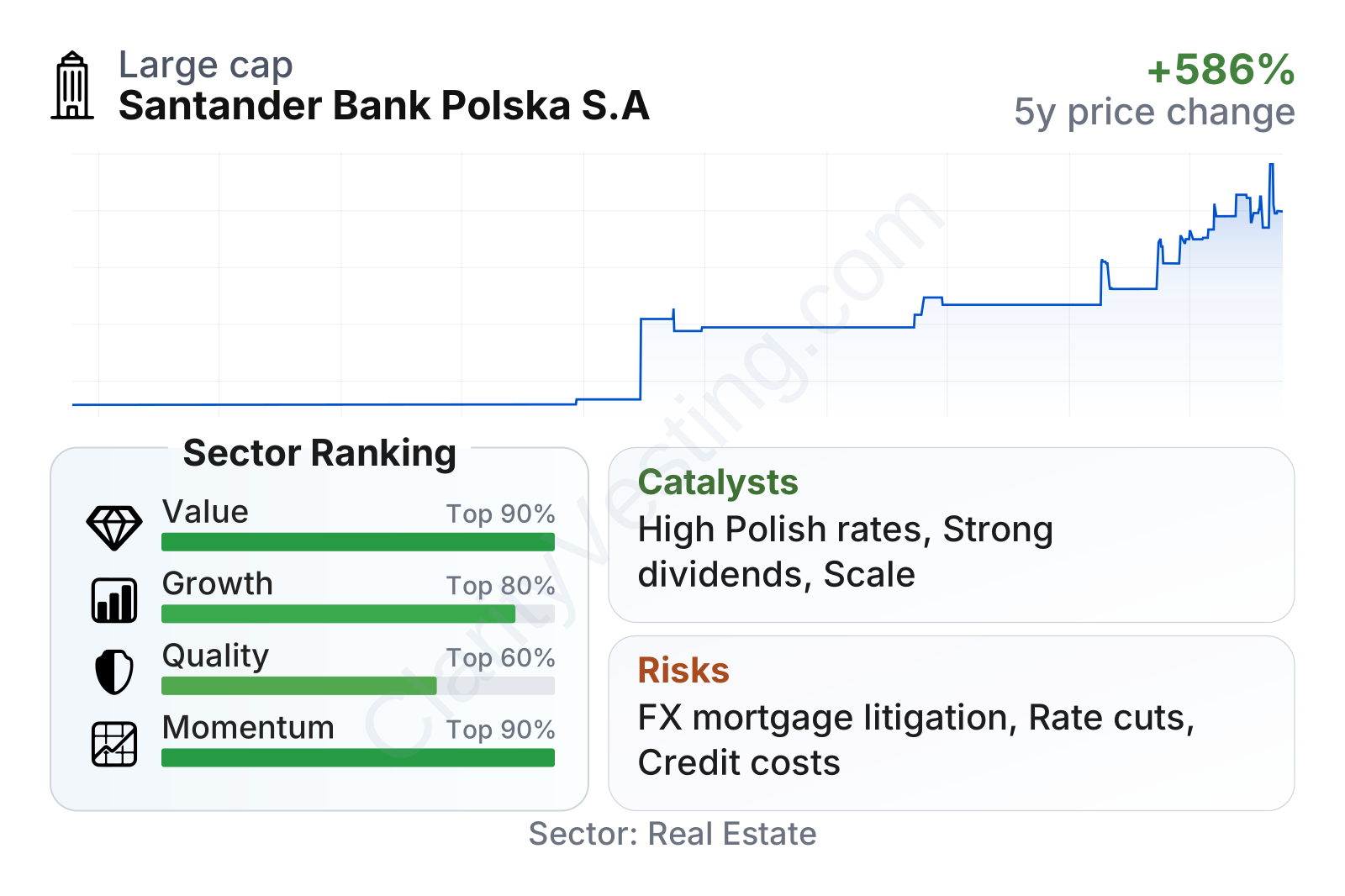
The overall picture is stronger than the sector comparison in several areas, even though the sector label attached to the stock does not reflect its real business as a bank. Valuation looks moderate with a P/E below the displayed sector median, profitability is solid with return on equity around the mid-teens, and recent growth has been strong. Momentum is especially notable, with the share price far above its level of three years ago and still trading well above its long-term average. The weaker point is that earnings growth over five years is distorted by earlier low-profit periods, so recent strength is more informative than the full-period average.
Santander Bank Polska is a large company by market value, but not so large that growth becomes impossible. Its beta slightly above 1 suggests share-price movements can be somewhat more volatile than the broad market.
Growth
The company operates in Polish banking, a sector that still has room for long-term expansion through rising household wealth, mortgage penetration, digital banking adoption, investment products, and increasing use of cashless payments. Poland remains one of Europe’s more dynamic economies over long periods, and that creates a supportive backdrop for retail and commercial banking if credit quality stays under control.
Santander Bank Polska’s strategy is coherent for that environment. It combines a large branch-based and digital retail platform with business banking, consumer finance, leasing, and investment services. That model allows the bank to deepen customer relationships rather than rely only on loan volume growth. For long-term analysis, this is important because cross-selling and transaction-based services can make earnings more resilient than pure lending.
Revenue per share has moved up clearly since 2021, with a strong jump in 2022 and 2023, a small pause in 2024, and stabilization at a high level afterward. That pattern fits a bank that benefited from a favorable rate backdrop and then held on to much of that improvement rather than giving it all back.
The dividend trend is also striking. After modest levels earlier in the period, distributions increased sharply in 2023 and 2024 and remained high in 2025. That does not guarantee the same pace ahead, but it does show that capital generation has recently been strong enough to support materially higher payouts.
One of the clearest catalysts is the bank’s earnings sensitivity to interest rates and deposit pricing. When a bank has a strong deposit base and can reprice assets effectively, higher or still-elevated rates can lift profitability. Another support is operating efficiency: recent figures show that profit has grown faster than administrative costs. In addition, Santander Bank Polska continues to benefit from scale in one of Poland’s biggest banking markets, where digital channels can help lower service costs while expanding product reach.
Recent corporate developments have also kept market attention on capital returns and strong earnings generation. In banking, that combination often matters more than rapid top-line expansion alone, because capital strength and payout capacity can signal durable franchise quality.
Risks
This article is for informational purposes only and does not constitute financial advice. Some content is AI-generated. See Disclaimer


