Stock Analysis · BKV Corporation (BKV)
Overview
BKV Corporation is an energy company focused on natural gas production, natural gas gathering and processing, power generation, and carbon capture and storage. In simple terms, it produces gas from its wells, moves and prepares part of that gas through related infrastructure, uses gas to generate electricity in some cases, and is also trying to build a position in lower-carbon services by capturing and storing carbon dioxide. The company has operated mainly in U.S. shale regions and has emphasized an integrated model rather than being only a traditional upstream producer.
Based on the company’s recent public filings, revenue is still primarily tied to commodity production and related energy sales, although the exact mix can move meaningfully from quarter to quarter as gas prices, output volumes, and power activity change. The broad revenue picture can be summarized as follows:
- Natural gas, natural gas liquids, and oil sales: approximately 70% to 85% of revenue in the recent business mix. This is the core activity and remains the main earnings driver.
- Power and related energy sales: approximately 10% to 25%. This includes electricity generated from gas-fired assets and related commercial activity.
- Gathering, processing, and other services: generally a small share of revenue. This includes midstream-related and miscellaneous business lines.
- Carbon capture and storage-related activity: currently minimal in revenue terms, but strategically important because management presents it as a future growth platform.
BKV’s appeal for long-term analysis comes from that mixed profile. It is not just exposed to commodity extraction; it is also trying to build a more resilient operating model with infrastructure, power exposure, and carbon management capabilities. That said, the company is still heavily dependent on natural gas economics today, so its results can swing sharply with market conditions.
The long-term operating picture has been uneven rather than linear. Revenue and profitability surged in 2022 when energy prices were favorable, weakened materially in 2023 and 2024, and improved again in 2025. That pattern shows both the upside and the cyclicality of the business: BKV can produce strong earnings when prices and volumes line up well, but the income statement can deteriorate quickly when the commodity backdrop turns less supportive.
Key Figures
| Metric | Value | Sector ⓘ |
|---|---|---|
| Date | Oct 17, 2026 | |
| Context | ||
| Sector | Energy | |
| Industry | Oil & Gas E&P | |
| Market Cap ⓘ | $2.67B | |
| Beta ⓘ | 1.12 | |
Value (Cheapness) | ||
| P/E Ratio ⓘ | 8.61 | 15.44 |
| P/B Ratio ⓘ | 1.16 | 1.73 |
| FCF Yield ⓘ | -6.66% | 8.20% |
| Dividend Yield ⓘ | N/A | 3.59% |
| EBIT / EV ⓘ | 11.54% | 7.46% |
| PEG ⓘ | N/A | |
Growth (Business expansion) | ||
| Revenue Growth ⓘ | 18.80% | 26.90% |
| RPS Growth (5Y CAGR) ⓘ | -2.22% | 6.90% |
| EPS Growth (5Y CAGR) ⓘ | N/A | -15.73% |
| BVPS Growth (5Y CAGR) ⓘ | 26.00% | 6.07% |
| Margin Growth (5Y Trend) ⓘ | 47.69% | 0.58% |
| FCF Growth (5Y CAGR) ⓘ | N/A | 1.86% |
| DPS Growth (5Y CAGR) ⓘ | N/A | 16.79% |
Quality (Business durability) | ||
| ROIC (Latest) ⓘ | 11.43% | 11.40% |
| ROA (Latest) ⓘ | 7.50% | 6.06% |
| ROIC (5Y Median) ⓘ | N/A | 10.30% |
| ROA (5Y Median) ⓘ | 4.34% | 5.42% |
| Net Debt / EBIT (Latest) ⓘ | 2.61 | 1.64 |
| Net Debt / EBIT (5Y Median) ⓘ | 1.14 | 1.83 |
| Net Debt / EBITDA (Latest) ⓘ | 1.80 | 1.08 |
| Net Debt / Assets ⓘ | 25.92% | 17.29% |
| EBITDA / Interest ⓘ | 8.22 | 9.64 |
| Operating Margin (Latest) ⓘ | 32.75% | 16.27% |
| Operating Margin (5Y Median) ⓘ | 28.25% | 20.39% |
| Debt to Equity (Latest) ⓘ | 54.41% | 54.76% |
| Profit Margin (Latest) ⓘ | 25.46% | 8.82% |
| Free Cash Flow (Latest) ⓘ | -$178.17M | |
Momentum (Price trend) | ||
| 3Y Return ⓘ | N/A | +67.38% |
| 12M Return (excl. last month) ⓘ | +7.78% | +49.19% |
| 6M Return ⓘ | -12.63% | +7.07% |
| Price vs. 200-Day MA ⓘ | -14.05% | +9.56% |
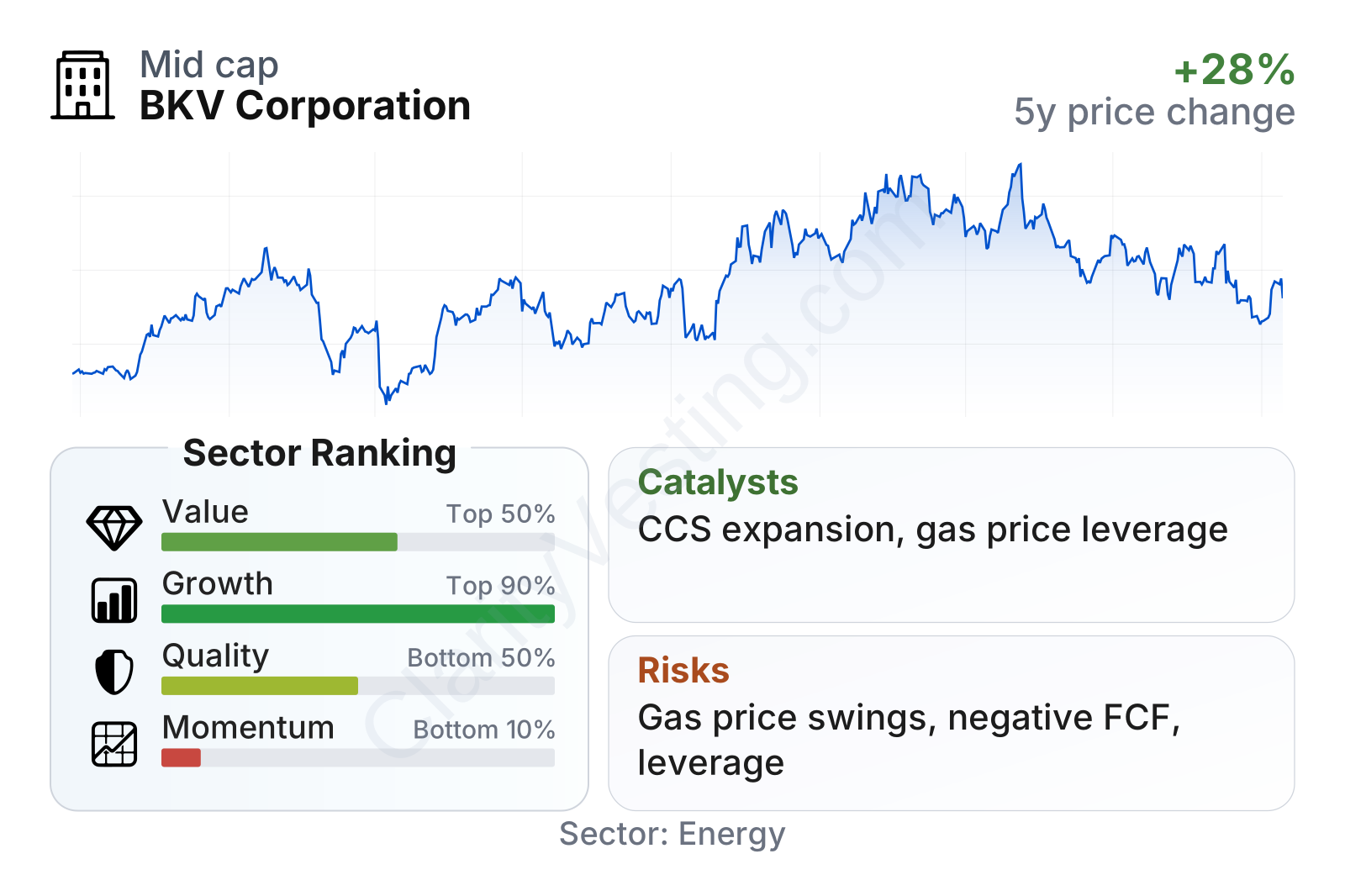
BKV is a mid-sized energy company with stock volatility close to the broader market, which is somewhat unusual for a commodity-linked producer. On valuation, the company screens cheaper than the sector on earnings and book value, while its operating return measures and recent margins look solid. Growth characteristics are mixed: recent revenue expansion has been strong, but the longer multi-year record is less consistent. The weakest area is market momentum, with the shares trailing much of the sector over recent periods even as profitability has improved.
The broader takeaway is that BKV currently looks stronger on current earnings power and asset-based valuation than on cash generation consistency or stock market sentiment. That combination often appears in cyclical companies that have recently improved operationally but have not yet fully convinced the market that the improvement is durable.
Growth
Natural gas remains a relevant growth market in the U.S. energy system because it supports power generation, industrial demand, and grid reliability. It also often serves as a bridge fuel alongside renewable buildout. On top of that, carbon capture has become a meaningful strategic theme because industrial companies and power operators are looking for ways to reduce emissions without fully replacing existing infrastructure. BKV is positioned where those trends overlap: gas production on one side, and carbon management on the other.
The company’s strategy makes industrial sense. By combining upstream production with power and carbon capture initiatives, BKV is trying to create more ways to monetize its gas resource base. If that model scales, it could reduce dependence on a single revenue stream and support better margins than a pure commodity producer might achieve on its own.
Recent top-line momentum has been notable. Year-over-year revenue growth accelerated sharply through the latest reported periods, moving from already strong levels to very high growth by mid-2026. Part of that likely reflects a combination of stronger volumes, a changed business mix, and easier comparisons after a weaker prior period. For long-term readers, the important point is not just that revenue is rising, but that the company has shown it can recover from a down cycle and rebuild scale relatively quickly.
The more cautious part of the growth picture is cash generation. Free cash flow remained negative on a trailing basis, and it worsened over the most recent period shown. That suggests BKV is still in a phase where capital spending, development activity, and strategic buildout are absorbing more cash than the business is currently returning. Negative free cash flow is not automatically a problem if it funds productive expansion, but it does mean future growth needs to translate into sustained cash returns, not just accounting profits.
A major catalyst is the company’s carbon capture platform. If BKV can secure commercial agreements, expand storage capacity, and connect that business to industrial or power customers, it could create a differentiated earnings stream that many traditional exploration and production peers do not have. Another catalyst is simple but powerful: a supportive natural gas price environment can quickly lift earnings for producers with operating leverage.
Recent company communications have also highlighted progress in scaling the business after its public listing period, including continued development of its carbon management operations and power-related strategy. That does not remove execution risk, but it does show management is pursuing a clear growth agenda rather than simply maintaining existing production.
Risks
This article is for informational purposes only and does not constitute financial advice. Some content is AI-generated. See Disclaimer


