Stock Analysis · BankUnited Inc (BKU)
Overview
BankUnited Inc is a regional bank headquartered in Florida. It provides traditional banking services to businesses and households, with a business mix that is more commercial than consumer. The bank gathers deposits, makes loans, earns interest on those loans and securities, and also collects fees from services such as treasury management, card activity, and capital markets-related banking products. Its footprint is centered on Florida and the New York metropolitan area, with additional national reach in selected commercial lending niches.
For a bank like BankUnited, revenue is best understood through the main earning engines rather than through product sales. Based on its recent annual reporting structure, the largest sources are roughly the following:
- Net interest income: approximately 75% to 85% of total revenue in a typical year. This is the spread between what the bank earns on loans and securities and what it pays on deposits and borrowings.
- Noninterest income: approximately 15% to 25% of total revenue. This includes deposit account fees, treasury and payment services, card income, loan-related fees, and other banking service income.
- By lending activity, commercial banking dominates the balance sheet, with commercial real estate, commercial and industrial loans, and specialized national lending activities representing the core of the franchise, while residential and other consumer lending play a smaller role.
This business model matters for long-term analysis because BankUnited is much more exposed to credit quality, deposit pricing, and interest-rate conditions than a typical fee-heavy financial company. The upside comes from disciplined commercial banking and deposit gathering; the downside comes when funding costs rise faster than asset yields or when credit losses increase.
The long-term pattern in revenue and profit has been uneven rather than smooth. Revenue has climbed materially since 2021, but profit has not followed the same path because interest expense and operating costs also moved sharply higher. That makes BankUnited a classic bank where headline revenue growth can look stronger than the underlying earnings power.
Over the last several years, total revenue has expanded from a little above $1.0 billion to more than $2.1 billion, but net income remains well below the 2021 peak. The main reason is that funding costs rose substantially as interest rates reset and deposit competition intensified, while operating expenses also increased.
Key Figures
| Metric | Value | Sector ⓘ |
|---|---|---|
| Date | Oct 24, 2026 | |
| Context | ||
| Sector | Financial Services | |
| Industry | Banks - Regional | |
| Market Cap ⓘ | $3.00B | |
| Beta ⓘ | 1.20 | |
Value (Cheapness) | ||
| P/E Ratio ⓘ | 11.62 | 12.46 |
| P/B Ratio ⓘ | 1.09 | 1.25 |
| FCF Yield ⓘ | 12.40% | 9.82% |
| Dividend Yield ⓘ | N/A | 2.94% |
| EBIT / EV ⓘ | 3.83% | 8.11% |
| PEG ⓘ | 0.27 | |
Growth (Business expansion) | ||
| Revenue Growth ⓘ | 4.20% | 9.10% |
| RPS Growth (5Y CAGR) ⓘ | 23.17% | 12.31% |
| EPS Growth (5Y CAGR) ⓘ | -7.30% | -6.97% |
| BVPS Growth (5Y CAGR) ⓘ | -42.66% | 5.02% |
| Margin Growth (5Y Trend) ⓘ | -24.41% | -4.00% |
| FCF Growth (5Y CAGR) ⓘ | -25.69% | 4.71% |
| DPS Growth (5Y CAGR) ⓘ | 5.91% | 8.92% |
Quality (Business durability) | ||
| ROIC (Latest) ⓘ | 2.70% | 9.18% |
| ROE (Latest) ⓘ | 9.25% | 13.93% |
| ROA (Latest) ⓘ | 0.79% | 1.57% |
| ROIC (5Y Median) ⓘ | 4.00% | 7.80% |
| ROE (5Y Median) ⓘ | 6.98% | 12.15% |
| ROA (5Y Median) ⓘ | 0.76% | 1.28% |
| Net Debt / EBIT (Latest) ⓘ | 10.07 | 1.02 |
| Net Debt / EBIT (5Y Median) ⓘ | 9.95 | 0.72 |
| Net Debt / EBITDA (Latest) ⓘ | 8.14 | 0.88 |
| Operating Margin (Latest) ⓘ | 9.83% | 22.30% |
| Operating Margin (5Y Median) ⓘ | 16.68% | 24.50% |
| Debt to Equity (Latest) ⓘ | 73.71% | 59.34% |
| Profit Margin (Latest) ⓘ | 26.19% | 26.42% |
| Free Cash Flow (Latest) ⓘ | $371.58M | |
Momentum (Price trend) | ||
| 3Y Return ⓘ | +125.53% | +95.73% |
| 12M Return (excl. last month) ⓘ | +17.85% | +17.30% |
| 6M Return ⓘ | -3.49% | +6.07% |
| Price vs. 200-Day MA ⓘ | -4.28% | +5.36% |
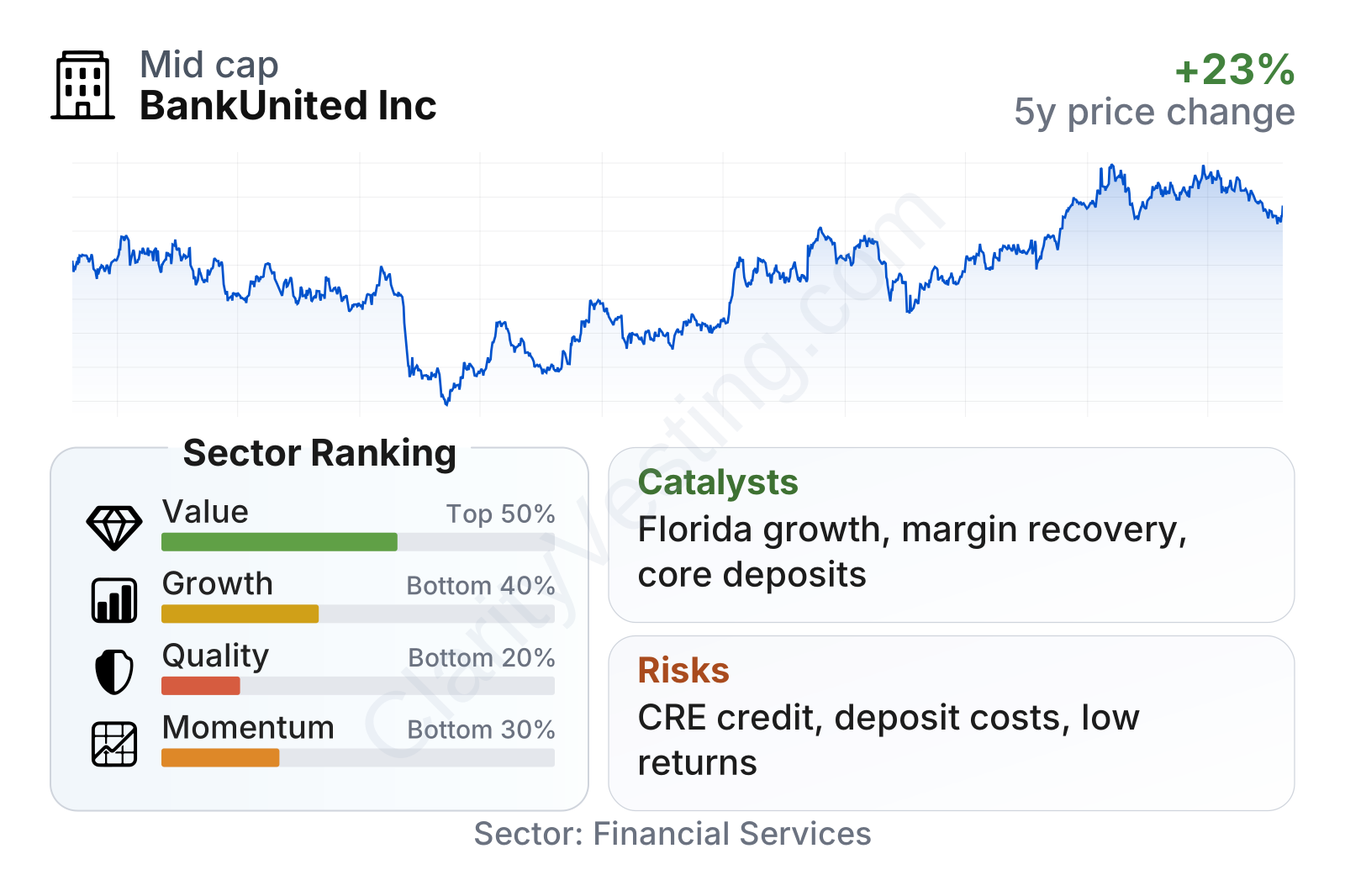
BankUnited is a mid-sized regional bank with a market value of roughly $3 billion and a share price history that reflects the banking turbulence of 2023 followed by a strong recovery into 2026. On valuation, the stock trades around sector-average earnings multiples and slightly below sector-average book multiples. Income generation is notable, with a dividend yield close to 3% and free cash flow yield above the sector median. The weaker area is business quality and recent growth ranking: profitability measures sit below many regional bank peers, and recent momentum has softened after a strong multi-year rebound.
Growth
Regional banking is not a fast-growth industry in the way software or semiconductors are, but it remains a durable sector tied to population growth, business formation, real estate activity, and the need for credit and payment services. BankUnited has some attractive exposure here. Florida continues to benefit from migration, business relocation, and wealth inflows, while the New York market gives the bank access to large commercial clients and specialized lending opportunities. That combination can support steady balance-sheet growth if underwriting remains disciplined.
BankUnited’s strategy also makes sense in principle. Management has emphasized commercial banking, treasury services, and relationship-based deposits rather than relying only on spread income. For a regional bank, that is important because operating accounts and business services can create stickier deposits and reduce dependence on more expensive wholesale funding. The company has also built specialty lending businesses that extend beyond its branch footprint, which can widen its addressable market without requiring a massive physical expansion.
Earnings per share show the challenge clearly: profits dropped meaningfully after 2021, then recovered through 2024 and 2025. That suggests the franchise is still earning through a tougher rate environment, but not yet back to its earlier level of profitability. For long-term readers, the key question is whether the recent recovery is the start of a more durable normalization or just a partial rebound from a weak base.
Book value per share has improved in recent years after a distorted 2021 comparison point, and the upward trend from 2022 through 2025 is constructive. For banks, book value matters because it represents the capital base that supports lending. A rising book value usually signals retained earnings and improving balance-sheet resilience, although in BankUnited’s case the longer five-year compound trend still looks weak because of the starting-point distortion and the pressure experienced during the 2022-2023 period.
A meaningful catalyst for future growth is the path of interest rates. If deposit costs stabilize or decline faster than loan yields reset downward, the bank’s net interest margin could improve. Another catalyst is continued population and business growth in Florida, which supports loan demand, payments activity, and new deposit relationships. In recent company updates, management has also pointed to ongoing balance-sheet repositioning and a focus on core deposits, both of which can improve earnings quality if executed well.
Recent developments in the broader banking environment also create an opening. After the regional banking stress of 2023, customers and counterparties have paid more attention to liquidity, capital, and deposit mix. Banks that came through that period with stable operations have a chance to strengthen client relationships as weaker competitors retrench. BankUnited is not the largest player, but it can still benefit if commercial clients seek capable regional alternatives to both small community banks and money-center giants.
Risks
This article is for informational purposes only and does not constitute financial advice. Some content is AI-generated. See Disclaimer


