Stock Analysis · Bank of Ireland Group plc (BKRIY)
Overview
Bank of Ireland Group plc is one of Ireland’s largest banking groups. It provides everyday banking services such as mortgages, current accounts, savings, business lending, wealth and insurance products, and corporate banking. Its core market is Ireland, with additional activities in the U.K., especially in selected consumer and commercial lending areas. For U.S. readers, BKRIY is the ADR representing this Irish banking group.
The business is organized around a few major operating divisions. Based on the latest annual reporting and management disclosures, revenue is mainly generated from lending and deposit activities, with smaller contributions from fees, wealth, insurance, and treasury-related income. Banking revenue can move meaningfully from year to year because interest rates strongly affect what a bank earns on loans versus what it pays on deposits.
- Retail Ireland: approximately 40% to 45% of group income. This includes mortgages, personal loans, current accounts, deposits, credit cards, and other day-to-day consumer banking services in Ireland.
- Wealth & Insurance: approximately 15% to 20%. This covers life assurance, pensions, investment products, protection products, and financial advice.
- Retail U.K.: approximately 10% to 15%. This mainly includes motor finance, asset finance, and other selected consumer and partnership lending activities in the U.K.
- Corporate & Commercial: approximately 20% to 25%. This division serves small businesses, larger Irish corporates, commercial real estate clients, and some international business banking customers.
- Group Center and treasury-related items: approximately 5% to 10%, although this can fluctuate. It includes capital management, funding, liquid asset income, and other central items.
In simple terms, the company makes most of its money by taking deposits, lending those funds at higher rates, and adding fee income from insurance, wealth, and business banking services. Over the last few years, higher interest rates have been a major earnings driver for many European banks, including Bank of Ireland.
The income flow also shows how sensitive the business is to interest costs and operating discipline. Revenue improved sharply in 2023, normalized in 2024, and remained elevated in 2025 versus earlier years, but profit did not rise in a straight line because funding costs and operating expenses also moved higher.
Key Figures
| Metric | Value | Sector ⓘ |
|---|---|---|
| Date | Nov 21, 2026 | |
| Context | ||
| Sector | Financial Services | |
| Industry | Banks - Regional | |
| Market Cap ⓘ | $19.60B | |
| Beta ⓘ | 0.41 | |
Value (Cheapness) | ||
| P/E Ratio ⓘ | 13.16 | 12.01 |
| P/B Ratio ⓘ | N/A | 1.48 |
| FCF Yield ⓘ | 38.85% | 8.77% |
| Dividend Yield ⓘ | 4.48% | 3.01% |
| EBIT / EV ⓘ | 17.79% | 8.31% |
| PEG ⓘ | N/A | |
Growth (Business expansion) | ||
| Revenue Growth ⓘ | 13.30% | 6.70% |
| RPS Growth (5Y CAGR) ⓘ | 20.13% | 12.35% |
| EPS Growth (5Y CAGR) ⓘ | -35.67% | -0.27% |
| BVPS Growth (5Y CAGR) ⓘ | 5.70% | 4.83% |
| Margin Growth (5Y Trend) ⓘ | -15.46% | -4.16% |
| FCF Growth (5Y CAGR) ⓘ | -34.75% | 4.69% |
| DPS Growth (5Y CAGR) ⓘ | 69.31% | 8.82% |
Quality (Business durability) | ||
| ROIC (Latest) ⓘ | N/A | 9.49% |
| ROE (Latest) ⓘ | 21.38% | 14.02% |
| ROA (Latest) ⓘ | 1.61% | 1.53% |
| ROIC (5Y Median) ⓘ | 4.98% | 7.80% |
| ROE (5Y Median) ⓘ | 9.41% | 12.09% |
| ROA (5Y Median) ⓘ | 0.74% | 1.28% |
| Net Debt / EBIT (Latest) ⓘ | -4.79 | 0.88 |
| Net Debt / EBIT (5Y Median) ⓘ | -10.26 | 0.73 |
| Net Debt / EBITDA (Latest) ⓘ | -3.59 | 0.71 |
| Operating Margin (Latest) ⓘ | 15.20% | 23.37% |
| Operating Margin (5Y Median) ⓘ | 34.19% | 24.29% |
| Debt to Equity (Latest) ⓘ | 108.78% | 59.34% |
| Profit Margin (Latest) ⓘ | 32.71% | 26.65% |
| Free Cash Flow (Latest) ⓘ | $7.62B | |
Momentum (Price trend) | ||
| 3Y Return ⓘ | +163.17% | +73.29% |
| 12M Return (excl. last month) ⓘ | +43.29% | +18.35% |
| 6M Return ⓘ | +6.07% | +3.24% |
| Price vs. 200-Day MA ⓘ | +3.29% | +2.17% |
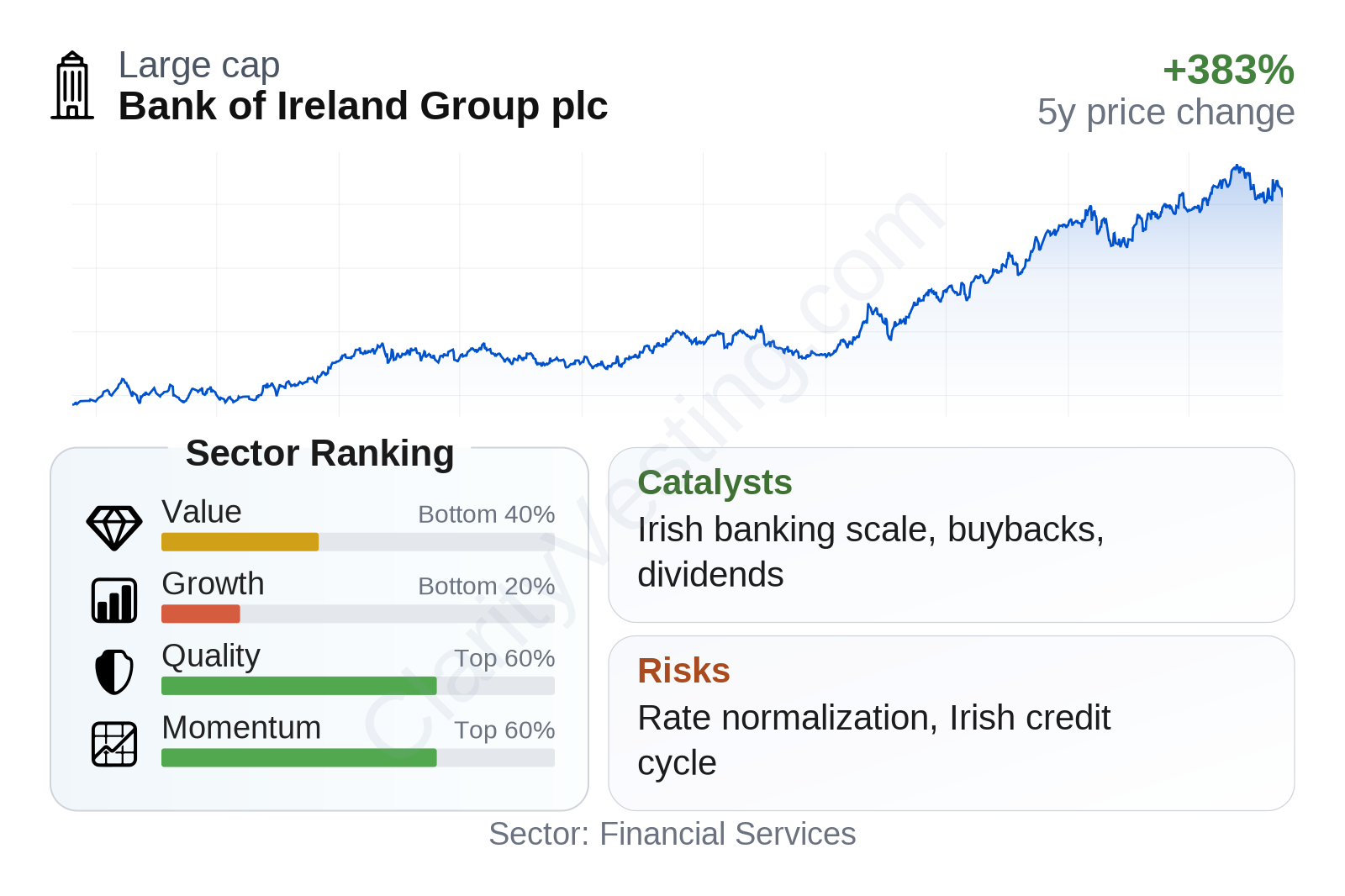
Bank of Ireland is now a large regional bank by market value, and its shares have been much stronger than the typical company in its sector over the last one, three, and six-year periods. Profitability metrics currently look solid, with return on equity above 21% and return on assets around 1.6%, both slightly to clearly above the sector median. Dividend yield is also above the sector median. On the other hand, the valuation is no longer obviously low: both the earnings multiple and especially the price-to-book multiple sit above the sector median, while the growth profile is less convincing than the recent share price performance suggests.
Growth
Banking is not usually viewed as a high-growth industry, but Ireland remains a relatively attractive banking market within Europe. Loan demand can be supported by population growth, housing shortages, business investment, and a concentrated market structure. For Bank of Ireland, the main long-term growth question is less about rapid expansion and more about whether it can steadily grow lending, protect margins, and cross-sell more products to existing customers without taking excessive risk.
The company’s strategy is logical for that type of environment. It is focused on core Irish banking, selective U.K. niches, digital service improvements, and deeper relationships in wealth, insurance, and business banking. That matters because these areas can produce more recurring fee income and reduce dependence on pure lending spreads. The group has also benefited from customer deposit strength and from a stronger capital position than in earlier parts of its history.
Recent operating trends show both progress and limits. Revenue growth has been strong on a one-year and five-year per-share basis, helped in large part by the interest-rate backdrop. Book value per share has also kept moving up at a mid-single-digit annual pace over five years, which is an important sign for a bank because book value is closely tied to balance-sheet strength and long-term compounding capacity.
Even without a visible earnings-per-share chart here, the broader pattern is clear: earnings have been volatile across the last five years and have not compounded smoothly. That is normal for banks, but it means long-term growth depends on maintaining credit quality and cost control once the tailwind from high rates fades.
The steady rise in book value per share is one of the stronger elements in the company’s profile. It suggests that retained profits and capital discipline have continued to add underlying value, even though annual earnings have been uneven.
One notable catalyst has been capital returns. In recent years, management has highlighted shareholder distributions through dividends and buybacks, supported by stronger profitability and capital generation. Another positive factor is competitive positioning in Irish mortgages, business lending, and everyday banking, where scale matters. If Irish economic activity remains resilient and interest rates settle at levels that are still supportive for bank margins, Bank of Ireland has room to keep producing healthy earnings even without rapid balance-sheet growth.
Risks
This article is for informational purposes only and does not constitute financial advice. Some content is AI-generated. See Disclaimer