Stock Analysis · Bank of Ireland Group PLC (BKRIF)
Overview
Bank of Ireland Group PLC is one of Ireland’s largest banking groups. It provides everyday banking services to personal customers, small and medium-sized businesses, corporate clients, and wealth or insurance customers. In simple terms, it collects deposits, makes loans, earns interest on those loans, charges fees for certain services, and also generates income from activities such as wealth management, insurance partnerships, and treasury operations.
The group is centered on the Irish market, which is important because Ireland has a relatively concentrated banking industry after years of consolidation. That gives large incumbent banks like Bank of Ireland a meaningful domestic position in mortgages, consumer banking, business lending, and corporate banking. It also has operations in the U.K., mainly in selected lending and partnership activities rather than as a broad retail bank.
Its revenue mix changes with interest rates and credit conditions, but the main sources can be described in this order:
- Net interest income: typically the largest source, likely around 70% to 80% of total income in recent years. This is the spread between what the bank earns on mortgages, commercial loans, and other assets and what it pays on deposits and funding.
- Fee and commission income: usually around 10% to 20%. This includes fees from current accounts, cards, business banking services, wealth activity, and other customer transactions.
- Other income: generally around 5% to 15%. This can include treasury-related income, life and pensions-related contributions, partnership income, and valuation or disposal effects.
That structure is typical for a traditional bank: the core engine is lending funded by deposits, with fee income acting as a useful supplement. The business flow over the last few years shows a strong jump in revenue during the period of higher interest rates, followed by some moderation in profit as costs and normalization effects became more visible.
The broad trend is that revenue and profitability improved sharply from 2022 into 2023 as interest income expanded, while later results show that earnings remain solid but less linear as funding costs, operating expenses, and the normal ups and downs of banking profitability begin to matter more again.
Key Figures
| Metric | Value | Sector ⓘ |
|---|---|---|
| Date | Nov 21, 2026 | |
| Context | ||
| Sector | Financial Services | |
| Industry | Banks - Regional | |
| Market Cap ⓘ | $19.99B | |
| Beta ⓘ | 0.41 | |
Value (Cheapness) | ||
| P/E Ratio ⓘ | 13.42 | 12.01 |
| P/B Ratio ⓘ | N/A | 1.48 |
| FCF Yield ⓘ | 37.74% | 8.77% |
| Dividend Yield ⓘ | 3.96% | 3.01% |
| EBIT / EV ⓘ | 16.97% | 8.31% |
| PEG ⓘ | N/A | |
Growth (Business expansion) | ||
| Revenue Growth ⓘ | 13.30% | 6.70% |
| RPS Growth (5Y CAGR) ⓘ | 20.62% | 12.35% |
| EPS Growth (5Y CAGR) ⓘ | -0.02% | -0.27% |
| BVPS Growth (5Y CAGR) ⓘ | 6.13% | 4.83% |
| Margin Growth (5Y Trend) ⓘ | -15.46% | -4.16% |
| FCF Growth (5Y CAGR) ⓘ | -34.75% | 4.69% |
| DPS Growth (5Y CAGR) ⓘ | 70.00% | 8.82% |
Quality (Business durability) | ||
| ROIC (Latest) ⓘ | N/A | 9.49% |
| ROE (Latest) ⓘ | 21.21% | 14.02% |
| ROA (Latest) ⓘ | 1.59% | 1.53% |
| ROIC (5Y Median) ⓘ | 4.98% | 7.80% |
| ROE (5Y Median) ⓘ | 9.41% | 12.09% |
| ROA (5Y Median) ⓘ | 0.74% | 1.28% |
| Net Debt / EBIT (Latest) ⓘ | -4.83 | 0.88 |
| Net Debt / EBIT (5Y Median) ⓘ | -10.26 | 0.73 |
| Net Debt / EBITDA (Latest) ⓘ | -3.62 | 0.71 |
| Operating Margin (Latest) ⓘ | 12.81% | 23.37% |
| Operating Margin (5Y Median) ⓘ | 34.19% | 24.29% |
| Debt to Equity (Latest) ⓘ | 108.78% | 59.34% |
| Profit Margin (Latest) ⓘ | 32.71% | 26.65% |
| Free Cash Flow (Latest) ⓘ | $7.54B | |
Momentum (Price trend) | ||
| 3Y Return ⓘ | +162.03% | +73.29% |
| 12M Return (excl. last month) ⓘ | +36.25% | +18.35% |
| 6M Return ⓘ | +4.68% | +3.24% |
| Price vs. 200-Day MA ⓘ | +2.42% | +2.17% |
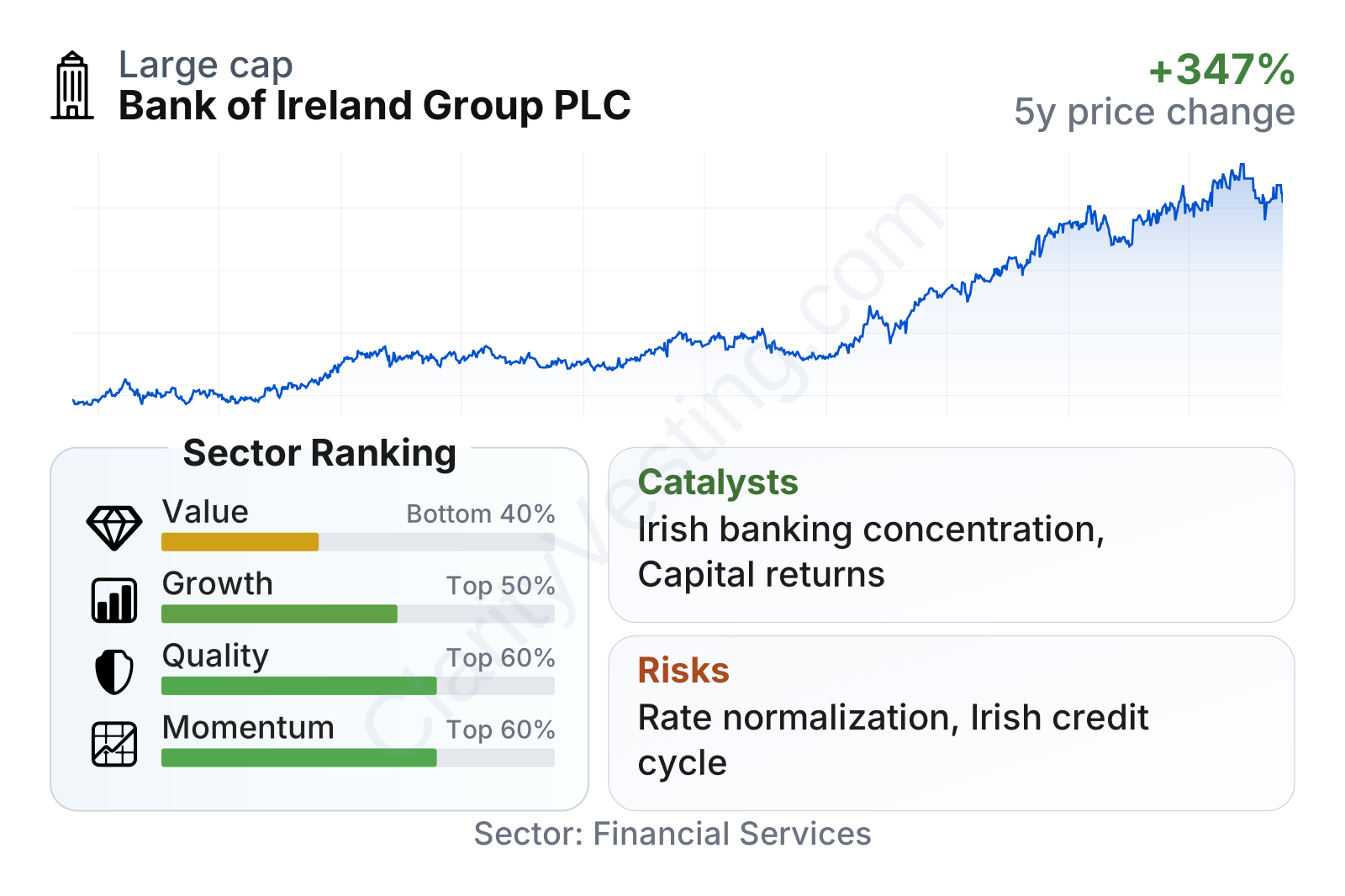
Bank of Ireland is a large regional bank by market value, and its recent market performance has been strong compared with much of the banking sector. The share price has risen significantly over the last three years, which suggests that the market has already recognized the improvement in earnings and capital returns.
On valuation, the picture is mixed rather than obviously cheap. Its earnings multiple sits a bit above the sector median, so the stock is not being treated as a distressed bank. At the same time, income-related measures such as free cash flow yield, EBIT-to-enterprise value, and dividend yield look stronger than many peers. In quality terms, current profitability is healthy, especially return on equity, but leverage remains structurally high as expected for a bank and some long-term profitability averages are less impressive than the latest year. Growth indicators are decent overall, helped by revenue expansion and book value growth, while momentum remains favorable after a strong share-price run.
Growth
Banking is not a high-growth industry in the same way as software or semiconductors, but Ireland’s banking market still offers room for disciplined expansion. The sector benefits from a concentrated competitive structure, a growing economy over the long term, and customer demand for mortgages, business lending, and savings products. For Bank of Ireland, future growth is likely to come less from dramatic expansion and more from deepening relationships with existing customers, improving digital efficiency, selective loan growth, and returning excess capital while still growing tangible equity.
The company’s strategy broadly makes sense for that environment. Management has emphasized a combination of customer retention, digital service upgrades, operational simplification, and disciplined capital allocation. For a mature bank, this is often more valuable than chasing aggressive balance-sheet growth. A stronger deposit base and tighter cost control can be as important as headline loan growth.
Earnings remain the main near-term growth driver to watch. The recent earnings path shows that profitability surged during the higher-rate period, but it also points to a business that may now be moving from rapid expansion into a more normalized phase. That does not remove the long-term case, but it changes the lens: sustained returns, capital generation, and resilience matter more than extraordinary annual jumps.
Book value per share has moved steadily upward over the last several years, which is an important sign for a bank. It suggests that the company has been adding to shareholder equity over time rather than merely benefiting from short-term market conditions. For banks, this measure often matters because long-term value creation is closely tied to building capital while earning returns above the cost of that capital.
A meaningful catalyst is the group’s ability to keep producing solid income even if interest rates gradually normalize. If loan growth, fee income, and cost discipline offset some pressure on net interest income, the bank could continue compounding book value and distributing capital. Another supportive factor is the relatively rational competitive backdrop in Ireland, where not many large players dominate the market. Recent company updates have also highlighted capital strength and shareholder distributions, which can reinforce market confidence if profitability remains stable.
Risks
This article is for informational purposes only and does not constitute financial advice. Some content is AI-generated. See Disclaimer


