Stock Analysis · Bangkok Bank Public Company Limited (BKKPF)
Overview
Bangkok Bank Public Company Limited is one of Thailand’s largest commercial banks. It provides traditional banking services such as deposits, lending, payments, trade finance, treasury activities, and wealth-related services. The bank serves large corporations, small and medium-sized businesses, and retail customers, and it also has an international network that supports cross-border business flows across Southeast Asia and other markets. That international reach matters because Bangkok Bank has long been positioned as a bank for trade, business customers, and regional connectivity rather than only a domestic consumer lender.
Its revenue base is typical of a large regional bank: interest income from loans and investments is the biggest driver, while fees, service income, and market-related activities add diversification. Based on the company’s business model and recent reporting structure, the main sources of revenue can be understood as follows:
- Net interest income: approximately 65% to 75% of revenue. This is the spread between what the bank earns on loans and investments and what it pays on deposits and funding.
- Fee and service income: approximately 10% to 20%. This generally includes transaction banking, trade services, cards, asset management-related fees, remittances, and other customer service charges.
- Net fees from investment and wealth-related activities: a smaller mid-single to low-double-digit share depending on market conditions, including mutual fund, bancassurance, and securities-related services where reported.
- Treasury and market income: usually a smaller but sometimes volatile contribution, driven by foreign exchange, investment gains, and other financial market activities.
- Other operating income: a limited residual category that can include recoveries, gains on disposals, or miscellaneous banking income.
Over the last several years, the bank’s revenue and profit flow has generally expanded, with total revenue rising materially from 2021 through 2025 and net income also moving higher. At the same time, funding costs and interest expense increased as rates normalized, which is an important part of the banking cycle rather than an isolated company issue.
The broad picture is a bank that has been growing its income base while absorbing higher funding costs and maintaining positive profitability. That is a constructive sign for a mature financial institution, even if growth is not perfectly smooth from year to year.
Key Figures
| Metric | Value | Sector ⓘ |
|---|---|---|
| Date | Nov 21, 2026 | |
| Context | ||
| Sector | Financial Services | |
| Industry | Banks - Regional | |
| Market Cap ⓘ | $10.55B | |
| Beta ⓘ | 0.11 | |
Value (Cheapness) | ||
| P/E Ratio ⓘ | 8.52 | 12.01 |
| P/B Ratio ⓘ | N/A | 1.48 |
| FCF Yield ⓘ | 25.83% | 8.77% |
| Dividend Yield ⓘ | 5.91% | 3.01% |
| EBIT / EV ⓘ | 0.58% | 8.31% |
| PEG ⓘ | 17.98 | |
Growth (Business expansion) | ||
| Revenue Growth ⓘ | -13.90% | 6.70% |
| RPS Growth (5Y CAGR) ⓘ | 12.02% | 12.35% |
| EPS Growth (5Y CAGR) ⓘ | 7.71% | -0.27% |
| BVPS Growth (5Y CAGR) ⓘ | 3.79% | 4.83% |
| Margin Growth (5Y Trend) ⓘ | 1.35% | -4.16% |
| FCF Growth (5Y CAGR) ⓘ | N/A | 4.69% |
| DPS Growth (5Y CAGR) ⓘ | 24.81% | 8.82% |
Quality (Business durability) | ||
| ROIC (Latest) ⓘ | 3.23% | 9.49% |
| ROE (Latest) ⓘ | 6.51% | 14.02% |
| ROA (Latest) ⓘ | 0.81% | 1.53% |
| ROIC (5Y Median) ⓘ | 4.19% | 7.80% |
| ROE (5Y Median) ⓘ | 8.08% | 12.09% |
| ROA (5Y Median) ⓘ | 0.93% | 1.28% |
| Net Debt / EBIT (Latest) ⓘ | 12.32 | 0.88 |
| Net Debt / EBIT (5Y Median) ⓘ | 9.09 | 0.73 |
| Net Debt / EBITDA (Latest) ⓘ | 10.92 | 0.71 |
| Operating Margin (Latest) ⓘ | 22.36% | 23.37% |
| Operating Margin (5Y Median) ⓘ | 21.15% | 24.29% |
| Debt to Equity (Latest) ⓘ | 107.37% | 59.34% |
| Profit Margin (Latest) ⓘ | 28.91% | 26.65% |
| Free Cash Flow (Latest) ⓘ | $2.72B | |
Momentum (Price trend) | ||
| 3Y Return ⓘ | +52.58% | +73.29% |
| 12M Return (excl. last month) ⓘ | +39.06% | +18.35% |
| 6M Return ⓘ | +11.15% | +3.24% |
| Price vs. 200-Day MA ⓘ | +28.25% | +2.17% |
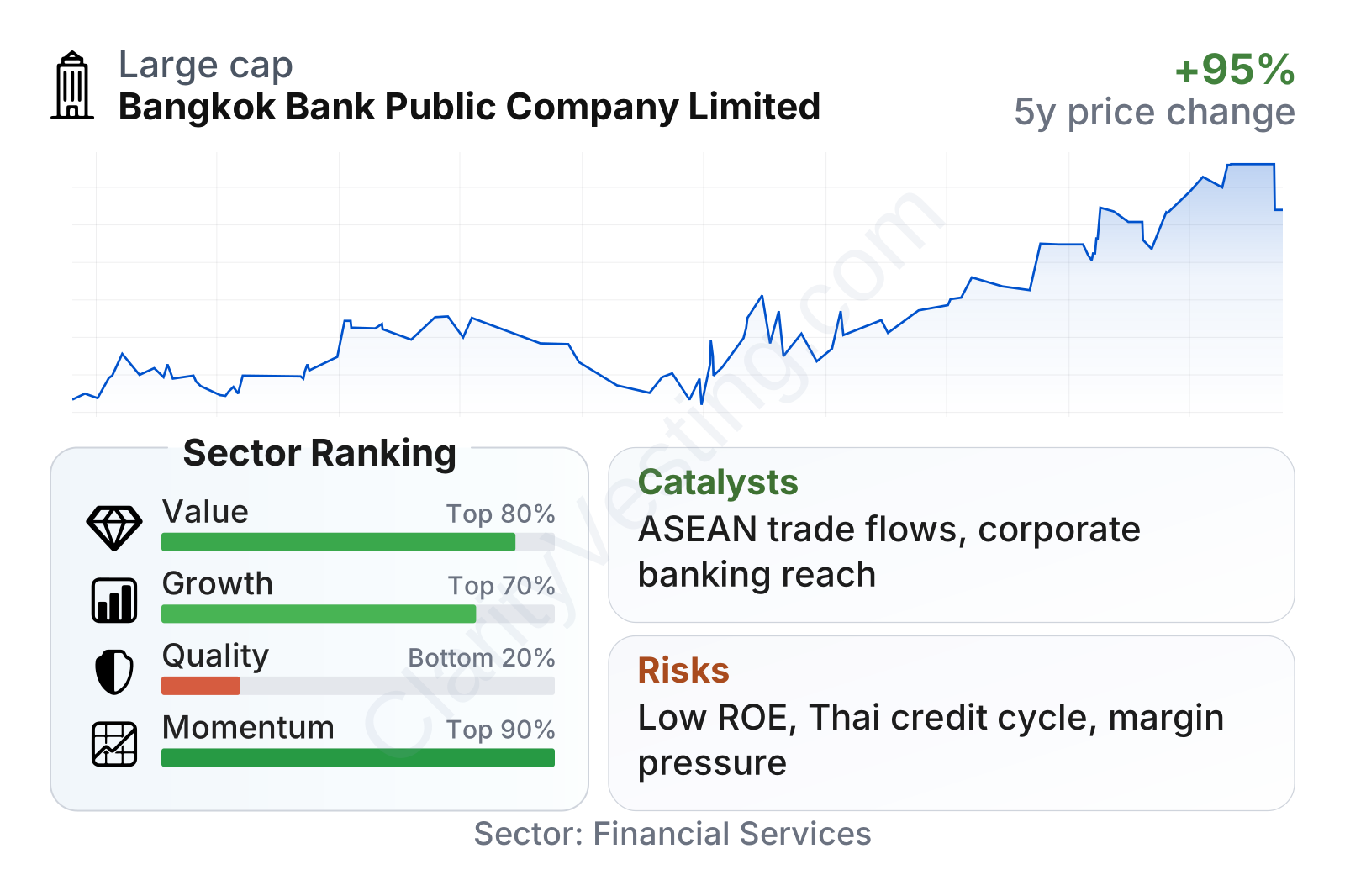
Bangkok Bank is a large bank by regional standards, with a market value around the low tens of billions of dollars, and its share price volatility has been very low, reflected in a beta close to 0.1. On valuation, the shares trade at an earnings multiple below the sector median, while the dividend yield is also above the sector median. Free cash flow measures are unusually strong on the surface, although for banks these metrics should be read carefully because balance sheet movements can distort them.
The factor mix is interesting. Value and momentum both rank well relative to the broader sector, suggesting the market is still not placing an aggressive multiple on the business despite solid recent share performance. Growth looks better over a five-year lens than on the most recent year-over-year revenue reading, which was negative. Quality is the weak point: profitability ratios such as return on equity and return on assets sit below many peers, and leverage-related metrics are naturally elevated because this is a bank, though still worth monitoring in comparison with other financial institutions.
Growth
Banking in Thailand is not a classic high-growth sector, but it remains strategically important and benefits from long-term drivers that are still relevant: rising regional trade, digitization of payments, wealth accumulation, and financing needs from businesses operating across ASEAN. Bangkok Bank’s strategy fits those themes reasonably well because it combines a strong domestic franchise with cross-border commercial banking capabilities. That positioning can be more durable than relying mainly on fast-growing unsecured consumer lending.
A major growth angle is the bank’s role in serving corporate clients, supply chains, exporters, and companies investing across Southeast Asia. Thailand’s economy is tightly linked to tourism, trade, manufacturing, and regional business flows. A bank with strong corporate relationships and overseas branches can benefit when capital expenditure, trade volumes, and transaction activity recover or deepen.
Earnings per share have shown a clear upward path from 2021 through 2023, which indicates the bank has been able to translate a more favorable rate environment and business activity into stronger profit per share. Even though the latest point available is a partial-year figure, the medium-term direction has been positive rather than stagnant. Five-year EPS growth is also stronger than the sector median, which supports the view that the business has produced real earnings progress over time.
Book value per share has also risen steadily, which is especially important for banks because book value is a core measure of balance sheet strength and retained earning power. The pace is not exceptional, but the consistency matters. It suggests the institution has been adding capital and preserving franchise value while continuing to distribute cash to shareholders through dividends.
Another notable point is dividend growth. The dividend per share growth rate over five years is well above the sector median, which signals improving distributable capacity after the more difficult pandemic period. That does not by itself define future growth, but it does show management has had room to restore and expand payouts.
As for recent opportunity signals, the strongest practical catalyst is not a single headline event but the combination of higher regional economic integration, ongoing digital banking adoption, and Bangkok Bank’s ability to capture business banking flows across Thailand and neighboring markets. If loan demand improves while credit costs remain contained, the bank has room to turn modest revenue growth into stronger bottom-line progression.
Risks
This article is for informational purposes only and does not constitute financial advice. Some content is AI-generated. See Disclaimer


