Stock Analysis · Black Hills Corporation (BKH)
Overview
Black Hills Corporation is a regulated utility company serving customers primarily in the Midwest and Mountain West. Its core business is delivering natural gas and electricity to homes, businesses, and industrial users through local utility networks. Because most of its operations are regulated, a large part of its earnings depends on approved rates, customer growth, infrastructure investment, and service reliability rather than on rapid swings in commodity prices.
The company operates through electric utilities, natural gas utilities, power generation, and pipeline-related assets. In practice, the largest revenue stream comes from natural gas service, followed by electric service, while smaller contributions come from wholesale power, transmission, and other energy-related activities. Based on the company’s recent annual mix, the revenue base can be summarized approximately as follows:
- Natural gas utilities: about 55% to 65% of revenue. This includes retail gas distribution, transportation, and related customer charges across several states.
- Electric utilities: about 30% to 40% of revenue. This includes generation, transmission, and retail electricity sales to residential, commercial, and industrial customers.
- Other utility and energy services: generally less than 10% of revenue. This can include non-regulated energy activities, wholesale transactions, and miscellaneous service revenue.
This structure matters for long-term analysis because regulated utility revenue is typically steadier than revenue in most cyclical industries. Black Hills is not a high-growth technology business; it is an infrastructure-heavy operator whose value largely comes from essential service demand, approved returns on investment, and gradual expansion of its regulated asset base.
Over the last several years, revenue has moved around more than profit, which is common in utilities exposed to weather patterns and fuel pass-through effects. Even with that revenue volatility, the business has shown a generally rising path in operating income and net income, suggesting that the underlying regulated earnings base has been improving.
The broad pattern is encouraging: revenue has fluctuated, but gross profit, operating income, and net income have trended upward over time. That usually points to better rate recovery and a healthier regulated business mix, although rising interest expense is also visible and remains an important part of the long-term picture.
Key Figures
| Metric | Value | Sector ⓘ |
|---|---|---|
| Date | Oct 17, 2026 | |
| Context | ||
| Sector | Utilities | |
| Industry | Utilities - Regulated Gas | |
| Market Cap ⓘ | $5.89B | |
| Beta ⓘ | 0.66 | |
Value (Cheapness) | ||
| P/E Ratio ⓘ | 19.46 | 17.28 |
| P/B Ratio ⓘ | 1.51 | 1.51 |
| FCF Yield ⓘ | -5.18% | 0.65% |
| Dividend Yield ⓘ | 3.61% | 3.77% |
| EBIT / EV ⓘ | 5.67% | 5.01% |
| PEG ⓘ | 2.51 | |
Growth (Business expansion) | ||
| Revenue Growth ⓘ | 3.10% | 6.10% |
| RPS Growth (5Y CAGR) ⓘ | 0.63% | 3.87% |
| EPS Growth (5Y CAGR) ⓘ | -13.37% | -11.30% |
| BVPS Growth (5Y CAGR) ⓘ | 4.76% | 4.23% |
| Margin Growth (5Y Trend) ⓘ | 2.37% | 3.57% |
| FCF Growth (5Y CAGR) ⓘ | -33.35% | -8.84% |
| DPS Growth (5Y CAGR) ⓘ | 4.24% | 4.84% |
Quality (Business durability) | ||
| ROIC (Latest) ⓘ | 5.77% | 6.53% |
| ROA (Latest) ⓘ | 2.80% | 3.20% |
| ROIC (5Y Median) ⓘ | 5.78% | 5.95% |
| ROA (5Y Median) ⓘ | 2.76% | 2.75% |
| Net Debt / EBIT (Latest) ⓘ | 7.96 | 7.13 |
| Net Debt / EBIT (5Y Median) ⓘ | 8.96 | 7.23 |
| Net Debt / EBITDA (Latest) ⓘ | 5.20 | 4.31 |
| Net Debt / Assets ⓘ | 40.06% | 38.42% |
| EBITDA / Interest ⓘ | 4.08 | 4.58 |
| Operating Margin (Latest) ⓘ | 24.18% | 20.83% |
| Operating Margin (5Y Median) ⓘ | 21.16% | 20.08% |
| Debt to Equity (Latest) ⓘ | 113.96% | 137.69% |
| Profit Margin (Latest) ⓘ | 13.01% | 11.37% |
| Free Cash Flow (Latest) ⓘ | -$305.20M | |
Momentum (Price trend) | ||
| 3Y Return ⓘ | +71.99% | +52.37% |
| 12M Return (excl. last month) ⓘ | +23.54% | +8.84% |
| 6M Return ⓘ | +1.69% | -3.95% |
| Price vs. 200-Day MA ⓘ | +6.34% | -0.79% |
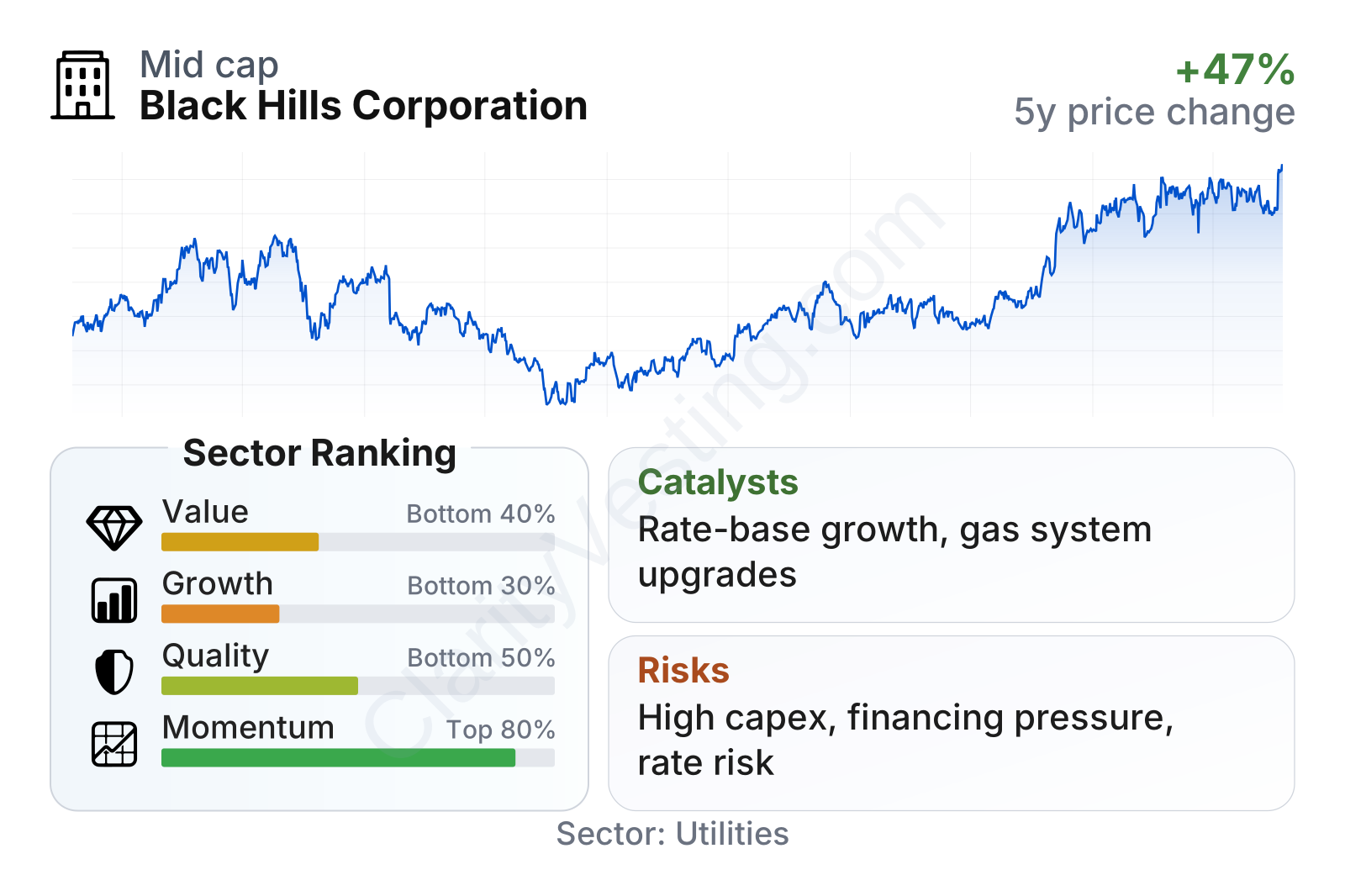
Black Hills is a mid-sized utility with relatively low share-price volatility, reflected by a beta well below 1. In simple terms, the stock has tended to swing less than the broader market. The overall factor profile is mixed: momentum has been comparatively solid, but value, growth, and quality rank in the weaker part of the utility sector. The main reason is not a single problem, but a combination of slow top-line growth, weak recent cash generation, and debt-related pressure on returns.
The dividend yield is close to the sector median, which fits the profile of a traditional regulated utility. However, free cash flow is currently negative, and earnings-based valuation is near the sector average rather than clearly discounted. That makes the company look more like a steady operator with some balance-sheet and capital-spending constraints than a clearly underappreciated outlier.
Growth
Black Hills operates in a sector that is usually considered mature, but not stagnant. Utilities can grow for long periods through population expansion in service territories, grid modernization, natural gas system replacement, renewable integration, and rate-base growth approved by regulators. For Black Hills, that means future expansion is less about dramatic market share wins and more about investing in infrastructure that can earn regulated returns over time.
The company’s strategy broadly matches that model. It continues to invest in electric and gas networks, reliability upgrades, generation resources, and customer connections. That approach makes strategic sense because regulated utilities often create shareholder value by enlarging the asset base on which they are allowed to earn a return. If execution is disciplined and regulators remain constructive, this can support gradual earnings and dividend growth even when revenue growth looks modest.
Revenue per share has been uneven over the last five years. There was a strong jump in 2022, followed by a decline and then a modest recovery. That pattern suggests Black Hills is not currently delivering smooth top-line expansion, and its long-term growth profile remains moderate rather than strong. Relative to many utilities, recent revenue growth has also trailed the sector median.
Free cash flow is the more important growth constraint to watch. It has shifted from positive territory to a deeply negative recent level, which is common when a utility is spending heavily on infrastructure. In one sense, that can be a sign of future earnings capacity being built. In another, it means near-term growth is relying on external financing rather than internally generated cash. For a capital-intensive business, that tradeoff is manageable only if regulators allow timely cost recovery and financing costs remain under control.
One potential catalyst is the continuing need for grid hardening, system upgrades, and replacement of aging gas infrastructure across the regions Black Hills serves. Another is customer growth in its service areas, especially where economic development, housing activity, or industrial demand support additional connections. The company has also emphasized multi-year capital programs in recent filings and investor materials, which can translate into a larger regulated earnings base if projects are completed on time and added to rates.
Recent company updates have continued to point toward infrastructure investment and regulatory execution as the main source of opportunity. That is not a sudden breakthrough catalyst, but it is a realistic one for a utility: growth built through approved projects, customer additions, and incremental rate cases rather than through transformative disruption.
Risks
This article is for informational purposes only and does not constitute financial advice. Some content is AI-generated. See Disclaimer


