Stock Analysis · Brookdale Senior Living Inc (BKD)
Overview
Brookdale Senior Living Inc. is one of the largest senior housing operators in the United States. It runs retirement communities that provide housing, daily support, and healthcare-related services for older adults. Its communities generally serve residents across three main care levels: independent living for seniors who need little day-to-day help, assisted living for those who need support with activities such as bathing or medication management, and memory care for residents living with Alzheimer’s disease or other forms of dementia. Brookdale also offers skilled nursing, rehabilitation, home health, hospice, and outpatient therapy in a smaller part of the business.
The company’s revenue is primarily generated from monthly resident fees and service charges paid by residents and, in some cases, by government programs or third-party payors tied to healthcare services. Based on Brookdale’s recent business mix disclosed in company filings, revenue is concentrated in senior housing operations, with healthcare services representing a much smaller portion.
- Retirement center operating revenue: approximately 94% to 96% — this is the core business and includes resident rent, dining, housekeeping, personal care, assisted living services, and memory care fees across Brookdale’s communities.
- Managed community fees and other operating income: approximately 2% to 4% — this includes fees from managing communities for third-party owners and other ancillary community-related income.
- Healthcare services revenue: approximately 2% to 3% — this includes home health, hospice, therapy, and other clinical services provided to residents and patients.
Brookdale’s economics are heavily influenced by occupancy, resident rate increases, labor costs, and interest expense. In recent years, revenue has gradually recovered from pandemic disruption, but the company still faces a difficult balance between improving community profitability and handling a large debt burden. The long-term appeal of the business comes from the essential nature of senior care and Brookdale’s national operating scale, while the main challenge remains converting that scale into durable earnings.
The operating picture shows why Brookdale remains a turnaround case rather than a fully stabilized operator. Revenue has been moving higher over the last several years, and gross profit improved meaningfully through 2024, but interest expense has stayed heavy and has continued to absorb much of the benefit from better operations. That gap between improving community-level performance and weak bottom-line results is central to understanding the company.
Key Figures
| Metric | Value | Sector ⓘ |
|---|---|---|
| Date | Oct 24, 2026 | |
| Context | ||
| Sector | Healthcare | |
| Industry | Medical Care Facilities | |
| Market Cap ⓘ | $2.41B | |
| Beta ⓘ | 0.53 | |
Value (Cheapness) | ||
| P/E Ratio ⓘ | N/A | 25.42 |
| P/B Ratio ⓘ | N/A | 3.08 |
| FCF Yield ⓘ | 0.99% | 3.12% |
| Dividend Yield ⓘ | N/A | 1.85% |
| EBIT / EV ⓘ | 0.77% | 0.56% |
| PEG ⓘ | 0.28 | |
Growth (Business expansion) | ||
| Revenue Growth ⓘ | -8.90% | 7.50% |
| RPS Growth (5Y CAGR) ⓘ | -2.64% | 8.60% |
| EPS Growth (5Y CAGR) ⓘ | N/A | -17.73% |
| BVPS Growth (5Y CAGR) ⓘ | N/A | 3.72% |
| Margin Growth (5Y Trend) ⓘ | -3.29% | -0.57% |
| FCF Growth (5Y CAGR) ⓘ | N/A | 0.96% |
| DPS Growth (5Y CAGR) ⓘ | N/A | 6.69% |
Quality (Business durability) | ||
| ROIC (Latest) ⓘ | 1.12% | 3.17% |
| ROA (Latest) ⓘ | -2.32% | 2.98% |
| ROIC (5Y Median) ⓘ | 0.49% | 4.56% |
| ROA (5Y Median) ⓘ | -3.39% | 1.87% |
| Net Debt / EBIT (Latest) ⓘ | 15.30 | 1.34 |
| Net Debt / EBIT (5Y Median) ⓘ | 84.79 | 1.86 |
| Net Debt / EBITDA (Latest) ⓘ | 2.35 | 1.00 |
| Net Debt / Assets ⓘ | 15.57% | 5.06% |
| EBITDA / Interest ⓘ | 1.55 | 9.55 |
| Operating Margin (Latest) ⓘ | 1.99% | 9.25% |
| Operating Margin (5Y Median) ⓘ | 0.93% | 7.33% |
| Debt to Equity (Latest) ⓘ | -4449.35% | 26.68% |
| Profit Margin (Latest) ⓘ | -4.72% | 3.34% |
| Free Cash Flow (Latest) ⓘ | $23.73M | |
Momentum (Price trend) | ||
| 3Y Return ⓘ | +174.66% | +51.61% |
| 12M Return (excl. last month) ⓘ | +37.56% | +19.90% |
| 6M Return ⓘ | -24.07% | +10.10% |
| Price vs. 200-Day MA ⓘ | -23.73% | +6.44% |
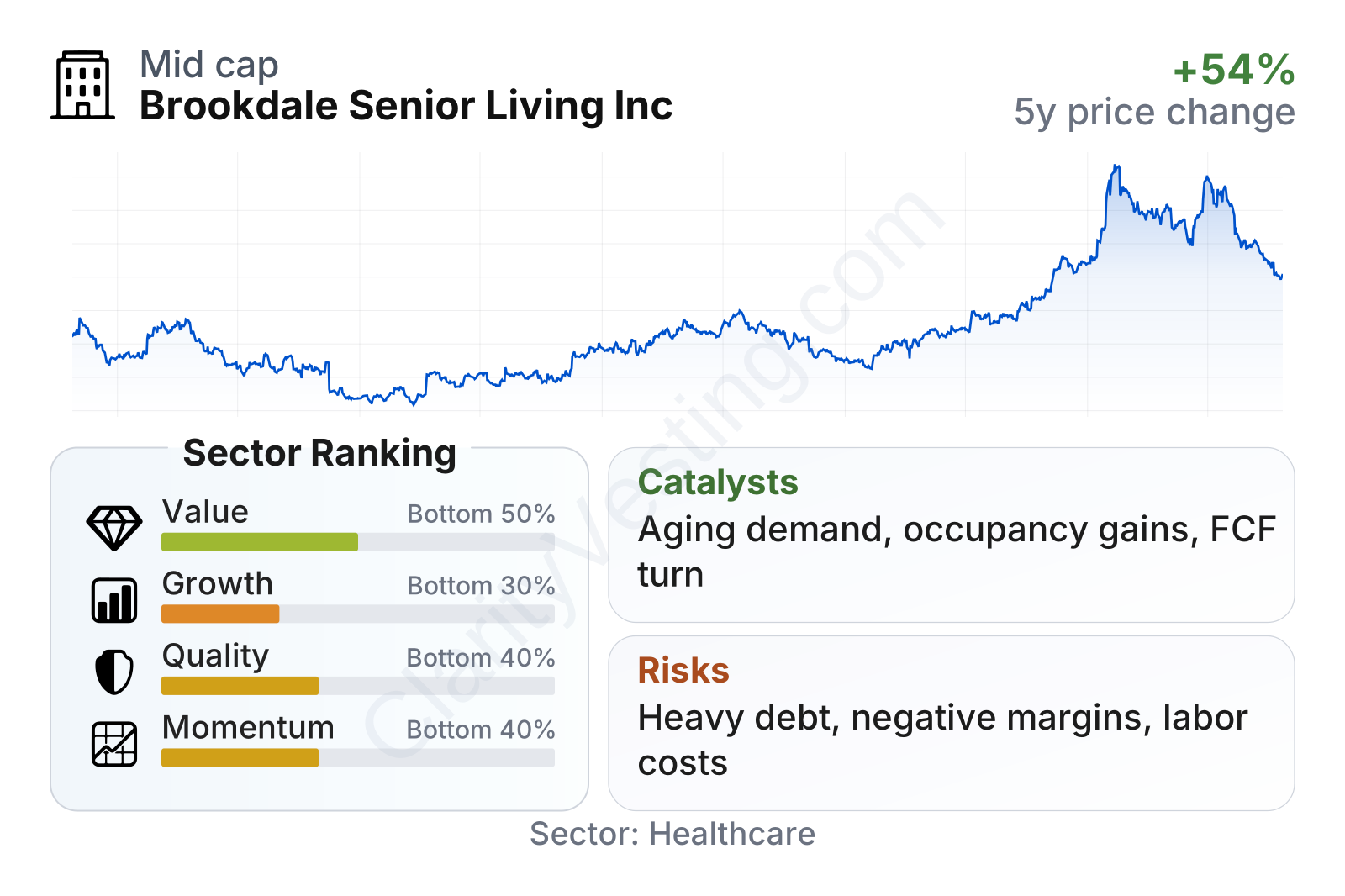
Brookdale is a mid-sized public company by market value, and its share price has risen sharply over the last three years, even with a weaker last six months. That contrast matters: the market has recognized operational recovery, but the recent pullback suggests that expectations are now being tested against slower near-term growth and still-thin profitability. The broader factor profile is mixed. Valuation metrics do not point to a clear bargain relative to the healthcare sector, while quality and growth measures remain below sector norms. Free cash flow has turned positive, which is important, but the yield remains modest and does not yet fully offset concerns around leverage and margins.
Growth
Brookdale operates in a part of healthcare with favorable long-term demand drivers. The U.S. population is aging, and the number of people entering the older age brackets that most often use senior housing is expected to rise over the coming years. That demographic backdrop supports industry demand for independent living, assisted living, and memory care. In simple terms, the potential customer base is expanding, and that is a real tailwind for operators that already have a large installed footprint.
Brookdale’s strategy is broadly logical for that environment. The company has focused on improving occupancy, raising rates where possible, streamlining operations, and prioritizing higher-return communities. For a senior housing operator, even modest occupancy gains can have a strong effect on profits because many property-level costs are fixed. Once a community is staffed and running, additional residents can contribute meaningfully to margin improvement.
The revenue trend shows that the recovery has not been perfectly smooth. Brookdale posted several quarters of healthy year-over-year growth from 2022 through 2025, but the most recent readings turned negative, including a sharp decline by mid-2026. That weakens the near-term growth case and suggests the company is now facing either tougher comparisons, portfolio changes, or operational softness in parts of the business. For long-term analysis, the key question is whether this is a pause inside a multi-year recovery or a sign that the rebound is losing momentum.
Cash generation has improved materially from deeply negative levels to positive territory over the trailing twelve months. That shift is one of the most important developments in the Brookdale case. A business with positive free cash flow has more room to fund maintenance needs, manage debt, and withstand pressure from wages or occupancy fluctuations. Even so, the amount remains relatively small compared with the company’s overall size and debt obligations, so this improvement looks more like an early step toward stabilization than proof of a fully healed financial profile.
A meaningful catalyst is the industry’s demographic setup. The senior population most likely to need assisted living and memory care is expected to grow for years, while new construction across the sector has been more restrained than in earlier periods. If that supply discipline continues, established operators like Brookdale may benefit from better pricing power and fuller communities. Another catalyst is operational leverage: if occupancy rises and labor conditions stay manageable, earnings can improve faster than revenue.
Recent company updates have also emphasized efforts around portfolio optimization, expense discipline, and community-level operating improvement. None of these changes transforms the business overnight, but together they support the idea that Brookdale is trying to become a more efficient version of itself just as the demand backdrop becomes more favorable.
Risks
This article is for informational purposes only and does not constitute financial advice. Some content is AI-generated. See Disclaimer


