Stock Analysis · Beijing Enterprises Water Group Limited (BJWTY)
Overview
Beijing Enterprises Water Group Limited is a Chinese environmental utility company focused on water treatment and related municipal services. Its core business is building, owning, and operating water infrastructure, especially wastewater treatment plants, reclaimed water facilities, raw water supply systems, and some solid waste and environmental projects. In practical terms, the company helps cities and industrial customers collect, treat, reuse, and distribute water, which places it in an essential public-service segment rather than a discretionary market.
The business model is built around long-duration utility and concession assets. That usually means recurring operating income once facilities are in service, although reported results can also be affected by construction activity, project handovers, and accounting treatment tied to concession arrangements. The company is listed in Hong Kong, while BJWTY is the U.S. ADR.
Based on recent annual reporting, revenue is mainly generated from the following activities:
- Sewage and reclaimed water services: approximately 55% to 65% of revenue. This includes wastewater treatment, reclaimed water treatment, and related operating service income from municipal projects.
- Water distribution and water supply services: approximately 15% to 25%. This covers raw water supply, tap water supply, and related operating income from water plants and pipeline networks.
- Construction services for water and environmental projects: approximately 10% to 20%. This reflects engineering and build-out work associated with concession and infrastructure projects.
- Technical and consultancy services, solid waste treatment, and other environmental activities: generally below 10% combined. These activities broaden the platform but are not the main earnings driver.
The most important point for long-term readers is that the company is tied to a basic need: cities must keep investing in water treatment, reuse, and pollution control. That gives the business a structurally defensive role, even if individual years can look uneven because of leverage, regulation, and project mix.
The multi-year profit flow shows a business that still generates solid gross and operating profit, but with a noticeable decline in total revenue since 2021 and persistent financing costs that absorb a large share of operating earnings. That helps explain why the company can look operationally resilient while bottom-line growth remains subdued.
Key Figures
| Metric | Value | Sector ⓘ |
|---|---|---|
| Date | Oct 17, 2026 | |
| Context | ||
| Sector | Utilities | |
| Industry | Utilities - Regulated Water | |
| Market Cap ⓘ | $2.35B | |
| Beta ⓘ | 0.52 | |
Value (Cheapness) | ||
| P/E Ratio ⓘ | 13.05 | 17.28 |
| P/B Ratio ⓘ | 0.09 | 1.51 |
| FCF Yield ⓘ | 251.21% | 0.65% |
| Dividend Yield ⓘ | 8.03% | 3.77% |
| EBIT / EV ⓘ | N/A | 5.01% |
| PEG ⓘ | N/A | |
Growth (Business expansion) | ||
| Revenue Growth ⓘ | -5.60% | 6.10% |
| RPS Growth (5Y CAGR) ⓘ | -6.23% | 3.87% |
| EPS Growth (5Y CAGR) ⓘ | -32.75% | -11.30% |
| BVPS Growth (5Y CAGR) ⓘ | -22.06% | 4.23% |
| Margin Growth (5Y Trend) ⓘ | -9.93% | 3.57% |
| FCF Growth (5Y CAGR) ⓘ | N/A | -8.84% |
| DPS Growth (5Y CAGR) ⓘ | -3.43% | 4.84% |
Quality (Business durability) | ||
| ROIC (Latest) ⓘ | N/A | 6.53% |
| ROA (Latest) ⓘ | 1.85% | 3.20% |
| ROIC (5Y Median) ⓘ | 4.20% | 5.95% |
| ROA (5Y Median) ⓘ | 1.09% | 2.75% |
| Net Debt / EBIT (Latest) ⓘ | 6.67 | 7.13 |
| Net Debt / EBIT (5Y Median) ⓘ | 10.51 | 7.23 |
| Net Debt / EBITDA (Latest) ⓘ | 5.13 | 4.31 |
| Net Debt / Assets ⓘ | 45.86% | 38.42% |
| EBITDA / Interest ⓘ | 2.98 | 4.58 |
| Operating Margin (Latest) ⓘ | 25.05% | 20.83% |
| Operating Margin (5Y Median) ⓘ | 26.83% | 20.08% |
| Debt to Equity (Latest) ⓘ | 302.25% | 137.69% |
| Profit Margin (Latest) ⓘ | 6.88% | 11.37% |
| Free Cash Flow (Latest) ⓘ | $5.92B | |
Momentum (Price trend) | ||
| 3Y Return ⓘ | +29.66% | +52.37% |
| 12M Return (excl. last month) ⓘ | -19.95% | +8.84% |
| 6M Return ⓘ | -19.95% | -3.95% |
| Price vs. 200-Day MA ⓘ | -19.45% | -0.79% |
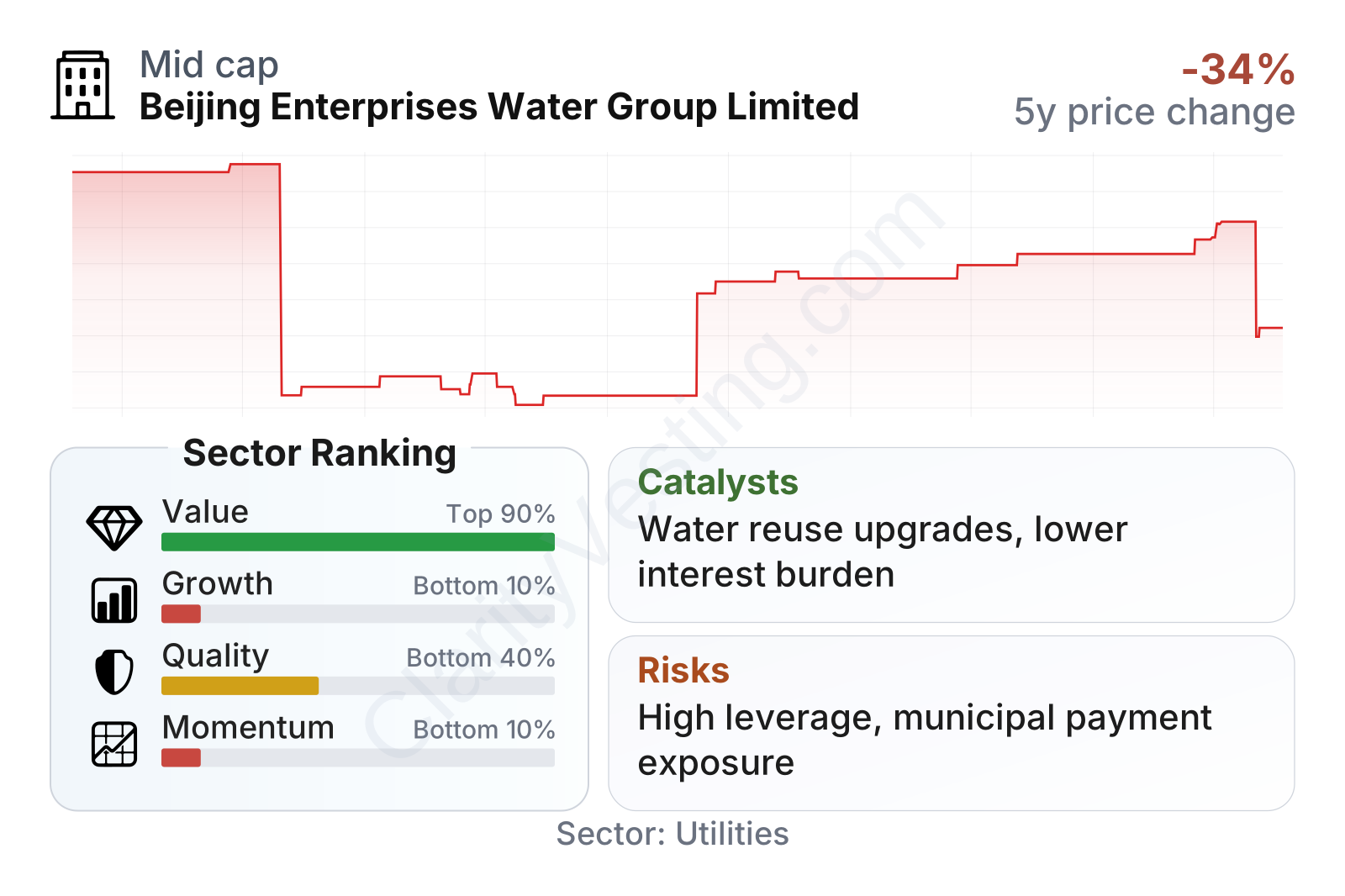
The overall profile is unusual: valuation metrics look very inexpensive versus the regulated water sector, but that low pricing comes alongside weak growth rankings, below-median returns on assets, and a heavy balance sheet. The company’s market value is in the mid-cap range, and its beta is low, which fits the defensive nature of water utilities. The dividend yield is high relative to the sector, and free cash flow is positive, but leverage remains elevated, with debt-to-equity above 300% and interest coverage under 3 times. In short, the market appears to be discounting balance-sheet pressure and slow growth more than near-term cash generation.
Growth
The water and wastewater treatment sector remains supported by long-term fundamentals. Urbanization, tighter discharge standards, water scarcity, and rising reuse requirements all favor companies that already operate treatment networks at scale. In China, these themes are especially relevant because local governments continue to prioritize water quality, river basin management, sewage collection, and reclaimed water usage as part of broader environmental targets.
Beijing Enterprises Water Group’s strategy still makes industrial sense. It already has a large installed base of municipal water assets, which can create follow-on opportunities in upgrades, efficiency improvement, sludge treatment, rural sewage treatment, and water reuse. In utility-like businesses, growth does not only come from building new plants; it also comes from improving utilization, renewing tariffs, extending concession periods, and adding adjacent treatment services around existing projects.
That said, the recent operating pattern points more to consolidation than expansion. Revenue per share has been trending downward over the last five years, which suggests that the company has not yet translated its asset base into clear per-share growth.
A major catalyst could come from policy-driven capital spending on wastewater reuse and stricter environmental compliance. Water scarcity in northern China and broader national decarbonization and pollution-control goals could also support demand for upgrading treatment standards rather than simply adding basic capacity. Another positive sign is that financing costs have eased from their recent peak, which matters because lower interest burden can materially improve net profit in a capital-intensive utility.
Recent company communications have also emphasized continued focus on core water operations, disciplined project selection, and operational efficiency. For a business with an already large footprint, better project quality and lower financing intensity may be more important than headline expansion.
Risks
This article is for informational purposes only and does not constitute financial advice. Some content is AI-generated. See Disclaimer


