Stock Analysis · Beijing Enterprises Holdings Limited (BJINF)
Overview
Beijing Enterprises Holdings Limited is a Hong Kong-listed infrastructure and public-utility group with operations centered on mainland China. Its businesses are tied to everyday essential services rather than discretionary consumer demand. The company is best known for city gas distribution, water-related operations, and environmental services, and it also has brewery exposure through its stake in Yanjing Beer.
This mix makes the group different from a typical industrial conglomerate. A large share of activity comes from regulated or quasi-regulated utility services, which can provide steadier demand than cyclical manufacturing businesses. At the same time, the portfolio structure also makes the company more complex to analyze because earnings come from several subsidiaries and associates with different economics.
Based on recent annual reporting and segment disclosures, revenue is mainly generated from the following activities:
- Gas operations: approximately 65% to 75% of revenue. This includes natural gas transmission, gas distribution networks, gas sales to residential, commercial, and industrial users, and related connection services.
- Beer operations: approximately 15% to 25% of revenue. This comes mainly from the Yanjing Beer business, including production and sale of beer and related beverages.
- Water and environmental operations: approximately 8% to 15% of revenue. This includes water treatment, sewage treatment, reclaimed water, solid waste treatment, and environmental infrastructure services.
- Other businesses: typically a small residual share. This can include corporate-level items and smaller operating segments.
The broad revenue base helps reduce dependence on any single activity, but gas remains the economic core of the group. That matters because gas demand, infrastructure buildout, and regulation are likely to shape most of the company’s long-term results.
The business flow over the last several years shows a company with large revenue volume but relatively thin operating margins. Revenue has moved in a wide range and recovered strongly by 2025, yet profit conversion has been less consistent. Gross profit has stayed fairly stable compared with revenue, while interest expense remains meaningful, which highlights how important financing costs are to the overall earnings picture.
Key Figures
| Metric | Value | Sector ⓘ |
|---|---|---|
| Date | Oct 17, 2026 | |
| Context | ||
| Sector | Industrials | |
| Industry | Conglomerates | |
| Market Cap ⓘ | $4.37B | |
| Beta ⓘ | 0.65 | |
Value (Cheapness) | ||
| P/E Ratio ⓘ | 5.88 | 22.10 |
| P/B Ratio ⓘ | 0.05 | 1.97 |
| FCF Yield ⓘ | 149.71% | 6.38% |
| Dividend Yield ⓘ | 35.58% | 1.94% |
| EBIT / EV ⓘ | N/A | 4.79% |
| PEG ⓘ | 0.44 | |
Growth (Business expansion) | ||
| Revenue Growth ⓘ | 1.10% | 9.30% |
| RPS Growth (5Y CAGR) ⓘ | 9.57% | 7.81% |
| EPS Growth (5Y CAGR) ⓘ | -21.99% | -13.06% |
| BVPS Growth (5Y CAGR) ⓘ | -2.78% | 6.14% |
| Margin Growth (5Y Trend) ⓘ | -1.39% | 0.88% |
| FCF Growth (5Y CAGR) ⓘ | N/A | 11.01% |
| DPS Growth (5Y CAGR) ⓘ | 9.53% | 9.48% |
Quality (Business durability) | ||
| ROIC (Latest) ⓘ | N/A | 10.84% |
| ROA (Latest) ⓘ | 4.47% | 5.41% |
| ROIC (5Y Median) ⓘ | 1.99% | 9.38% |
| ROA (5Y Median) ⓘ | 2.85% | 4.95% |
| Net Debt / EBIT (Latest) ⓘ | 7.99 | 2.08 |
| Net Debt / EBIT (5Y Median) ⓘ | 11.24 | 2.27 |
| Net Debt / EBITDA (Latest) ⓘ | 3.45 | 1.39 |
| Net Debt / Assets ⓘ | 23.03% | 19.28% |
| EBITDA / Interest ⓘ | 4.87 | 9.58 |
| Operating Margin (Latest) ⓘ | 4.30% | 10.50% |
| Operating Margin (5Y Median) ⓘ | 5.37% | 10.29% |
| Debt to Equity (Latest) ⓘ | 88.07% | 65.48% |
| Profit Margin (Latest) ⓘ | 5.92% | 6.67% |
| Free Cash Flow (Latest) ⓘ | $6.54B | |
Momentum (Price trend) | ||
| 3Y Return ⓘ | +41.12% | +61.68% |
| 12M Return (excl. last month) ⓘ | +5.13% | +12.58% |
| 6M Return ⓘ | +16.22% | 0.00% |
| Price vs. 200-Day MA ⓘ | +13.72% | +0.02% |
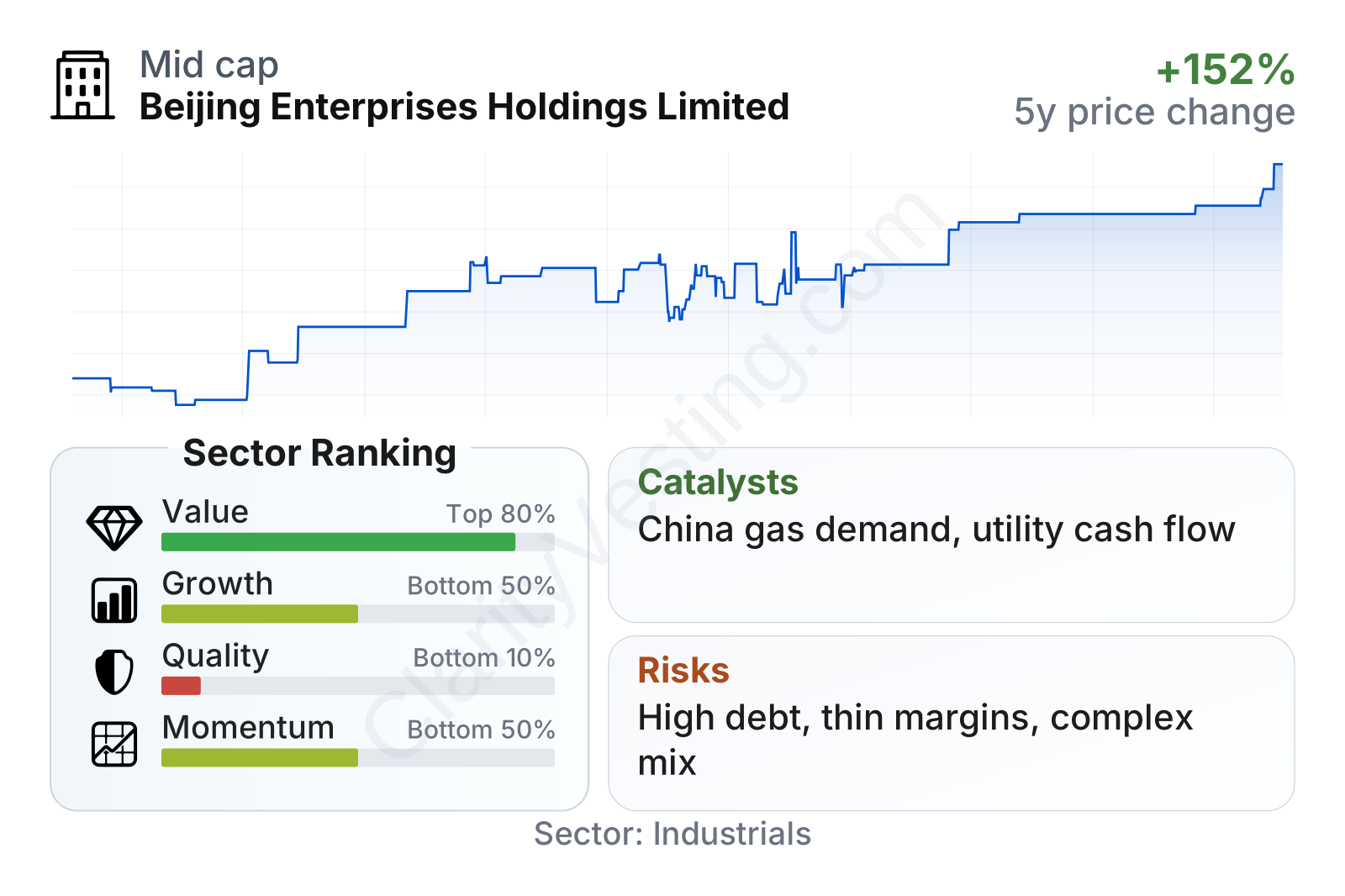
Beijing Enterprises is a mid-sized listed company with lower share-price volatility than many industrial names, as shown by a beta well below 1. On valuation measures, it screens as unusually cheap relative to the sector, with a low earnings multiple, a very low price-to-book ratio, and an elevated free cash flow yield and dividend yield. The tradeoff is that quality and growth indicators are weaker: leverage is above sector norms, margins are thinner, and recent revenue growth has lagged the broader industrial group. Momentum has improved in the shorter term, but the longer record is more mixed than the valuation alone would suggest.
Growth
The company operates in sectors that still have long-term relevance in China: urban gas distribution, water treatment, wastewater handling, and environmental infrastructure. These are not fast-moving technology markets, but they are linked to urbanization, cleaner energy use, stricter environmental standards, and the need to modernize municipal systems. That gives the business a structural demand base even when the broader economy softens.
The clearest long-term growth logic is in gas and environmental services. Natural gas has often been positioned as a transition fuel in China’s energy mix, especially where it replaces coal in urban and industrial use. Water and waste treatment also benefit from long investment cycles and recurring service demand once assets are built and connected to municipalities. This is the kind of expansion that tends to be gradual rather than explosive.
The company’s strategy also makes sense in another way: it is concentrated in essential infrastructure where scale, licenses, and local government relationships matter. These are markets where new entrants usually face more barriers than in ordinary consumer categories. If Beijing Enterprises can keep adding projects, improving utilization, and controlling financing costs, modest top-line growth can still translate into meaningful cash generation.
A visible positive point is that the stock has shown a firmer trend over the past year and is trading above its longer-term average level, while the company continues to generate sizable free cash flow in absolute terms. In addition, the dividend profile remains prominent, which can support market attention when earnings growth is not especially rapid. The main opportunity is not a sudden transformation, but the possibility that stable utility-like assets and low valuation continue to attract interest if operating results remain resilient.
Risks
This article is for informational purposes only and does not constitute financial advice. Some content is AI-generated. See Disclaimer


