Stock Analysis · BJs Wholesale Club Holdings Inc (BJ)
Overview
BJ’s Wholesale Club Holdings operates membership-based warehouse clubs in the United States. The company sells groceries, fresh food, general merchandise, gasoline, and household essentials, mainly to value-focused families and small business customers. Its model is built around charging an annual membership fee and then using that recurring relationship to drive frequent purchases, including both in-club shopping and digital orders. Compared with a traditional supermarket, the warehouse club format emphasizes larger pack sizes, a narrower assortment, and lower prices per unit.
The business is heavily driven by merchandise sales, while membership fees provide a smaller but important stream of recurring income that helps support profitability. Based on recent annual reporting, the revenue mix is approximately:
- Merchandise sales: about 97% of total revenue. This includes food, perishables, sundries, non-food general merchandise, and other items sold in clubs and through digital channels.
- Membership fee income: about 2% of total revenue. This comes from annual memberships, including higher-tier plans with added rewards or benefits.
- Other revenue: about 1% or less. This mainly includes services and other ancillary activities tied to club operations.
Inside merchandise sales, groceries and everyday consumables are the biggest categories, which tends to make demand steadier than in more discretionary retail models. Gasoline is also a useful traffic driver because it encourages repeat visits and improves the value proposition of the membership.
Over the last several fiscal years, revenue has climbed from roughly $16.7 billion to about $21.5 billion, while net income also moved higher. That points to a business that has expanded meaningfully in scale, even though retail margins remain structurally thin.
The operating picture shows a familiar warehouse-club pattern: very high cost of goods, modest operating margins, and gradual gains in gross profit dollars as sales rise. Selling and administrative costs have also increased with growth, but earnings have still improved over the period, suggesting the company has preserved discipline while expanding.
Key Figures
| Metric | Value | Sector ⓘ |
|---|---|---|
| Date | Oct 17, 2026 | |
| Context | ||
| Sector | Consumer Defensive | |
| Industry | Discount Stores | |
| Market Cap ⓘ | $12.61B | |
| Beta ⓘ | 0.17 | |
Value (Cheapness) | ||
| P/E Ratio ⓘ | 21.84 | 17.88 |
| P/B Ratio ⓘ | 5.79 | 1.29 |
| FCF Yield ⓘ | 2.89% | 12.39% |
| Dividend Yield ⓘ | N/A | 2.85% |
| EBIT / EV ⓘ | 6.17% | 6.43% |
| PEG ⓘ | 2.08 | |
Growth (Business expansion) | ||
| Revenue Growth ⓘ | 15.70% | 4.10% |
| RPS Growth (5Y CAGR) ⓘ | 7.70% | 6.18% |
| EPS Growth (5Y CAGR) ⓘ | -12.48% | -13.59% |
| BVPS Growth (5Y CAGR) ⓘ | 37.21% | 3.20% |
| Margin Growth (5Y Trend) ⓘ | 0.16% | -0.15% |
| FCF Growth (5Y CAGR) ⓘ | -10.98% | 4.10% |
| DPS Growth (5Y CAGR) ⓘ | 0.97% | 6.79% |
Quality (Business durability) | ||
| ROIC (Latest) ⓘ | 22.57% | 12.34% |
| ROA (Latest) ⓘ | 7.65% | 6.30% |
| ROIC (5Y Median) ⓘ | 27.87% | 10.49% |
| ROA (5Y Median) ⓘ | 7.94% | 5.44% |
| Net Debt / EBIT (Latest) ⓘ | 3.15 | 1.96 |
| Net Debt / EBIT (5Y Median) ⓘ | 3.69 | 2.35 |
| Net Debt / EBITDA (Latest) ⓘ | 2.34 | 1.38 |
| Net Debt / Assets ⓘ | 34.33% | 21.51% |
| EBITDA / Interest ⓘ | 25.31 | 9.46 |
| Operating Margin (Latest) ⓘ | 3.82% | 8.87% |
| Operating Margin (5Y Median) ⓘ | 3.79% | 9.53% |
| Debt to Equity (Latest) ⓘ | 126.21% | 72.35% |
| Profit Margin (Latest) ⓘ | 2.61% | 5.40% |
| Free Cash Flow (Latest) ⓘ | $364.21M | |
Momentum (Price trend) | ||
| 3Y Return ⓘ | +44.07% | +20.92% |
| 12M Return (excl. last month) ⓘ | -7.08% | +2.13% |
| 6M Return ⓘ | +6.87% | +1.26% |
| Price vs. 200-Day MA ⓘ | +6.29% | +1.39% |
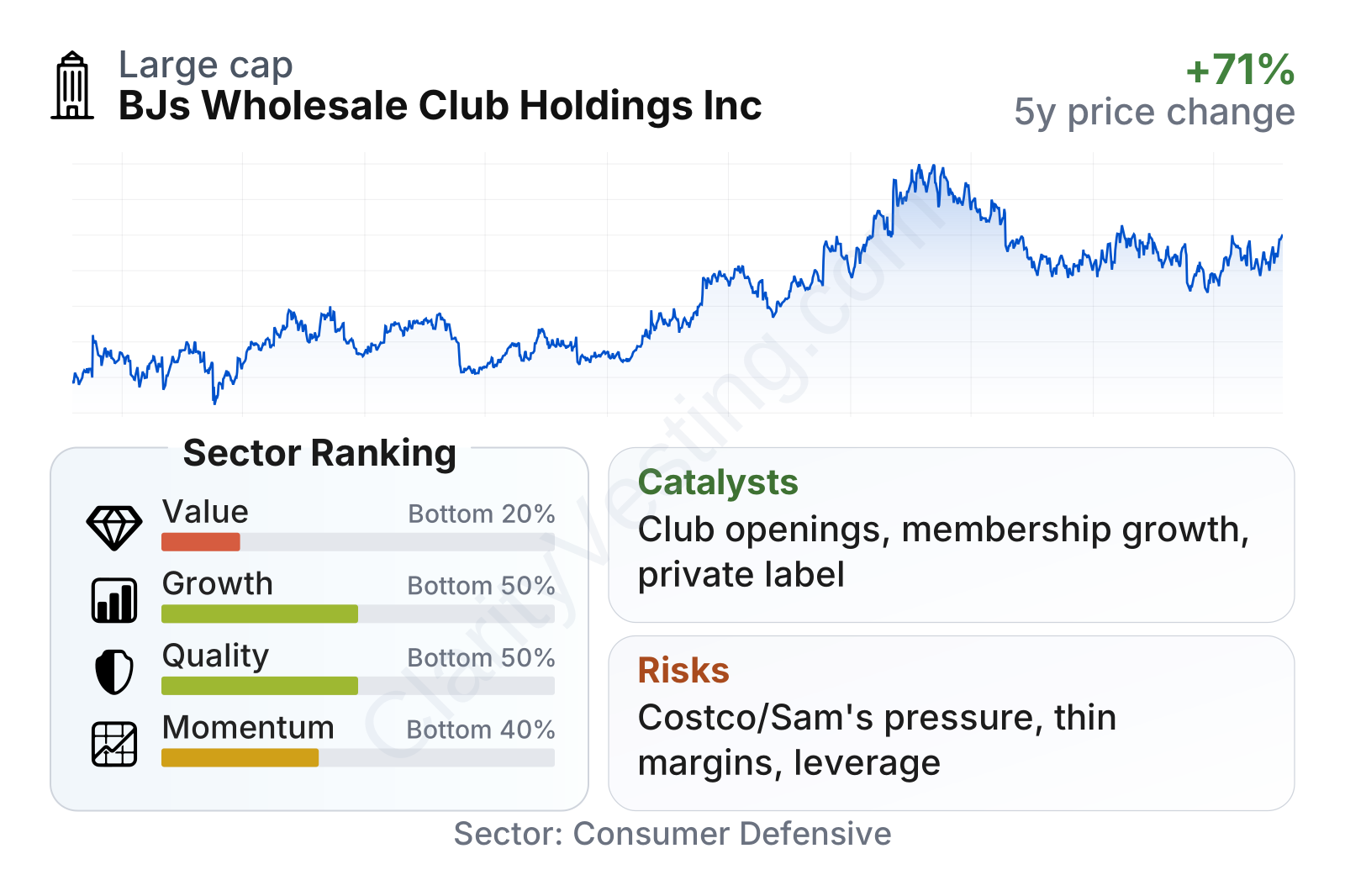
BJ’s is a mid-sized public retailer with a market value a little above $12 billion and a notably low stock beta, which means its share price has historically moved less than the broader market. The factor profile is mixed. Growth has been solid on revenue, and returns on invested capital are strong versus many sector peers, but value metrics do not look cheap relative to the sector, while momentum has cooled after a strong multi-year run.
The market has rewarded the company over the last three years, but the stock has been more uneven more recently. That combination usually reflects a business the market respects for consistency, while also expecting continued execution.
Growth
BJ’s operates in a part of retail that still has attractive long-term features. Warehouse clubs benefit from consumers’ ongoing search for value, especially during periods of grocery inflation or economic pressure. Food-at-home demand is naturally recurring, and the membership structure creates habits that can strengthen customer retention over time. This is not a high-growth technology market, but it is a durable segment with room for steady expansion.
The company’s strategy for future growth is straightforward and credible: open more clubs, grow membership, improve digital convenience, and lift spending per member. BJ’s has been expanding beyond its more established Northeast base into other regions, which matters because unit growth remains one of the clearest ways to increase scale. The model also becomes stronger as density improves around distribution, private-label sourcing, and marketing.
Recent revenue growth has reaccelerated and is running well above the sector median. The pattern has not been perfectly smooth from quarter to quarter, but the broader trend suggests BJ’s has continued to gain sales despite a competitive consumer environment. Its five-year revenue-per-share growth also stands above the sector median, indicating that expansion has not depended only on financial engineering.
Another important growth support is private label, led by the Wellsley Farms and Berkley Jensen brands. Private-label products can improve margins, deepen customer loyalty, and make direct price comparisons with competitors harder. In a value-focused format, that is a meaningful advantage.
Free cash flow has been positive throughout the period, although it has not grown in a straight line. That matters because club expansion, supply-chain investment, and technology upgrades all require cash. The recent improvement from earlier lows suggests the business still has internal capacity to fund growth, even if cash generation is not especially abundant relative to the company’s size.
A recent opportunity worth watching is BJ’s continued club-opening pipeline and market expansion efforts, along with investments in digital fulfillment and advertising-related capabilities. These are practical levers rather than speculative ones: more locations can add members, digital tools can increase convenience and basket size, and retail media can create a higher-margin incremental revenue stream over time.
Risks
This article is for informational purposes only and does not constitute financial advice. Some content is AI-generated. See Disclaimer


