Stock Analysis · Bio-Rad Laboratories Inc (BIO)
Overview
Bio-Rad Laboratories is a healthcare tools company that sells instruments, software, reagents, and services used in research laboratories, clinical diagnostics, and biopharmaceutical production. In simple terms, it provides the equipment and consumable products that scientists and medical labs use to analyze samples, run tests, and manufacture or monitor biologic drugs. The business is built around many routine, repeat-use applications, which is important because customers often keep buying reagents and test materials long after an instrument is installed.
Bio-Rad reports two main operating segments, and the larger one is Life Science. Based on the company’s latest annual reporting, revenue sources are approximately:
- Life Science, about 56% of revenue: products for cell biology, gene expression, protein analysis, chromatography, process analytics, digital PCR, and tools used in biopharma development and quality control. This segment includes a mix of instruments and recurring consumables.
- Clinical Diagnostics, about 44% of revenue: quality controls, blood typing, diabetes testing, autoimmune and infectious disease testing, and other products used by hospitals and clinical laboratories to support diagnostic workflows.
Geographically, Bio-Rad is a global company with revenue spread across the Americas, Europe, and Asia-Pacific, which reduces dependence on a single country but also exposes it to currency swings and uneven lab spending trends across regions.
One important point for long-term readers: Bio-Rad’s accounting results can look unusually volatile because the company has historically held a significant equity stake in Sartorius AG. Changes in the value of that holding have at times had a very large effect on reported net income, even when the underlying operating business was much steadier. That means revenue, operating margin, and cash flow are often more useful than net income alone when judging the core business.
The longer-term pattern in the business mix is fairly stable: a large base of recurring consumables, moderate capital equipment exposure, and an installed base that supports repeat purchases. Revenue has been soft in recent years, but gross profit has remained substantial and free cash flow has recovered, suggesting the operating franchise remains intact even through a slower demand cycle.
Key Figures
| Metric | Value | Sector ⓘ |
|---|---|---|
| Date | Oct 10, 2026 | |
| Context | ||
| Sector | Healthcare | |
| Industry | Medical Devices | |
| Market Cap ⓘ | $9.84B | |
| Beta ⓘ | 1.07 | |
Value (Cheapness) | ||
| P/E Ratio ⓘ | 46.63 | 24.79 |
| P/B Ratio ⓘ | 1.35 | 2.97 |
| FCF Yield ⓘ | 3.59% | 3.11% |
| Dividend Yield ⓘ | N/A | 2.04% |
| EBIT / EV ⓘ | 4.07% | 0.57% |
| PEG ⓘ | 1.19 | |
Growth (Business expansion) | ||
| Revenue Growth ⓘ | -0.10% | 7.35% |
| RPS Growth (5Y CAGR) ⓘ | -0.54% | 8.61% |
| EPS Growth (5Y CAGR) ⓘ | -26.40% | -18.43% |
| BVPS Growth (5Y CAGR) ⓘ | -11.88% | 3.94% |
| Margin Growth (5Y Trend) ⓘ | N/A | -0.61% |
| FCF Growth (5Y CAGR) ⓘ | -8.56% | 0.88% |
| DPS Growth (5Y CAGR) ⓘ | 127.95% | 6.74% |
Quality (Business durability) | ||
| ROIC (Latest) ⓘ | 3.08% | 3.34% |
| ROA (Latest) ⓘ | 2.23% | 2.95% |
| ROIC (5Y Median) ⓘ | -6.02% | 4.60% |
| ROA (5Y Median) ⓘ | -4.94% | 1.89% |
| Net Debt / EBIT (Latest) ⓘ | 1.72 | 1.36 |
| Net Debt / EBIT (5Y Median) ⓘ | N/A | 1.86 |
| Net Debt / EBITDA (Latest) ⓘ | 1.33 | 1.02 |
| Net Debt / Assets ⓘ | 6.70% | 5.85% |
| EBITDA / Interest ⓘ | 10.55 | 9.60 |
| Operating Margin (Latest) ⓘ | 15.42% | 9.19% |
| Operating Margin (5Y Median) ⓘ | -29.97% | 7.53% |
| Debt to Equity (Latest) ⓘ | 16.78% | 29.44% |
| Profit Margin (Latest) ⓘ | 8.59% | 3.52% |
| Free Cash Flow (Latest) ⓘ | $353.10M | |
Momentum (Price trend) | ||
| 3Y Return ⓘ | +0.41% | +34.80% |
| 12M Return (excl. last month) ⓘ | +30.90% | +19.33% |
| 6M Return ⓘ | +28.19% | +7.18% |
| Price vs. 200-Day MA ⓘ | +16.60% | +3.20% |
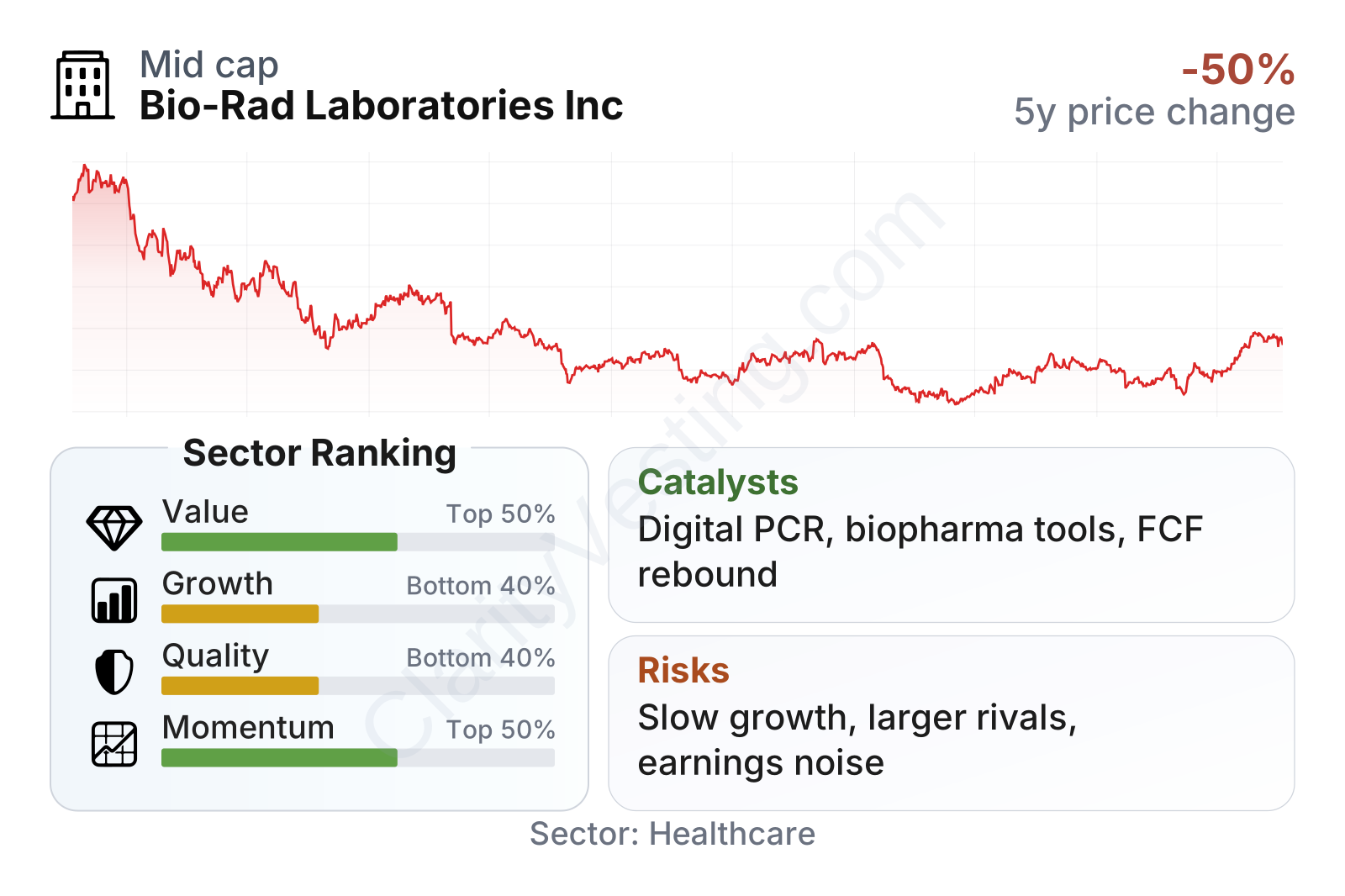
Bio-Rad is a mid-to-large healthcare tools company with share-price volatility close to the broader market. The overall profile is mixed. On valuation measures, it screens reasonably well in some areas such as price-to-book, free-cash-flow yield, and EBIT relative to enterprise value, but the earnings multiple is above the sector median. The larger issue is growth: recent revenue growth has been close to flat, and five-year growth measures are weak relative to the healthcare sector. Profitability today looks healthier than the long-run averages suggest, with operating margin and profit margin currently above sector medians, while leverage remains relatively modest.
Growth
Bio-Rad operates in parts of healthcare that generally have favorable long-term demand drivers. Research tools, molecular biology, bioprocessing support, and clinical diagnostics all benefit from rising testing volumes, drug development activity, biologics manufacturing, and the broader use of precision medicine. These are not short-lived themes. Over long periods, labs need higher accuracy, more automation, and better data handling, all of which support demand for specialized instruments and consumables.
That said, being in an attractive sector has not automatically translated into strong recent growth for Bio-Rad. Revenue has been under pressure for several years, reflecting softer academic and biotech spending, normalization after pandemic-era demand distortions, and uneven capital equipment purchases. More recently, the trend appears to have stabilized, with year-over-year comparisons moving closer to flat and occasionally returning to low positive growth.
The growth debate therefore depends less on whether the sector itself is promising and more on whether Bio-Rad can convert its technology base and installed customer relationships into a stronger sales trajectory. Its strategy still makes sense for that goal. The company is focused on high-value niches where performance matters, such as digital PCR, quality control in diagnostics, and biopharma-related workflow tools. These areas can support repeat revenue because customers often validate processes around a platform and then stay with it for years.
A notable catalyst is digital PCR, where Bio-Rad has long had a recognized position. The technology is used in applications such as oncology research, cell and gene therapy workflows, infectious disease analysis, and highly sensitive sample quantification. If adoption broadens further in clinical and biopharma settings, it could support both instrument placements and recurring consumable sales.
Another growth support is the company’s clinical diagnostics franchise, especially quality controls and specialized testing categories that tend to be less discretionary than research budgets. This does not usually produce rapid growth, but it can create steadier demand and help balance weakness in more cyclical research markets.
Cash generation has improved meaningfully from the weaker levels seen earlier in the cycle.
The rebound in free cash flow is important because it suggests the business is converting a larger share of its revenue into usable cash again, even before a strong top-line recovery is visible. That can support internal investment, acquisitions, and balance-sheet flexibility. In 2026, public company communications have continued to emphasize productivity, portfolio discipline, and selective investment in higher-value platforms rather than chasing volume at any cost. For a long-term view, that is a more credible path than relying on a sharp near-term sales rebound.
Risks
This article is for informational purposes only and does not constitute financial advice. Some content is AI-generated. See Disclaimer


