Stock Analysis · Bio-Rad Laboratories Inc (BIO-B)
Overview
Bio-Rad Laboratories is a healthcare and life science tools company that sells instruments, consumables, software, and services used in research laboratories, clinical diagnostics, and biopharmaceutical production. Its products help scientists study genes and proteins, support quality control in drug manufacturing, and assist hospitals and labs in running diagnostic tests. The company operates globally and has built a broad installed base of instruments, which matters because many of its recurring sales come from the reagents, test kits, and other consumables used with those systems.
Bio-Rad reports its business in two main segments. Based on its latest annual reporting, revenue is primarily split as follows:
- Life Science: about 45% of revenue. This includes research instruments and consumables used in areas such as genomics, proteomics, cell biology, food safety, and biopharma process development. Important product families include droplet digital PCR, chromatography systems, imaging, and antibodies.
- Clinical Diagnostics: about 55% of revenue. This segment includes quality controls, immunohematology systems, diabetes testing products, and microbiology-related diagnostics sold to hospitals, blood banks, and clinical laboratories.
Within those segments, Bio-Rad has a useful mix of equipment and recurring consumables. Instruments create the installed base, while reagents and controls support repeat purchases over time. That model can provide resilience, although demand has recently been uneven across parts of the business. The long-term revenue pattern has also been influenced by the normalization that followed unusually strong pandemic-era testing activity.
The business profile still shows healthy gross profit, but recent years were heavily distorted by large accounting swings tied in part to mark-to-market changes in equity holdings rather than only core operations. That is why headline net income has looked unusually volatile compared with revenue and cash generation.
Revenue has drifted down from the 2021 peak, while operating expenses stayed fairly steady. That combination pressured reported profitability, but the latest period shows a clearer recovery in operating earnings and net income compared with the loss-making stretch that followed.
Key Figures
| Metric | Value | Sector ⓘ |
|---|---|---|
| Date | Oct 17, 2026 | |
| Context | ||
| Sector | Healthcare | |
| Industry | Medical Devices | |
| Market Cap ⓘ | $9.75B | |
| Beta ⓘ | 1.07 | |
Value (Cheapness) | ||
| P/E Ratio ⓘ | 46.15 | 24.79 |
| P/B Ratio ⓘ | 1.36 | 3.08 |
| FCF Yield ⓘ | 3.62% | 3.15% |
| Dividend Yield ⓘ | N/A | 1.94% |
| EBIT / EV ⓘ | 4.07% | 0.57% |
| PEG ⓘ | 1.21 | |
Growth (Business expansion) | ||
| Revenue Growth ⓘ | -0.10% | 7.45% |
| RPS Growth (5Y CAGR) ⓘ | -0.54% | 8.61% |
| EPS Growth (5Y CAGR) ⓘ | N/A | -17.81% |
| BVPS Growth (5Y CAGR) ⓘ | -11.88% | 3.72% |
| Margin Growth (5Y Trend) ⓘ | N/A | -0.62% |
| FCF Growth (5Y CAGR) ⓘ | -8.56% | 1.04% |
| DPS Growth (5Y CAGR) ⓘ | 127.95% | 6.77% |
Quality (Business durability) | ||
| ROIC (Latest) ⓘ | 3.08% | 3.24% |
| ROA (Latest) ⓘ | 2.23% | 3.01% |
| ROIC (5Y Median) ⓘ | -6.02% | 4.60% |
| ROA (5Y Median) ⓘ | -4.94% | 1.89% |
| Net Debt / EBIT (Latest) ⓘ | 1.72 | 1.34 |
| Net Debt / EBIT (5Y Median) ⓘ | N/A | 1.84 |
| Net Debt / EBITDA (Latest) ⓘ | 1.33 | 1.00 |
| Net Debt / Assets ⓘ | 6.70% | 5.45% |
| EBITDA / Interest ⓘ | 10.55 | 9.64 |
| Operating Margin (Latest) ⓘ | 15.42% | 9.27% |
| Operating Margin (5Y Median) ⓘ | -29.97% | 7.38% |
| Debt to Equity (Latest) ⓘ | 16.78% | 28.58% |
| Profit Margin (Latest) ⓘ | 8.59% | 3.59% |
| Free Cash Flow (Latest) ⓘ | $353.10M | |
Momentum (Price trend) | ||
| 3Y Return ⓘ | +2.56% | +42.80% |
| 12M Return (excl. last month) ⓘ | +47.78% | +18.50% |
| 6M Return ⓘ | +31.46% | +7.57% |
| Price vs. 200-Day MA ⓘ | +14.82% | +5.12% |
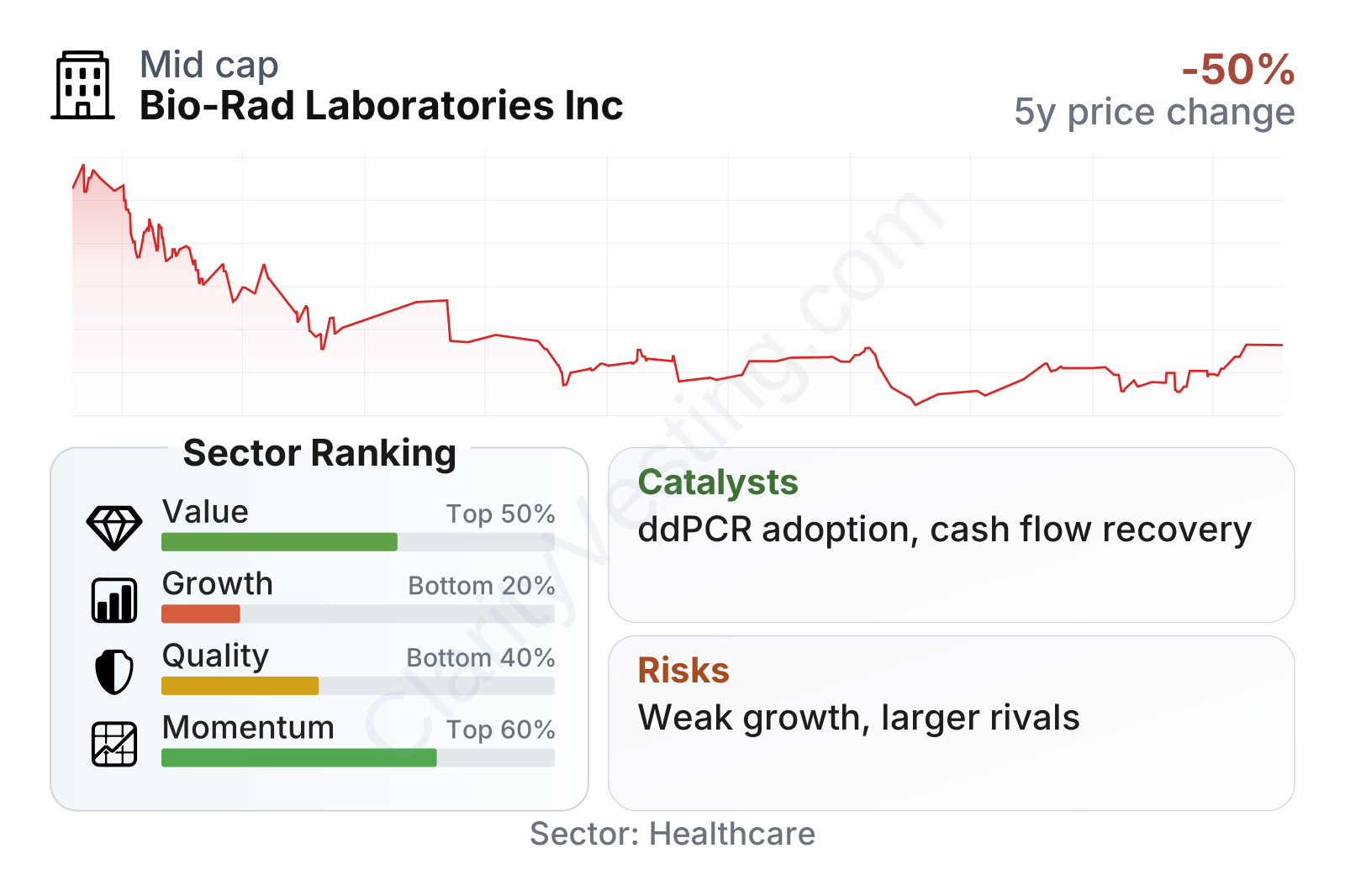
Bio-Rad sits in the large-cap range within healthcare, with share-price volatility close to the broader market. The overall profile is mixed: valuation measures are not uniformly expensive, especially on book value and cash flow, but growth metrics rank weakly versus the sector. Profitability has improved recently, and current operating margin stands above the sector median, yet longer-term return measures still reflect the difficult period after 2021. Market momentum has turned better over the last 6 to 12 months, even though the stock remains far below its earlier highs.
Growth
Bio-Rad operates in markets with attractive long-term foundations. Life science research tools benefit from growth in molecular biology, precision medicine, biologics manufacturing, and more complex testing workflows. Clinical diagnostics tends to be steadier and supported by ongoing healthcare demand, quality assurance needs, and chronic disease testing. These are not fast-changing consumer markets; they are specialized fields where installed systems, regulatory requirements, and laboratory workflows can create durable demand over time.
The main question is not whether the sector has long-term relevance, but whether Bio-Rad can return to a stronger growth path. Recent revenue performance has been soft, with several quarters of declines before stabilizing around flat to modestly positive territory.
The pattern suggests the business is moving out of a prolonged contraction, but not yet into a clearly strong expansion phase. That matters because the healthcare tools sector has many companies growing faster. Bio-Rad therefore needs more than industry tailwinds; it needs product execution and share gains in its core niches.
One of the company’s more important long-term growth engines is droplet digital PCR, a technology used for highly sensitive and precise genetic analysis. This is one of Bio-Rad’s best-known franchises and an area where it has meaningful technical credibility. Growth can also come from biopharma quality control, blood typing and transfusion-related testing, and recurring demand in clinical lab controls. In addition, management has continued to invest in research and development even during a weaker sales period, which supports the case for future product refreshes.
Cash generation has improved more clearly than revenue.
Free cash flow has recovered from the low point seen in 2023 and is now running at a healthier level. That does not solve the growth problem on its own, but it gives the company more flexibility to fund research, maintain its balance sheet, and absorb slower demand without immediate financial stress.
A meaningful recent development is the stronger rebound in reported earnings and margins during the latest period after several years distorted by non-cash investment-related swings. If that normalization continues, the market may increasingly focus on the operating business rather than the earlier accounting noise. Another opportunity is any broader recovery in life science spending, especially if academic, biotech, and biopharma customers loosen budgets after a cautious period.
Risks
This article is for informational purposes only and does not constitute financial advice. Some content is AI-generated. See Disclaimer


