Stock Analysis · Biogen Inc (BIIB)
Overview
Biogen is a large biotechnology company focused on treatments for serious neurological, neurodegenerative, and rare diseases. In simple terms, it develops and sells medicines mainly for conditions affecting the brain, spinal cord, and immune system. The company has long been known for multiple sclerosis, but its business has been shifting as older products mature and newer growth programs in Alzheimer’s disease, rare diseases, and immunology become more important.
Biogen’s revenue mix is spread across a handful of major medicines and partner-based arrangements. Based on recent company reporting, the business is still led by neuroscience products, with rare disease and biosimilars adding diversification.
- Multiple sclerosis products: approximately 45% to 50% of revenue. This group includes Tecfidera, Vumerity, Tysabri, Avonex, Plegridy, and related products. It remains the largest source, although several of these medicines face generic or competitive pressure.
- Spinal muscular atrophy royalties: approximately 15% to 20%. This mainly comes from royalty revenue tied to Spinraza sales booked by partner companies rather than by Biogen directly.
- Rare disease products: approximately 15% to 20%. This category has become more meaningful after the Reata acquisition, notably with Skyclarys for Friedreich’s ataxia.
- Alzheimer’s disease revenue: approximately 5% to 10%. This is centered on Leqembi, which Biogen commercializes with Eisai and which is still in an early launch phase.
- Biosimilars: approximately 5% to 10%. These are lower-cost versions of biologic medicines marketed mainly outside the United States through partnerships.
- Other neurology and partner revenue: a smaller share from products such as Zurzuvae collaboration economics and other contractual revenue items.
Biogen’s recent business profile shows a company in transition: older cash-generating products still matter a lot, but management is trying to replace those declines with newer launches and a broader rare disease platform.
The overall pattern over the last several years shows revenue drifting lower from 2021 through 2024, then stabilizing around the 2025 level. Research and development spending remains substantial, which is normal for a drug developer, while operating income and net income have been more volatile than revenue because launch costs, acquisitions, and product mix changes affect profitability.
Key Figures
| Metric | Value | Sector ⓘ |
|---|---|---|
| Date | Oct 03, 2026 | |
| Context | ||
| Sector | Healthcare | |
| Industry | Drug Manufacturers - General | |
| Market Cap ⓘ | $33.37B | |
| Beta ⓘ | 0.17 | |
Value (Cheapness) | ||
| P/E Ratio ⓘ | 40.19 | 24.06 |
| P/B Ratio ⓘ | 1.76 | 3.08 |
| FCF Yield ⓘ | 8.90% | 3.07% |
| Dividend Yield ⓘ | N/A | 2.05% |
| EBIT / EV ⓘ | 2.74% | 0.63% |
| PEG ⓘ | 2.35 | |
Growth (Business expansion) | ||
| Revenue Growth ⓘ | 3.40% | 7.50% |
| RPS Growth (5Y CAGR) ⓘ | -2.30% | 8.70% |
| EPS Growth (5Y CAGR) ⓘ | -21.41% | -18.20% |
| BVPS Growth (5Y CAGR) ⓘ | 14.50% | 3.95% |
| Margin Growth (5Y Trend) ⓘ | -9.22% | -0.58% |
| FCF Growth (5Y CAGR) ⓘ | -11.51% | 0.88% |
| DPS Growth (5Y CAGR) ⓘ | N/A | 6.80% |
Quality (Business durability) | ||
| ROIC (Latest) ⓘ | 3.65% | 3.29% |
| ROA (Latest) ⓘ | 2.72% | 3.02% |
| ROIC (5Y Median) ⓘ | 12.03% | 4.75% |
| ROA (5Y Median) ⓘ | 5.95% | 1.93% |
| Net Debt / EBIT (Latest) ⓘ | 6.35 | 1.33 |
| Net Debt / EBIT (5Y Median) ⓘ | 1.82 | 1.83 |
| Net Debt / EBITDA (Latest) ⓘ | 4.23 | 0.99 |
| Net Debt / Assets ⓘ | 22.03% | 5.33% |
| EBITDA / Interest ⓘ | 5.87 | 9.63 |
| Operating Margin (Latest) ⓘ | 11.19% | 9.25% |
| Operating Margin (5Y Median) ⓘ | 24.00% | 7.80% |
| Debt to Equity (Latest) ⓘ | 44.33% | 28.99% |
| Profit Margin (Latest) ⓘ | 8.32% | 3.60% |
| Free Cash Flow (Latest) ⓘ | $2.97B | |
Momentum (Price trend) | ||
| 3Y Return ⓘ | -11.88% | +37.48% |
| 12M Return (excl. last month) ⓘ | +63.39% | +20.85% |
| 6M Return ⓘ | +21.24% | +9.73% |
| Price vs. 200-Day MA ⓘ | +14.28% | +4.69% |
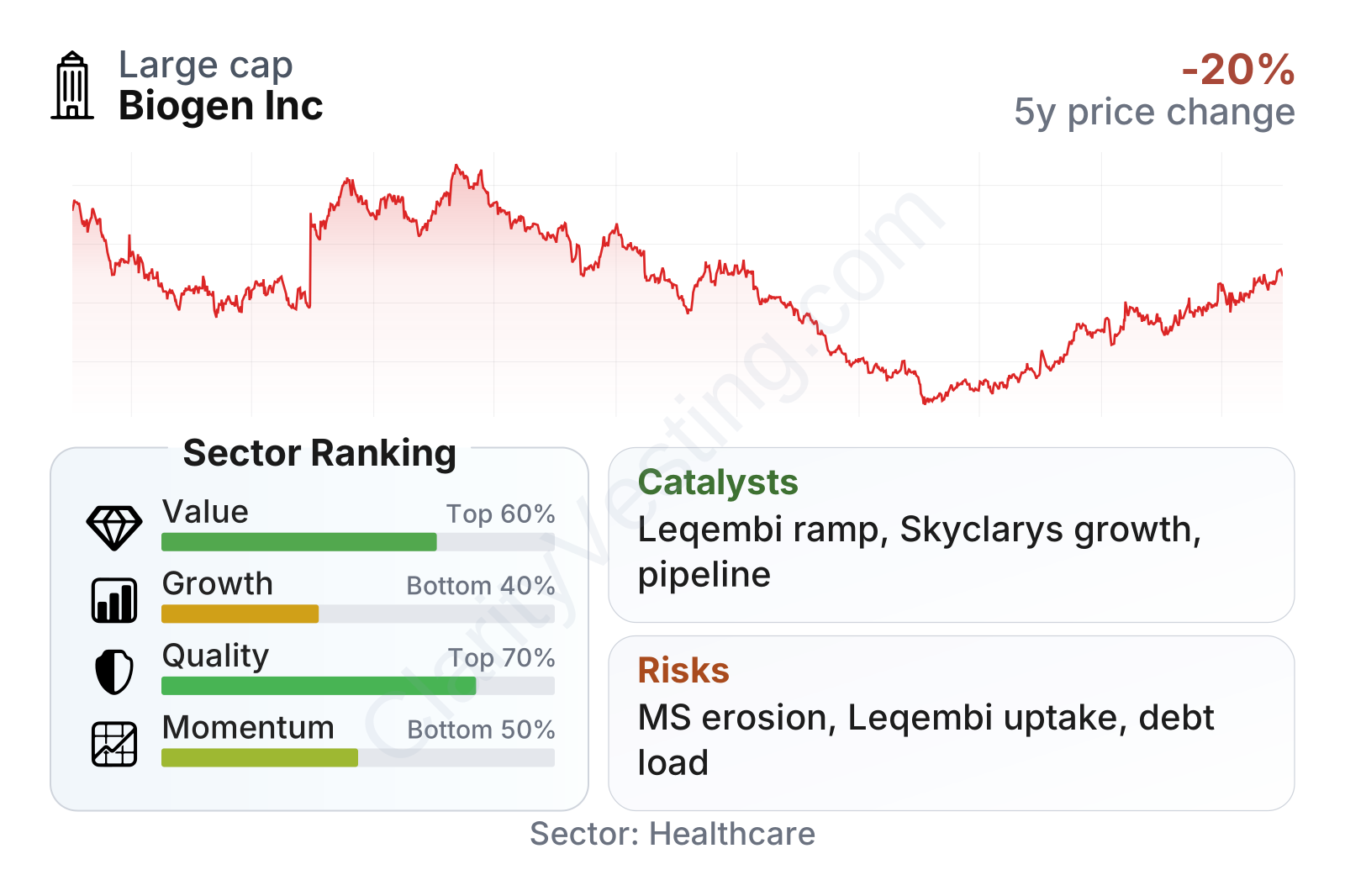
Biogen is a large healthcare company with a relatively low beta, meaning its share price has historically moved less violently than many stocks. On valuation-related metrics, the picture is mixed: the earnings multiple sits above the sector median, but cash generation looks stronger than many peers, with free cash flow yield and EBIT relative to enterprise value standing out positively. Quality is still respectable, especially when looking at longer-term returns on capital and margins, although current debt-related ratios are heavier than sector norms. Growth metrics are the weak point, reflecting a business that has been working through product erosion and portfolio transition rather than enjoying broad-based expansion.
Growth
Biogen operates in parts of healthcare that have attractive long-term demand. Neurology, Alzheimer’s disease, rare diseases, and specialized immunology are all areas where aging populations, unmet medical need, and premium pricing can support future industry growth. In that sense, the company is active in a favorable sector. The bigger question is not whether the market is growing, but whether Biogen can capture enough of that growth to offset declines in older franchises.
The strategy broadly makes sense. Biogen is using cash generated by established products to fund newer launches, acquisitions, and pipeline development. The central growth pillar is Alzheimer’s disease, where Leqembi is one of the few disease-modifying treatments on the market. If physician adoption, diagnostic capacity, and patient monitoring infrastructure continue to improve, this product could become much more meaningful over time. The acquisition of Reata also gave Biogen an immediate rare disease growth asset in Skyclarys, helping reduce reliance on multiple sclerosis.
Revenue growth has improved from the declines seen in 2022 through 2024. Recent year-over-year comparisons turned modestly positive again, which suggests the business may be moving from contraction toward stabilization. That is encouraging, but growth remains slower than the typical healthcare peer, so the turnaround is still incomplete rather than fully established.
Cash generation has also recovered from the low point reached in 2023 and 2024. Trailing free cash flow is back into a stronger range, close to $3 billion, which gives Biogen room to support research, partnerships, debt service, and selective business development. For a company rebuilding growth, that financial flexibility is important.
Recent company developments point to a few meaningful opportunities. Continued label expansion, geographic rollout, and operational improvements around Alzheimer’s treatment pathways could support Leqembi’s sales trajectory. Skyclarys also offers growth from a relatively early commercial base. In addition, Biogen has been reshaping its pipeline and external partnerships, which could create new sources of revenue beyond the mature multiple sclerosis portfolio if development programs succeed.
Risks
This article is for informational purposes only and does not constitute financial advice. Some content is AI-generated. See Disclaimer