Stock Analysis · Burke & Herbert Financial Services Corp (BHRB)
Overview
Burke & Herbert Financial Services Corp is a regional banking company centered in the Mid-Atlantic, with roots in community banking and a broader platform built through expansion and acquisitions. Through Burke & Herbert Bank and related operations, it provides traditional banking services such as commercial and consumer lending, deposit accounts, treasury management, mortgage banking, and wealth-related services. For long-term analysis, the key point is that this is fundamentally a spread-based banking business: it gathers deposits, lends money, invests part of its balance sheet, and earns fees from customer services.
The company’s revenue mix is led by interest income, which is typical for a regional bank. Based on recent annual reporting, the main sources can be summarized as follows:
- Net interest income: approximately 75% to 85% of total revenue. This is the profit earned from loans and securities after paying interest on deposits and other funding sources.
- Service charges and deposit-related fees: approximately 4% to 8%. This usually includes account service fees, overdraft-related charges, and treasury-management-related income.
- Mortgage banking and loan-related fees: approximately 3% to 7%. This can include gains on mortgage origination and sales, plus certain lending-related charges.
- Wealth management, trust, and other noninterest income: approximately 5% to 10%. This generally covers advisory, fiduciary, interchange, and miscellaneous banking fees.
The business remains heavily tied to loan growth, deposit costs, credit quality, and the health of local commercial markets. Recent scale-up has made the company meaningfully larger than it was a few years ago, which is visible in the strong jump in total revenue and expenses over the period. Revenue has expanded sharply since 2023, and net income recovered strongly in 2025 after the pressure that many regional banks experienced when funding costs rose.
The long-term picture shows a bank that became much larger in a short time. Revenue has risen materially since 2021, but the path was not smooth: higher interest expense and integration costs weighed on profitability in 2023 and 2024 before earnings improved again in 2025.
Key Figures
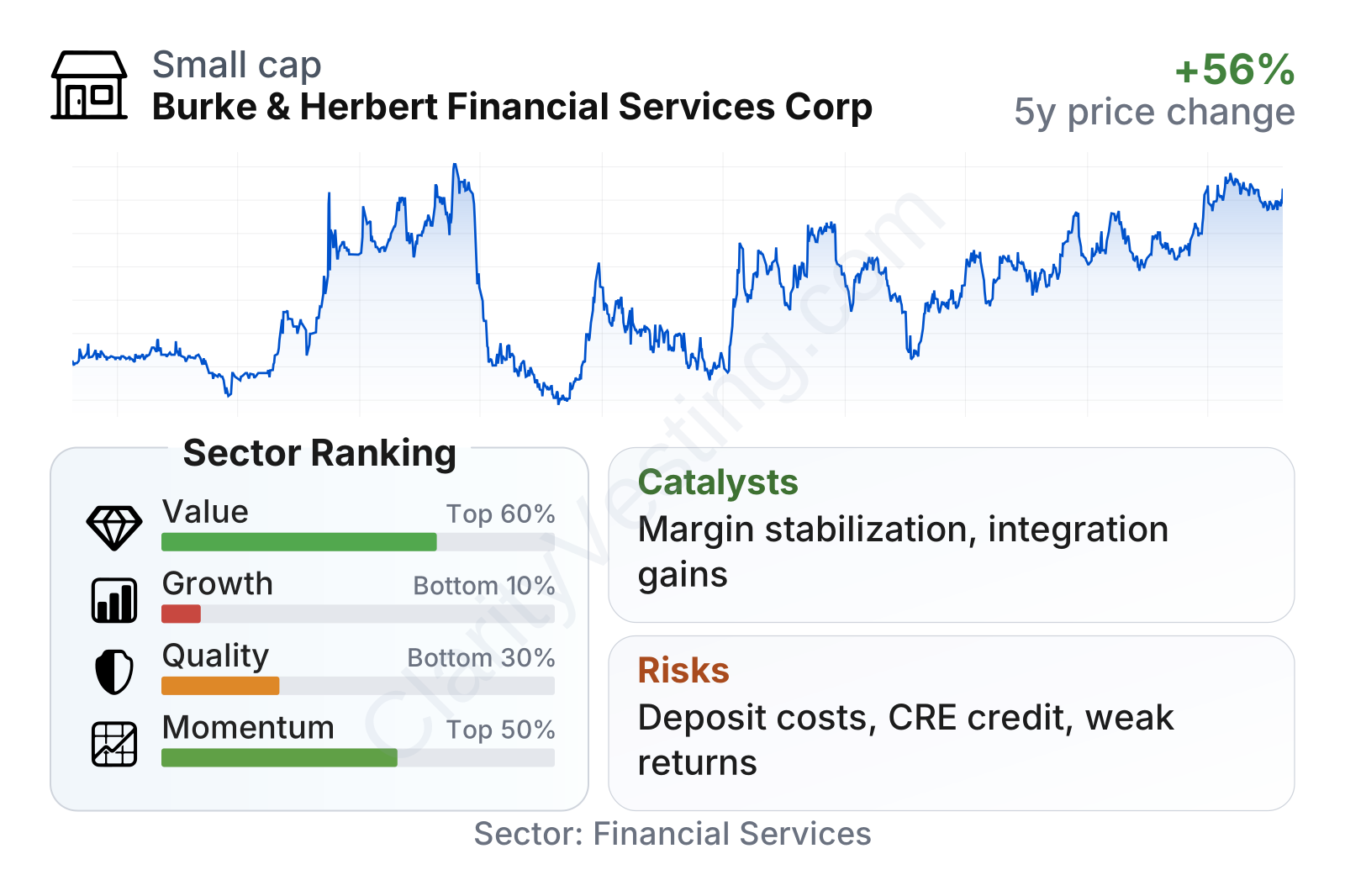
The share price history shows a volatile but overall upward path over the last several years. That pattern fits a regional bank that benefited from periods of higher earnings expectations but also faced swings tied to funding costs, credit concerns, and integration execution.
| Metric | Value | Sector ⓘ |
|---|---|---|
| Date | Oct 24, 2026 | |
| Context | ||
| Sector | Financial Services | |
| Industry | Banks - Regional | |
| Market Cap ⓘ | $1.40B | |
| Beta ⓘ | 0.22 | |
Value (Cheapness) | ||
| P/E Ratio ⓘ | 11.48 | 12.46 |
| P/B Ratio ⓘ | 1.10 | 1.25 |
| FCF Yield ⓘ | 6.17% | 9.82% |
| Dividend Yield ⓘ | 3.14% | 2.94% |
| EBIT / EV ⓘ | 6.16% | 8.11% |
| PEG ⓘ | N/A | |
Growth (Business expansion) | ||
| Revenue Growth ⓘ | 22.30% | 9.10% |
| RPS Growth (5Y CAGR) ⓘ | 21.71% | 12.31% |
| EPS Growth (5Y CAGR) ⓘ | -63.14% | -6.97% |
| BVPS Growth (5Y CAGR) ⓘ | 3.95% | 5.02% |
| Margin Growth (5Y Trend) ⓘ | -4.43% | -4.00% |
| FCF Growth (5Y CAGR) ⓘ | 15.69% | 4.71% |
| DPS Growth (5Y CAGR) ⓘ | 4.97% | 8.92% |
Quality (Business durability) | ||
| ROIC (Latest) ⓘ | 6.40% | 9.18% |
| ROE (Latest) ⓘ | 9.58% | 13.93% |
| ROA (Latest) ⓘ | 1.03% | 1.57% |
| ROIC (5Y Median) ⓘ | 4.00% | 7.80% |
| ROE (5Y Median) ⓘ | 9.34% | 12.15% |
| ROA (5Y Median) ⓘ | 1.03% | 1.28% |
| Net Debt / EBIT (Latest) ⓘ | 4.66 | 1.02 |
| Net Debt / EBIT (5Y Median) ⓘ | 11.69 | 0.72 |
| Net Debt / EBITDA (Latest) ⓘ | 3.87 | 0.88 |
| Operating Margin (Latest) ⓘ | 27.12% | 22.30% |
| Operating Margin (5Y Median) ⓘ | 29.51% | 24.50% |
| Debt to Equity (Latest) ⓘ | 56.27% | 59.34% |
| Profit Margin (Latest) ⓘ | 26.95% | 26.42% |
| Free Cash Flow (Latest) ⓘ | $86.49M | |
Momentum (Price trend) | ||
| 3Y Return ⓘ | +77.82% | +95.73% |
| 12M Return (excl. last month) ⓘ | +14.84% | +17.30% |
| 6M Return ⓘ | +13.21% | +6.07% |
| Price vs. 200-Day MA ⓘ | +7.76% | +5.36% |
The overall profile is mixed. On valuation, the stock sits below the sector median on both earnings and book value multiples, suggesting the market is not assigning a premium. On quality and growth factors, the picture is less flattering: profitability metrics are below many peers, even though revenue growth has been strong. Momentum is also not especially strong relative to the broader regional bank group, which suggests the market is still waiting for more proof that recent improvements can last.
Growth
Burke & Herbert operates in a mature sector, not a high-growth one. Regional banking in the United States usually grows through local market share gains, acquisitions, balance sheet expansion, and better cross-selling rather than through disruptive industry growth. That said, the Mid-Atlantic banking market remains attractive because it includes affluent households, small and midsize businesses, government-related activity, and dense commercial corridors. A well-run bank can still produce durable growth there.
The company’s strategy appears centered on building scale in contiguous markets and using that larger footprint to improve efficiency, deepen commercial relationships, and broaden fee income. That makes strategic sense for a regional bank: scale can lower unit costs, improve product breadth, and make the deposit base more resilient. The biggest opportunity is not explosive industry growth, but better earnings power from a larger franchise once integration work and funding pressures settle.
Earnings per share show how uneven that transition has been. Results were distorted in earlier periods, then weakened sharply during the banking stress and integration phase, and later recovered to much healthier levels. For long-term readers, the key takeaway is not the unusual outlier year, but the rebound after a difficult stretch. That rebound matters because it suggests the franchise still has meaningful earnings capacity when conditions normalize.
Book value per share has trended upward again after earlier pressure, which is important for a bank. A rising book value generally means the institution is rebuilding capital and internal value over time. Here, the progression points to balance-sheet repair and retained earnings rebuilding the base after a turbulent period for the industry.
A meaningful catalyst is the possibility of margin stabilization. If deposit costs stop rising as fast as they did during the most difficult part of the rate cycle, regional banks with sound loan books can translate that into improved profitability. Another catalyst is the company’s expanded scale: a larger institution has more room to improve operating efficiency, spread fixed costs, and extract benefits from cross-selling commercial, treasury, and wealth services.
Recent company communications and filings also point to continued focus on integration, balance-sheet optimization, and relationship banking. Those are not dramatic headlines, but for a regional bank they are exactly the operational levers that can drive sustained improvement over several years.
Risks
This article is for informational purposes only and does not constitute financial advice. Some content is AI-generated. See Disclaimer


