Stock Analysis · BHP Group Limited (BHPLF)
Overview
BHP Group Limited is one of the world’s largest diversified mining companies. It produces bulk commodities and metals that sit at the base of the industrial economy: iron ore for steelmaking, copper for electricity networks and electrification, and metallurgical coal for steel production. The group also has exposure to potash through its Jansen project in Canada, which is designed to supply fertilizer markets over the long term. BHP operates large, long-life assets in regions such as Australia, the Americas, and Canada, and its scale is one of the defining features of the business.
Revenue is mainly tied to a relatively small number of commodities, with iron ore and copper dominating the mix. Based on the latest annual reporting and segment disclosures, the broad revenue profile is approximately as follows:
- Iron ore: about 50% to 60% — mainly ore produced in Western Australia and sold into global steel markets, especially Asia.
- Copper: about 25% to 30% — includes operations such as Escondida in Chile and Olympic Dam in Australia; copper is used in power grids, electric vehicles, electronics, and construction.
- Coal: about 15% to 20% — primarily metallurgical coal used in blast-furnace steelmaking rather than thermal coal for power generation.
- Other: below 10% — includes nickel and smaller contributions from other activities; potash is still in development rather than a major current revenue source.
This mix matters because BHP is not a pure growth company in the usual sense. It is a resource producer whose earnings depend on production volumes, operating costs, and commodity prices. When prices are favorable, cash generation can be very strong. When prices soften, profits can fall quickly even if mines keep running efficiently.
The broad flow of the business shows that BHP remains highly profitable, but also cyclical. Revenue and operating income have stayed very large over recent years, while net income has moved much more sharply with commodity conditions, taxes, and cost swings. That pattern is typical for a major miner and is central to understanding the stock over the long term.
The financial profile highlights a company with very large sales, strong operating earnings, and meaningful year-to-year volatility in bottom-line profit. Recent years show that BHP can recover operating income even after weaker periods, but net earnings remain sensitive to commodity pricing, taxes, and project-related spending.
Key Figures
| Metric | Value | Sector ⓘ |
|---|---|---|
| Date | Oct 17, 2026 | |
| Context | ||
| Sector | Basic Materials | |
| Industry | Other Industrial Metals & Mining | |
| Market Cap ⓘ | $216.43B | |
| Beta ⓘ | 0.82 | |
Value (Cheapness) | ||
| P/E Ratio ⓘ | 22.65 | 16.90 |
| P/B Ratio ⓘ | 4.84 | 1.65 |
| FCF Yield ⓘ | 9.46% | 5.76% |
| Dividend Yield ⓘ | 4.10% | 2.13% |
| EBIT / EV ⓘ | 17.89% | 6.30% |
| PEG ⓘ | 2.95 | |
Growth (Business expansion) | ||
| Revenue Growth ⓘ | 18.30% | 11.10% |
| RPS Growth (5Y CAGR) ⓘ | -2.11% | 4.49% |
| EPS Growth (5Y CAGR) ⓘ | N/A | -13.47% |
| BVPS Growth (5Y CAGR) ⓘ | -0.65% | 5.51% |
| Margin Growth (5Y Trend) ⓘ | -8.89% | -1.54% |
| FCF Growth (5Y CAGR) ⓘ | -17.52% | 0.37% |
| DPS Growth (5Y CAGR) ⓘ | -21.23% | 6.08% |
Quality (Business durability) | ||
| ROIC (Latest) ⓘ | 34.81% | 9.26% |
| ROA (Latest) ⓘ | 17.02% | 4.91% |
| ROIC (5Y Median) ⓘ | 21.81% | 7.70% |
| ROA (5Y Median) ⓘ | 8.73% | 3.86% |
| Net Debt / EBIT (Latest) ⓘ | 0.21 | 1.40 |
| Net Debt / EBIT (5Y Median) ⓘ | 0.43 | 1.70 |
| Net Debt / EBITDA (Latest) ⓘ | 0.16 | 0.95 |
| Net Debt / Assets ⓘ | 7.08% | 13.69% |
| EBITDA / Interest ⓘ | 35.92 | 12.34 |
| Operating Margin (Latest) ⓘ | 37.86% | 13.20% |
| Operating Margin (5Y Median) ⓘ | 43.76% | 11.80% |
| Debt to Equity (Latest) ⓘ | 53.26% | 40.56% |
| Profit Margin (Latest) ⓘ | 16.73% | 6.43% |
| Free Cash Flow (Latest) ⓘ | $20.48B | |
Momentum (Price trend) | ||
| 3Y Return ⓘ | +92.75% | +68.89% |
| 12M Return (excl. last month) ⓘ | +86.47% | +30.21% |
| 6M Return ⓘ | +13.24% | -4.16% |
| Price vs. 200-Day MA ⓘ | +23.22% | -1.27% |
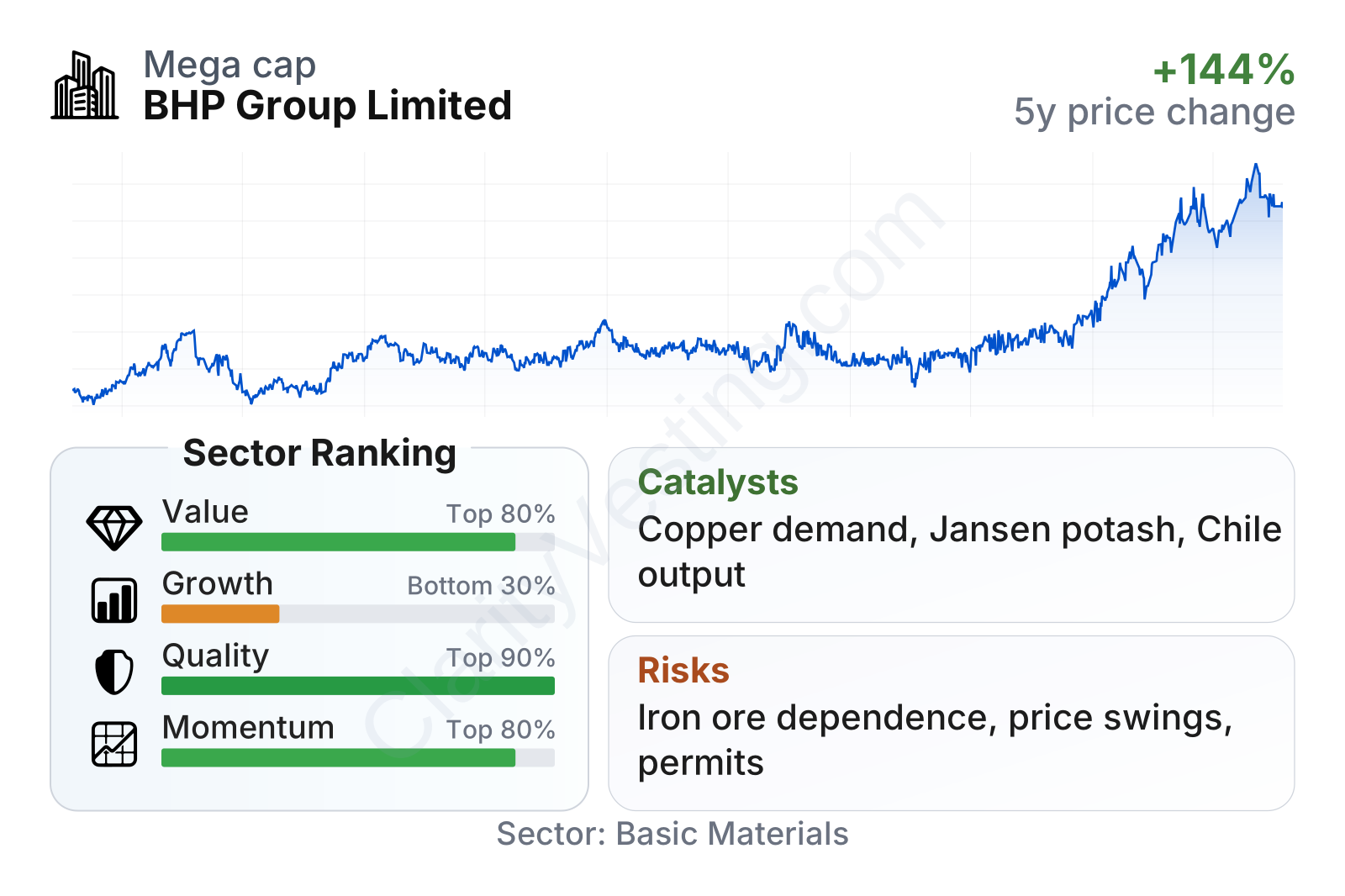
BHP is a very large mining group with lower share-price volatility than many materials stocks, as reflected by a beta below 1. On valuation, the picture is mixed: traditional multiples such as price-to-earnings and price-to-book sit above sector medians, but cash-based measures look stronger, with free cash flow yield, dividend yield, and EBIT relative to enterprise value all comparing well with the broader materials group. Quality stands out the most. Returns on capital and assets are far above sector norms, while net debt remains low relative to earnings and interest coverage is strong. Growth is less impressive over a five-year view, which fits the reality of a cyclical producer rather than a steady compounder. Momentum has recently been strong, with the stock outperforming much of the sector over multiple time frames.
Growth
BHP operates in sectors that remain strategically important for the global economy. Iron ore is tied to steel demand, which depends on construction and infrastructure. Copper has a stronger structural growth angle because power grids, renewable energy systems, electric vehicles, and data infrastructure all require large amounts of the metal. Potash adds a separate long-term theme through agricultural productivity and fertilizer demand. That combination gives BHP exposure to both mature industrial demand and newer electrification-related demand.
BHP’s strategy is relatively easy to understand: focus on large, low-cost assets in commodities where future supply may be constrained and long-term demand is likely to remain significant. In recent years, the company has leaned more heavily toward copper and potash while reducing exposure to petroleum and lower-priority businesses. Strategically, that shift makes sense. Copper is one of the clearest long-duration opportunities in mining because new supply is difficult, expensive, and slow to bring to market. Potash is not yet a major earnings contributor, but Jansen gives BHP a potential new platform outside the more familiar iron ore and copper base.
Recent revenue growth has been uneven, which is normal in mining. The yearly pattern shows periods of contraction as commodity prices cooled, followed by partial stabilization. The latest growth reading is better than the sector median, but the longer-term trend still looks inconsistent rather than steadily upward. That is an important distinction: BHP can grow over time, but the path is rarely smooth.
Cash generation remains one of the most important strengths in the case. Even though free cash flow has come down from earlier peaks, the business still produces very large absolute cash flow. That gives BHP room to fund dividends, invest in expansion projects, and preserve balance-sheet flexibility. For a capital-intensive miner, that financial capacity is a meaningful growth enabler because it reduces dependence on external financing during weaker parts of the cycle.
A notable current catalyst is BHP’s copper expansion pipeline, including activity around its major Chilean assets and the ramp-up path for future potash capacity in Canada. Industry-wide copper supply constraints can also work in BHP’s favor if demand from electrification, transmission investment, and industrial modernization remains firm. The company’s scale means that even moderate production improvements at flagship assets can have a visible effect on earnings.
Risks
This article is for informational purposes only and does not constitute financial advice. Some content is AI-generated. See Disclaimer


