Stock Analysis · BHP Group Limited (BHP)
Overview
BHP Group Limited is one of the world’s largest mining companies. It produces raw materials that sit near the beginning of the industrial supply chain, which means its products are used before many other goods can be made. The company’s portfolio is centered on iron ore, copper, metallurgical coal, and potash development, with operations and projects spread across Australia, the Americas, and other regions.
Its business is relatively simple to understand: BHP extracts mineral resources, processes them, and sells them to steelmakers, manufacturers, utilities, and industrial customers around the world. Demand for its products is closely linked to construction, infrastructure, manufacturing, and increasingly the energy transition, especially for copper.
Based on the latest annual reporting and segment disclosures, BHP’s revenue mix is led by a small number of large commodities.
- Iron ore: about 50% to 60% of revenue. This is mainly iron ore from Western Australia sold to global steel producers.
- Copper: about 25% to 30% of revenue. This includes mined copper and related products from assets such as Escondida in Chile and other copper operations.
- Coal: about 15% to 20% of revenue. This is primarily metallurgical coal used in steelmaking, rather than thermal coal for power generation.
- Other activities: less than 10% of revenue. This includes nickel and smaller contributions from other operations and marketing activity. Potash is strategically important but is still mainly a future growth project rather than a major current revenue source.
BHP’s earnings profile is concentrated, with iron ore still doing most of the heavy lifting. That concentration has advantages because iron ore is a large, established, high-margin business for the group, but it also means company results can move sharply when commodity prices change. Over the last several years, revenue has remained very large even as profits have swung with the cycle, which is typical for a diversified miner.
The business has shown how strongly commodity prices affect results. Revenue fell from the 2022 peak, then recovered by 2026, while operating income rebounded more clearly than net income. That suggests BHP has kept strong underlying operations, but taxes, interest costs, and cycle effects still make bottom-line earnings more volatile than sales.
Key Figures
| Metric | Value | Sector ⓘ |
|---|---|---|
| Date | Oct 10, 2026 | |
| Context | ||
| Sector | Basic Materials | |
| Industry | Other Industrial Metals & Mining | |
| Market Cap ⓘ | $216.58B | |
| Beta ⓘ | 0.82 | |
Value (Cheapness) | ||
| P/E Ratio ⓘ | 22.55 | 17.36 |
| P/B Ratio ⓘ | 4.93 | 1.73 |
| FCF Yield ⓘ | 9.82% | 5.81% |
| Dividend Yield ⓘ | 1.98% | 1.98% |
| EBIT / EV ⓘ | 17.89% | 6.34% |
| PEG ⓘ | 5.95 | |
Growth (Business expansion) | ||
| Revenue Growth ⓘ | 18.30% | 11.15% |
| RPS Growth (5Y CAGR) ⓘ | -2.62% | 4.49% |
| EPS Growth (5Y CAGR) ⓘ | -33.00% | -12.80% |
| BVPS Growth (5Y CAGR) ⓘ | -3.46% | 5.49% |
| Margin Growth (5Y Trend) ⓘ | -8.29% | -1.54% |
| FCF Growth (5Y CAGR) ⓘ | -17.75% | 0.20% |
| DPS Growth (5Y CAGR) ⓘ | -21.64% | 5.91% |
Quality (Business durability) | ||
| ROIC (Latest) ⓘ | 34.80% | 9.26% |
| ROA (Latest) ⓘ | 17.00% | 4.92% |
| ROIC (5Y Median) ⓘ | 22.67% | 7.82% |
| ROA (5Y Median) ⓘ | 8.54% | 3.88% |
| Net Debt / EBIT (Latest) ⓘ | 0.21 | 1.37 |
| Net Debt / EBIT (5Y Median) ⓘ | 0.35 | 1.70 |
| Net Debt / EBITDA (Latest) ⓘ | 0.16 | 0.92 |
| Net Debt / Assets ⓘ | 7.08% | 13.56% |
| EBITDA / Interest ⓘ | 29.46 | 12.28 |
| Operating Margin (Latest) ⓘ | 37.82% | 13.20% |
| Operating Margin (5Y Median) ⓘ | 40.00% | 11.82% |
| Debt to Equity (Latest) ⓘ | 53.26% | 39.91% |
| Profit Margin (Latest) ⓘ | 16.73% | 6.43% |
| Free Cash Flow (Latest) ⓘ | $21.27B | |
Momentum (Price trend) | ||
| 3Y Return ⓘ | +71.34% | +68.93% |
| 12M Return (excl. last month) ⓘ | +73.22% | +36.53% |
| 6M Return ⓘ | +18.78% | 0.00% |
| Price vs. 200-Day MA ⓘ | +9.36% | -0.18% |
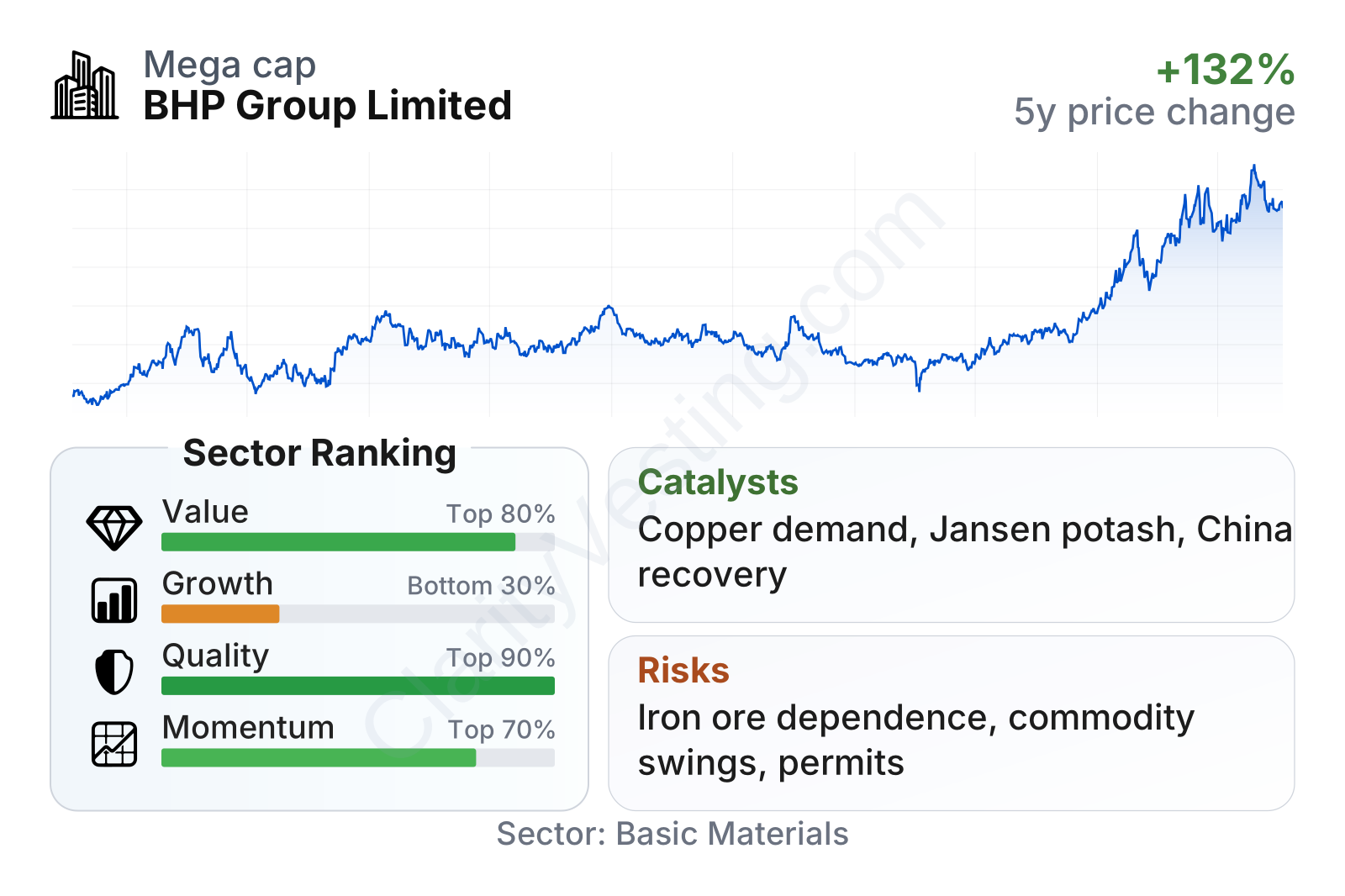
BHP is a very large company with below-market share price volatility, which can make it look steadier than many mining peers. Its overall profile is unusual for the sector: valuation metrics tied to cash generation look strong, quality metrics are clearly above industry norms, but long-term growth indicators are weaker because the last five years included a comedown from exceptionally strong commodity conditions. In short, BHP combines strong profitability and balance-sheet resilience with a more mixed growth record.
The share price has climbed sharply since early 2025 after a weaker period, showing that market sentiment can turn quickly when commodity expectations improve. The metrics table also points to a gap between quality and growth: returns on capital, margins, and leverage ratios are strong versus the sector, while five-year revenue, earnings, and free cash flow trends look less favorable. That is an important feature of cyclical resource businesses: short-term recovery can coexist with uneven longer-term compounding.
Growth
BHP operates in markets that should remain important for decades, but the growth outlook is not the same across all commodities. Iron ore is mature and tied to global steel demand, especially in China. Copper has a stronger structural growth case because it is essential for electric grids, renewable energy, electric vehicles, and broader electrification. Potash also offers a different type of long-duration opportunity because it is linked to agricultural productivity and global food demand.
The company’s strategy makes the most sense where it leans into these longer-life themes. BHP has spent the past several years reshaping its portfolio toward future-facing commodities, especially copper and potash, while reducing exposure to less strategic areas. For long-term analysis, that matters more than a single year of price movements. The core question is whether BHP can gradually become less dependent on iron ore and more exposed to materials with stronger structural demand.
Recent revenue growth has been uneven, which is normal in mining because price swings often matter as much as production volumes. The latest year-over-year reading is positive and above the sector median, indicating a recovery phase rather than a straight-line expansion. Even so, the broader pattern shows alternating growth and contraction, reinforcing that BHP’s top line is cyclical rather than consistently compounding.
Free cash flow remains one of BHP’s strongest characteristics. It has come down from the extraordinary highs reached earlier in the cycle, but it still sits at a very large level in absolute terms. That cash generation gives the company flexibility to fund dividends, invest in major projects, and manage debt without looking stretched. For a capital-intensive miner, this is a major strategic advantage.
A notable catalyst for future growth is the company’s copper pipeline and its large Jansen potash project in Canada. Copper assets are becoming more valuable as large new deposits are harder to find and develop. Jansen could also open a new earnings stream over time if potash demand develops as expected. In addition, any sustained improvement in Chinese industrial activity, steel demand, or global infrastructure spending would likely support BHP’s core operations.
Recent company updates have also emphasized operational simplification and productivity, which matters because growth in mining does not only come from discovering new resources. It can also come from raising output, extending mine life, cutting unit costs, and improving recovery rates from existing assets. In a sector where major projects are expensive and slow, efficient execution is often one of the most realistic growth drivers.
Risks
This article is for informational purposes only and does not constitute financial advice. Some content is AI-generated. See Disclaimer


