Stock Analysis · Brighthouse Financial Inc (BHFAP)
Overview
Brighthouse Financial is a U.S. life insurance and annuity company. Its business is centered on products that help customers save for retirement, protect income, and pass wealth to beneficiaries. In practical terms, the company collects premiums and deposits, invests those funds, earns spread income on its investment portfolio, and charges fees on certain insurance and annuity contracts.
The company’s operations are mainly organized around annuities and life insurance. Annuities are the core business and include products such as variable annuities, fixed annuities, indexed annuities, and income annuities. These products are designed to convert savings into retirement income or offer tax-deferred accumulation. Life insurance adds protection-oriented products, including universal life and term life, while the run-off business includes older contracts that are still being serviced but are no longer a major growth focus.
Based on Brighthouse Financial’s recent annual reporting, revenue is not as simple to split as it is for a typical industrial company because insurance accounting includes premiums, policy charges, investment spread income, derivatives, and market-related adjustments. Still, the business mix can be described in a practical way from largest to smallest using operating earnings and account-value importance:
- Annuities: approximately 70% to 80% of the business mix. This includes variable annuities with living benefits, fixed annuities, registered index-linked annuities, and payout annuities. It is the main engine of deposits, fee income, and spread-related earnings.
- Life insurance: approximately 15% to 25%. This includes universal life, term life, and other protection products that generate premiums, policy charges, and investment income.
- Run-off and corporate items: approximately 5% to 10%. This includes legacy blocks and corporate-level impacts that can create earnings volatility.
That mix matters because Brighthouse is less like a fast-growing asset manager and more like a capital-intensive retirement and protection company whose results depend on interest rates, capital markets, hedging, and disciplined risk management.
The profit picture has been unusually volatile over the last several years, which is common for insurers with meaningful exposure to market-sensitive annuity products. Revenue and earnings rebounded after a weak 2023, and the more recent pattern shows improving operating income and steadier net income, but not a smooth linear trend.
Key Figures
| Metric | Value | Sector ⓘ |
|---|---|---|
| Date | Oct 31, 2026 | |
| Context | ||
| Sector | Financial Services | |
| Industry | Insurance - Life | |
| Market Cap ⓘ | $2.68B | |
| Beta ⓘ | 0.83 | |
Value (Cheapness) | ||
| P/E Ratio ⓘ | 0.98 | 12.20 |
| P/B Ratio ⓘ | 0.11 | 1.26 |
| FCF Yield ⓘ | -33.57% | 9.87% |
| Dividend Yield ⓘ | N/A | 2.87% |
| EBIT / EV ⓘ | 29.37% | 8.17% |
| PEG ⓘ | N/A | |
Growth (Business expansion) | ||
| Revenue Growth ⓘ | 86.70% | 8.40% |
| RPS Growth (5Y CAGR) ⓘ | 6.25% | 12.31% |
| EPS Growth (5Y CAGR) ⓘ | 44.76% | -4.03% |
| BVPS Growth (5Y CAGR) ⓘ | -55.72% | 4.96% |
| Margin Growth (5Y Trend) ⓘ | 19.31% | -4.14% |
| FCF Growth (5Y CAGR) ⓘ | N/A | 4.70% |
| DPS Growth (5Y CAGR) ⓘ | 13.84% | 8.85% |
Quality (Business durability) | ||
| ROIC (Latest) ⓘ | 9.79% | 9.35% |
| ROE (Latest) ⓘ | 13.00% | 13.95% |
| ROA (Latest) ⓘ | 0.34% | 1.57% |
| ROIC (5Y Median) ⓘ | 6.41% | 7.78% |
| ROE (5Y Median) ⓘ | -0.08% | 12.12% |
| ROA (5Y Median) ⓘ | 0.16% | 1.28% |
| Net Debt / EBIT (Latest) ⓘ | -3.63 | 0.99 |
| Net Debt / EBIT (5Y Median) ⓘ | -3.29 | 0.73 |
| Net Debt / EBITDA (Latest) ⓘ | -3.51 | 0.79 |
| Operating Margin (Latest) ⓘ | 17.33% | 22.61% |
| Operating Margin (5Y Median) ⓘ | 10.08% | 24.52% |
| Debt to Equity (Latest) ⓘ | 48.15% | 58.76% |
| Profit Margin (Latest) ⓘ | 12.15% | 26.18% |
| Free Cash Flow (Latest) ⓘ | -$899.00M | |
Momentum (Price trend) | ||
| 3Y Return ⓘ | -16.65% | +95.34% |
| 12M Return (excl. last month) ⓘ | -7.06% | +16.22% |
| 6M Return ⓘ | -17.73% | +7.41% |
| Price vs. 200-Day MA ⓘ | -13.69% | +5.48% |
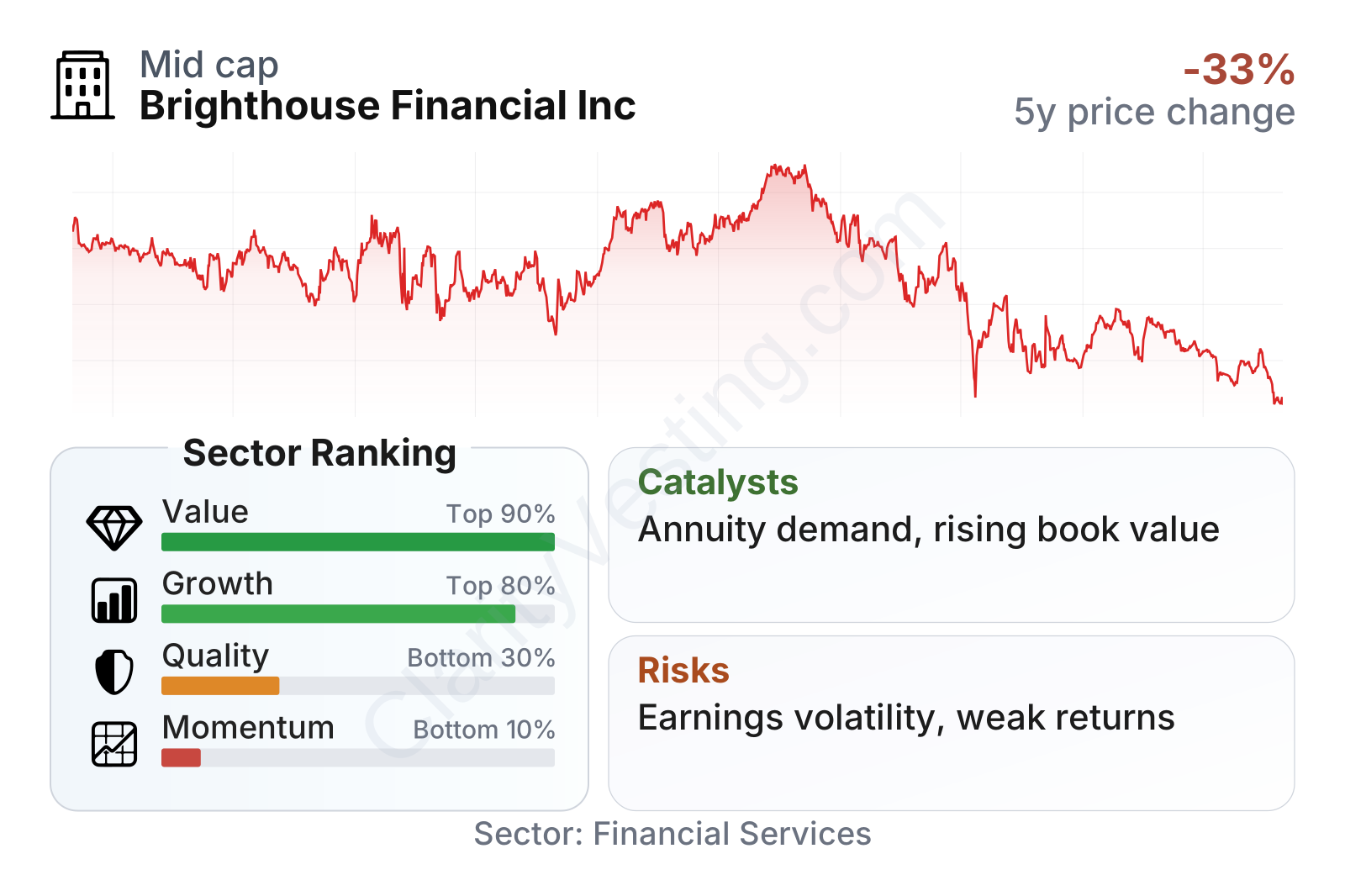
Brighthouse Financial is a mid-sized financial company with a relatively low beta, meaning its share price has historically moved somewhat less than the broader market. On valuation measures, it screens as exceptionally cheap versus the sector, especially on price-to-book and price-to-earnings. Growth indicators look mixed but include very strong recent revenue growth and a strong multiyear earnings trend. Quality measures are weaker: profitability is below many peers, free cash flow is negative, and longer-term return metrics have been inconsistent. Market momentum is clearly weak, with the share price trailing much of the sector over one-, three-, and six-month periods.
Growth
The broader retirement market remains supportive for companies like Brighthouse. An aging U.S. population, the shift from employer pensions to self-funded retirement, and continued demand for protected savings products all support long-term demand for annuities and related insurance solutions. This is a sector with structural demand, even if results can be uneven from year to year.
Brighthouse’s strategy is built around capital-light and protection-oriented products, especially annuities where customer demand has been healthy across the industry when interest rates are attractive. Higher rates can help insurers offer more appealing guaranteed products and improve investment spreads on new business. The company has also emphasized risk management and capital efficiency, which is important in a business where product guarantees can become expensive if not hedged correctly.
The earnings trend over the last five years has been strong, even though headline results have been volatile. That combination suggests the company has had meaningful recovery power after difficult periods. A recent earnings-per-share level in the low teens is high relative to the current share price, which helps explain why the stock appears statistically cheap. The main question is not whether Brighthouse can produce earnings in a favorable setup, but how repeatable those earnings are through different market conditions.
Book value per share has improved sharply since 2023 and reached a much stronger level in the latest period. For an insurer, book value is especially important because it reflects capital strength and the value of the balance sheet over time. A rising book value can support the case that the business is rebuilding economic value even when the stock market remains skeptical.
One additional catalyst is product positioning. Registered index-linked annuities and other retirement-income products have remained an active area of demand across the life insurance industry. If Brighthouse continues to capture sales while maintaining underwriting discipline and hedging effectiveness, that could support further improvement in earnings and capital generation.
Risks
This article is for informational purposes only and does not constitute financial advice. Some content is AI-generated. See Disclaimer


