Stock Analysis · Bausch Health Companies Inc (BHC)
Overview
Bausch Health Companies Inc. is a diversified pharmaceutical and medical products company. Its businesses span gastrointestinal treatments, neurology and other branded medicines, eye health products, dermatology, and a large generics platform. The company operates through a mix of prescription drugs, over-the-counter products, medical devices, and contact lenses, which gives it broader exposure than a single-product drug company.
Based on the company’s latest annual reporting structure, revenue is mainly generated from the following segments, listed from largest to smallest:
- Bausch + Lomb: about 45% of revenue. This includes contact lenses, ophthalmic pharmaceuticals, surgical products, and consumer eye-care brands.
- Salix: about 24% of revenue. This segment is centered on gastrointestinal products, with Xifaxan as the key brand.
- International: about 20% of revenue. This includes branded pharmaceuticals and certain consumer health products sold outside the U.S.
- Solta Medical: about 6% of revenue. This business focuses on aesthetic medical devices.
- Diversified Products: about 5% of revenue. This includes neurology, dermatology, and other legacy brands.
This mix matters for long-term analysis because Bausch Health is no longer only a highly leveraged specialty pharma group tied to a few mature assets. It now also has a sizeable eye-health platform and a more varied revenue base, although some of its most important cash flows still depend heavily on a limited number of core products.
The multi-year operating picture shows a useful pattern: revenue and gross profit have generally moved upward, operating income has improved, and net income has come much closer to break-even after several years of losses. At the same time, interest expense has stayed very heavy, which remains one of the main forces shaping the whole business.
Key Figures
| Metric | Value | Sector ⓘ |
|---|---|---|
| Date | Oct 10, 2026 | |
| Context | ||
| Sector | Healthcare | |
| Industry | Drug Manufacturers - Specialty & Generic | |
| Market Cap ⓘ | $2.30B | |
| Beta ⓘ | 0.37 | |
Value (Cheapness) | ||
| P/E Ratio ⓘ | N/A | 24.79 |
| P/B Ratio ⓘ | N/A | 2.97 |
| FCF Yield ⓘ | 60.54% | 3.11% |
| Dividend Yield ⓘ | N/A | 2.04% |
| EBIT / EV ⓘ | 4.15% | 0.57% |
| PEG ⓘ | 0.01 | |
Growth (Business expansion) | ||
| Revenue Growth ⓘ | 12.70% | 7.35% |
| RPS Growth (5Y CAGR) ⓘ | 3.89% | 8.61% |
| EPS Growth (5Y CAGR) ⓘ | -10.25% | -18.43% |
| BVPS Growth (5Y CAGR) ⓘ | N/A | 3.94% |
| Margin Growth (5Y Trend) ⓘ | -1.05% | -0.61% |
| FCF Growth (5Y CAGR) ⓘ | -3.21% | 0.88% |
| DPS Growth (5Y CAGR) ⓘ | 17.23% | 6.74% |
Quality (Business durability) | ||
| ROIC (Latest) ⓘ | -2.53% | 3.34% |
| ROA (Latest) ⓘ | -4.26% | 2.95% |
| ROIC (5Y Median) ⓘ | 5.43% | 4.60% |
| ROA (5Y Median) ⓘ | -0.82% | 1.89% |
| Net Debt / EBIT (Latest) ⓘ | 21.66 | 1.36 |
| Net Debt / EBIT (5Y Median) ⓘ | 12.92 | 1.86 |
| Net Debt / EBITDA (Latest) ⓘ | 9.26 | 1.02 |
| Net Debt / Assets ⓘ | 76.45% | 5.85% |
| EBITDA / Interest ⓘ | 1.27 | 9.60 |
| Operating Margin (Latest) ⓘ | 8.06% | 9.19% |
| Operating Margin (5Y Median) ⓘ | 19.20% | 7.53% |
| Debt to Equity (Latest) ⓘ | -1173.29% | 29.44% |
| Profit Margin (Latest) ⓘ | -10.12% | 3.52% |
| Free Cash Flow (Latest) ⓘ | $1.39B | |
Momentum (Price trend) | ||
| 3Y Return ⓘ | -21.05% | +34.80% |
| 12M Return (excl. last month) ⓘ | -12.28% | +19.33% |
| 6M Return ⓘ | +12.90% | +7.18% |
| Price vs. 200-Day MA ⓘ | +4.83% | +3.20% |
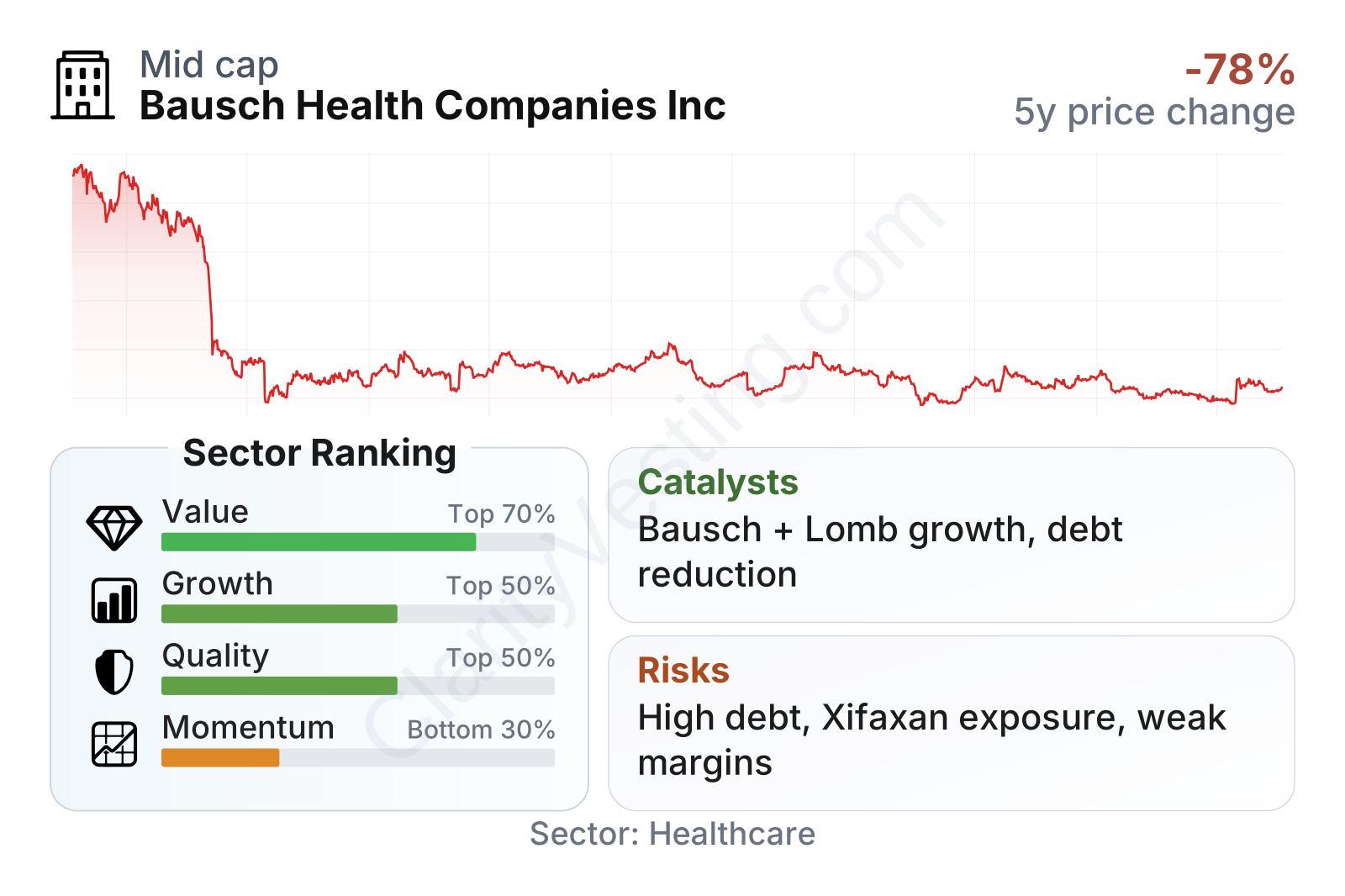
Bausch Health is a mid-sized healthcare company with a relatively low beta, which means its share price has historically moved less than the broader market. The factor snapshot is mixed. Value metrics look strong on paper, helped by unusually high free cash flow yield and EBIT relative to enterprise value. Growth ranks around the middle of the healthcare group, with recent revenue growth running above the sector median, but the longer-term record is less impressive. Quality looks weaker than headline cash generation suggests because profitability remains inconsistent and leverage ratios are far above normal sector levels. Price momentum has also been soft over longer periods, reflecting persistent market skepticism.
Growth
Healthcare is generally a favorable long-term sector because demand is supported by aging populations, chronic disease treatment, rising eye-care needs, and continuing use of specialty medicines. Bausch Health participates in several of these areas, especially gastrointestinal therapies and eye health, both of which can support durable demand if products remain competitive.
The company’s recent revenue trend has been encouraging. After a weaker period in 2022, year-over-year growth turned positive and has stayed positive, recently running in the low double digits. That is better than the sector median and suggests that the business has regained some commercial momentum.
A major part of the growth case is that Bausch Health is not relying on only one engine. Bausch + Lomb gives exposure to eye health, where demand can benefit from aging demographics, vision correction, dry-eye treatment, and procedure growth. Salix remains important because gastrointestinal disorders are large and recurring markets, and Xifaxan continues to be a central earnings contributor. Solta Medical adds an aesthetic device angle, which is smaller but can expand faster when procedure demand is healthy.
Cash generation is another constructive element. Free cash flow has been volatile, but the trailing level remains substantial in absolute terms and is large compared with the company’s current equity value. That matters because for Bausch Health, future progress depends not only on sales growth but also on turning operating cash into debt reduction and balance-sheet repair.
Strategically, the company’s path makes sense if management can keep doing three things at once: protect key franchises, grow eye health and international operations, and gradually reduce financial pressure from debt. In recent company communications, management has continued to emphasize business simplification, product execution, and liability management. Those are not flashy catalysts, but for this company they are meaningful because even moderate operational improvement can have an outsized effect when leverage is high.
One notable near- to medium-term opportunity is continued execution at Bausch + Lomb and ongoing expansion in higher-demand therapeutic and device categories. Another is any successful refinancing, repayment, or restructuring step that lowers interest burden over time. For Bausch Health, financing progress can be almost as important as product growth.
Risks
This article is for informational purposes only and does not constitute financial advice. Some content is AI-generated. See Disclaimer