Stock Analysis · Bunge Global SA (BG)
Overview
Bunge Global SA is one of the world’s major agricultural supply chain companies. It buys crops such as soybeans, corn, wheat, and canola from farmers, transports and stores them, processes them into higher-value products, and sells those products to food manufacturers, animal feed customers, biofuel producers, and other industrial users. In simple terms, Bunge sits in the middle of the global food and feed system: it connects farms to processing plants and end markets.
Its business is spread across several large activities, with oils and oilseeds at the center. Based on the company’s reporting structure and recent annual disclosures, the main revenue sources are approximately:
- Agribusiness: about 70% to 80% of revenue. This includes grain origination, storage, transportation, trading, and oilseed processing, especially soybeans and other crops.
- Refined and Specialty Oils: about 15% to 20% of revenue. This covers edible oils, shortenings, margarines, and specialty ingredients sold to food companies and commercial customers.
- Milling: about 3% to 6% of revenue. This includes wheat and corn milling products such as flours, corn-based ingredients, and other processed grain products.
- Sugar and Bioenergy: usually a small single-digit share of revenue, though it can contribute more visibly to earnings than to sales in some years. This activity includes sugarcane processing, ethanol, and electricity generation in Brazil.
Bunge’s revenue can swing sharply from year to year because agricultural commodity prices move a lot. That means rising sales do not always mean stronger underlying profitability. The company’s economics depend heavily on processing margins, trade flows, logistics execution, and risk management rather than just top-line growth.
Over the last several years, revenue has been very large but uneven, while earnings have been much more sensitive to margin cycles. Costs of goods sold consistently absorb the vast majority of sales, which is normal for this kind of commodity-processing business. The bigger issue recently has been the drop in operating profit and net income from the stronger 2023 level to weaker 2024 and 2025 results, showing how cyclical the business can be even when sales remain high.
Key Figures
| Metric | Value | Sector ⓘ |
|---|---|---|
| Date | Oct 17, 2026 | |
| Context | ||
| Sector | Consumer Defensive | |
| Industry | Farm Products | |
| Market Cap ⓘ | $20.02B | |
| Beta ⓘ | 0.72 | |
Value (Cheapness) | ||
| P/E Ratio ⓘ | 21.05 | 17.88 |
| P/B Ratio ⓘ | 1.45 | 1.29 |
| FCF Yield ⓘ | -3.55% | 12.39% |
| Dividend Yield ⓘ | 2.76% | 2.85% |
| EBIT / EV ⓘ | 5.46% | 6.43% |
| PEG ⓘ | 1.71 | |
Growth (Business expansion) | ||
| Revenue Growth ⓘ | 88.30% | 4.10% |
| RPS Growth (5Y CAGR) ⓘ | 2.14% | 6.18% |
| EPS Growth (5Y CAGR) ⓘ | -29.13% | -13.59% |
| BVPS Growth (5Y CAGR) ⓘ | 17.86% | 3.20% |
| Margin Growth (5Y Trend) ⓘ | -2.24% | -0.15% |
| FCF Growth (5Y CAGR) ⓘ | -28.12% | 4.10% |
| DPS Growth (5Y CAGR) ⓘ | 6.79% | 6.79% |
Quality (Business durability) | ||
| ROIC (Latest) ⓘ | 7.98% | 12.34% |
| ROA (Latest) ⓘ | 2.17% | 6.30% |
| ROIC (5Y Median) ⓘ | 25.47% | 10.49% |
| ROA (5Y Median) ⓘ | 6.65% | 5.44% |
| Net Debt / EBIT (Latest) ⓘ | 7.94 | 1.96 |
| Net Debt / EBIT (5Y Median) ⓘ | 1.91 | 2.35 |
| Net Debt / EBITDA (Latest) ⓘ | 5.40 | 1.38 |
| Net Debt / Assets ⓘ | 34.67% | 21.51% |
| EBITDA / Interest ⓘ | 2.69 | 9.46 |
| Operating Margin (Latest) ⓘ | 2.23% | 8.87% |
| Operating Margin (5Y Median) ⓘ | 3.76% | 9.53% |
| Debt to Equity (Latest) ⓘ | 105.38% | 72.35% |
| Profit Margin (Latest) ⓘ | 1.10% | 5.40% |
| Free Cash Flow (Latest) ⓘ | -$711.00M | |
Momentum (Price trend) | ||
| 3Y Return ⓘ | +14.87% | +20.92% |
| 12M Return (excl. last month) ⓘ | +53.82% | +2.13% |
| 6M Return ⓘ | -11.83% | +1.26% |
| Price vs. 200-Day MA ⓘ | -6.99% | +1.39% |
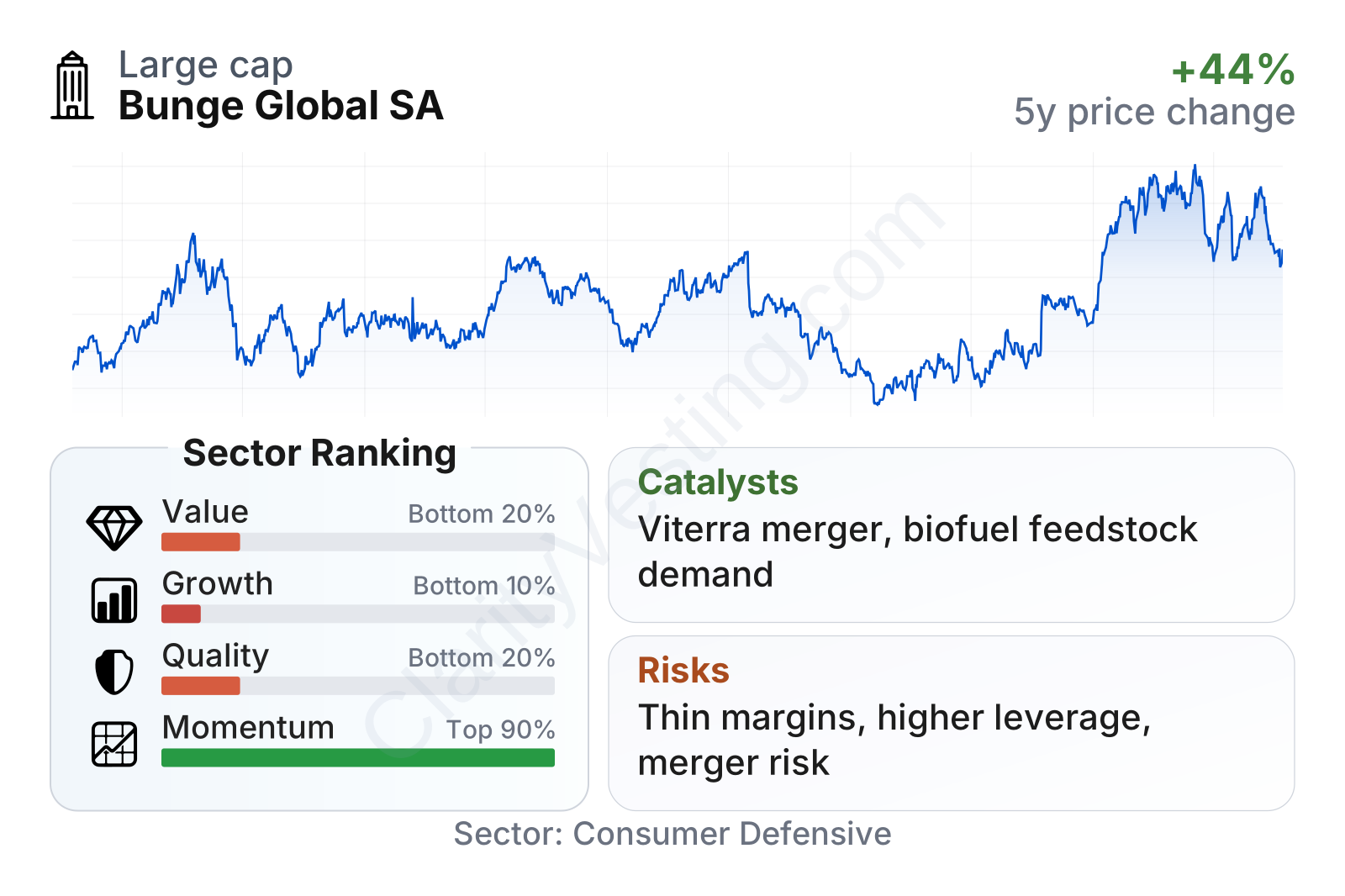
Bunge is a large-cap company with a relatively low beta of 0.66, which suggests the stock has historically moved less than the broader market. However, the fundamental profile is mixed. Relative to its sector, valuation does not look especially cheap at the moment, while quality and growth metrics rank in the lower part of the group. Profitability is currently thin, free cash flow is negative on a trailing basis, and leverage has risen. On the positive side, price performance over the last year has been stronger than the sector median, even after some recent pullback.
Growth
Bunge operates in a sector with durable long-term demand. Global consumption of vegetable oils, protein meal for animal feed, and staple food ingredients tends to rise over time with population growth, higher protein consumption, and increasing demand for biofuel feedstocks. That does not create smooth annual growth, but it does provide a strong structural base for companies that control important origination, processing, and distribution assets.
The company’s strategy is broadly logical for that environment. Bunge has been focusing on integrated value chains where it can source crops, process them efficiently, and sell into food, feed, and renewable fuel markets. Its network of crushing plants, export terminals, storage assets, and customer relationships is difficult to replicate at scale. A major strategic catalyst is the planned combination with Viterra, which would expand Bunge’s global footprint in grain handling, export infrastructure, and merchandising. If executed well, that deal could improve scale, geographic balance, and operating synergies.
There is also a sector-level catalyst in renewable diesel and biofuel demand. Soybean oil, canola, and other feedstocks have become more important in energy markets, which can support investment in oilseed processing capacity. That trend matters because Bunge is already positioned in the upstream part of that chain. Even if policy support changes over time, the connection between agriculture and energy has become more important than it was a decade ago.
Recent revenue growth looks spectacular on the surface, with year-over-year growth running close to 90% in the latest periods. That deserves caution. Bunge’s sales are highly influenced by commodity prices, trade volumes, and acquisition or consolidation effects, so very strong revenue growth does not automatically translate into stronger earnings power. In fact, the longer-term record is much less impressive: revenue per share growth over five years has been modest, while earnings per share over five years have declined.
Cash generation is another important reality check. Free cash flow has been volatile and is currently negative, after swinging from strongly positive to negative again over the past few years. For a company in Bunge’s industry, working capital can move sharply because crop inventories, receivables, and commodity prices fluctuate. That does not automatically signal weakness, but it does mean headline earnings need to be viewed alongside cash conversion and balance-sheet discipline.
As for recent developments, the biggest opportunity remains the reshaping of the global agricultural trade and processing system. A larger combined platform with Viterra, plus continued demand for oilseed processing linked to food and fuel markets, could materially strengthen Bunge’s strategic position if integration goes smoothly.
Risks
This article is for informational purposes only and does not constitute financial advice. Some content is AI-generated. See Disclaimer


