Stock Analysis · Business First Bancshares Inc (BFST)
Overview
Business First Bancshares is the parent company of b1BANK, a regional bank focused mainly on Louisiana, with additional presence in Texas and other nearby markets in the Southeast. In simple terms, it gathers deposits from customers, makes loans to businesses and individuals, and earns money from the difference between what it receives on loans and securities and what it pays on deposits and other funding. It also generates fee income from treasury services, mortgage-related activities, and other banking services.
The company’s business mix is still dominated by traditional banking. Based on recent annual disclosures and the bank’s operating model, the main revenue sources can be summarized as follows:
- Net interest income: approximately 75% to 85% of total revenue. This is the core engine of the bank and includes interest collected on commercial loans, commercial real estate loans, residential real estate loans, consumer loans, and investment securities, minus interest paid on deposits and borrowings.
- Service charges, card, and treasury management fees: approximately 5% to 10%. This includes deposit account fees, interchange income, and cash-management services used by business clients.
- Mortgage banking and loan-related fees: approximately 3% to 8%. This can include gains on loan sales, mortgage servicing or origination-related income, and other loan administration fees.
- Other noninterest income: approximately 3% to 7%. This usually includes items such as wealth-related services, bank-owned life insurance income, and miscellaneous banking fees.
That revenue mix matters for long-term analysis because it shows BFST is primarily a spread-based bank: its results depend much more on loan growth, deposit costs, and credit quality than on capital markets activity or highly volatile fee businesses.
The longer financial picture shows a bank that has grown revenue meaningfully over the past several years, but with periods of pressure from higher funding costs and operating expenses. Revenue rose from a little above $200 million in 2021 to above $500 million in 2025, while net income also moved higher over that span, though not in a straight line. This suggests scale has improved, but profitability has been more uneven than revenue growth alone would imply.
The revenue base has expanded strongly in recent years, and net income in 2025 was clearly above 2021 levels. At the same time, interest expense and operating costs also climbed sharply, which helps explain why earnings quality has looked less powerful than top-line growth.
Key Figures
| Metric | Value | Sector ⓘ |
|---|---|---|
| Date | Oct 17, 2026 | |
| Context | ||
| Sector | Financial Services | |
| Industry | Banks - Regional | |
| Market Cap ⓘ | $1.01B | |
| Beta ⓘ | 0.78 | |
Value (Cheapness) | ||
| P/E Ratio ⓘ | 11.08 | 12.26 |
| P/B Ratio ⓘ | 1.01 | 1.23 |
| FCF Yield ⓘ | 9.76% | 10.40% |
| Dividend Yield ⓘ | 1.95% | 3.02% |
| EBIT / EV ⓘ | 5.96% | 8.14% |
| PEG ⓘ | N/A | |
Growth (Business expansion) | ||
| Revenue Growth ⓘ | 12.70% | 9.35% |
| RPS Growth (5Y CAGR) ⓘ | 15.08% | 12.19% |
| EPS Growth (5Y CAGR) ⓘ | -13.78% | -9.53% |
| BVPS Growth (5Y CAGR) ⓘ | 9.54% | 4.99% |
| Margin Growth (5Y Trend) ⓘ | -9.63% | -3.86% |
| FCF Growth (5Y CAGR) ⓘ | 15.10% | 4.81% |
| DPS Growth (5Y CAGR) ⓘ | 13.17% | 8.79% |
Quality (Business durability) | ||
| ROIC (Latest) ⓘ | 3.53% | 9.49% |
| ROE (Latest) ⓘ | 9.85% | 13.90% |
| ROA (Latest) ⓘ | 1.10% | 1.55% |
| ROIC (5Y Median) ⓘ | 6.63% | 7.86% |
| ROE (5Y Median) ⓘ | 11.23% | 12.17% |
| ROA (5Y Median) ⓘ | 1.09% | 1.30% |
| Net Debt / EBIT (Latest) ⓘ | 0.68 | 0.96 |
| Net Debt / EBIT (5Y Median) ⓘ | 1.98 | 0.73 |
| Net Debt / EBITDA (Latest) ⓘ | 0.62 | 0.92 |
| Operating Margin (Latest) ⓘ | 13.08% | 22.30% |
| Operating Margin (5Y Median) ⓘ | 23.49% | 24.63% |
| Debt to Equity (Latest) ⓘ | 61.08% | 58.56% |
| Profit Margin (Latest) ⓘ | 27.83% | 26.57% |
| Free Cash Flow (Latest) ⓘ | $98.87M | |
Momentum (Price trend) | ||
| 3Y Return ⓘ | +77.87% | +88.33% |
| 12M Return (excl. last month) ⓘ | +31.58% | +19.38% |
| 6M Return ⓘ | +10.19% | +4.75% |
| Price vs. 200-Day MA ⓘ | +7.86% | +3.50% |
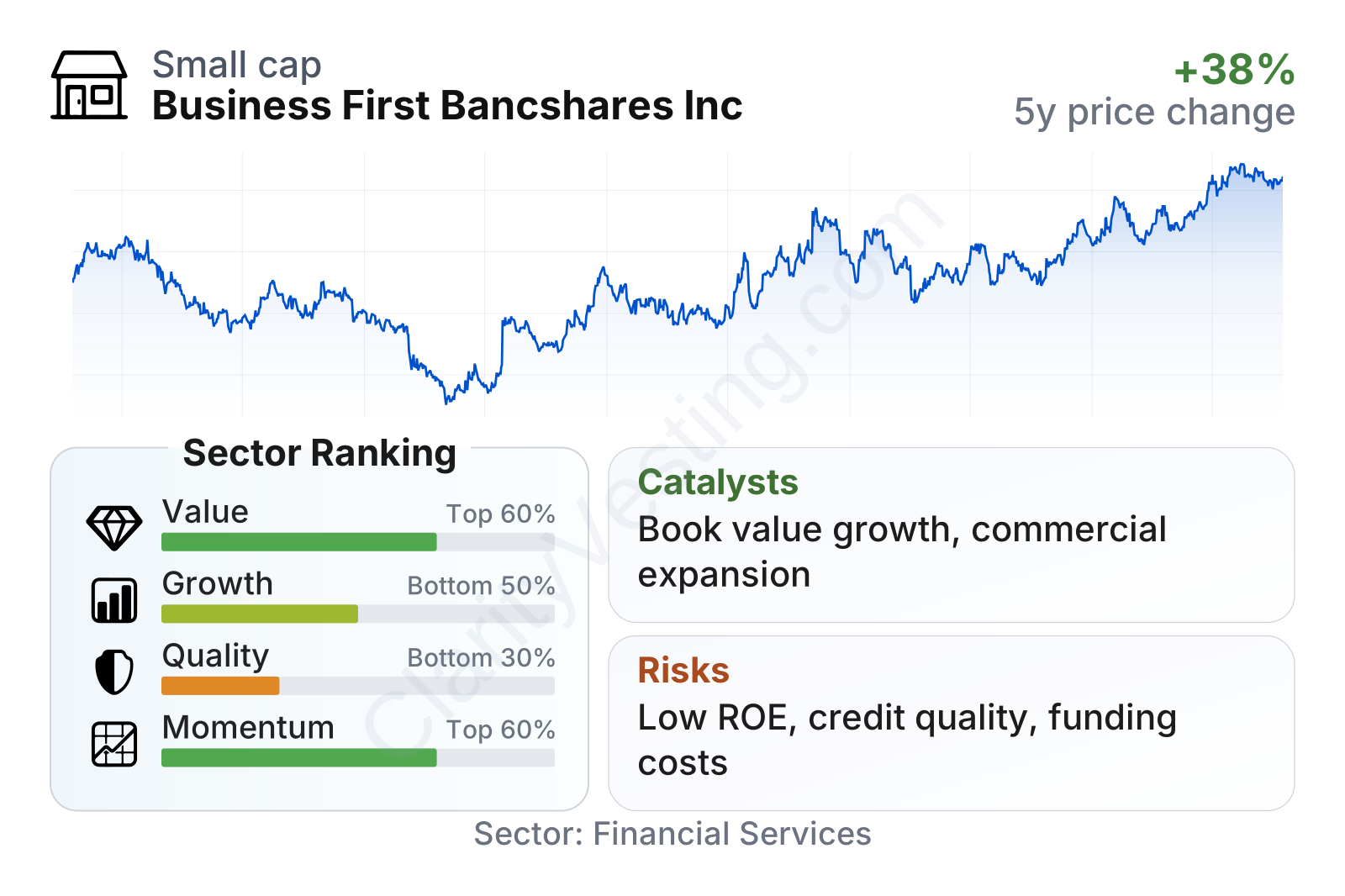
BFST is a small regional bank by market value, with a share price trend that has recovered well from the 2023 regional banking stress and reached materially higher levels in 2026. In the latest factor snapshot, valuation looks somewhat lighter than the sector on earnings and especially on book value, while quality metrics rank below many peers. Growth is mixed: revenue and book value progression have been solid, but earnings growth over a longer period has been less convincing. Momentum has been better than the sector median recently, showing that the market has become more constructive on the name.
The dividend yield is modest at roughly 2.0%, below the sector median near 3.0%. That suggests the stock is not being priced mainly as an income vehicle. Instead, the market appears to be giving more weight to operating recovery, balance-sheet value, and expectations for loan and deposit performance.
Growth
BFST operates in regional banking, a mature industry rather than a fast-growing one. That said, local banks can still grow at attractive rates when they expand relationships with small and midsize businesses, win deposits in underserved markets, and add scale through acquisitions or targeted hiring. Business First has followed exactly that kind of strategy: building a commercial-focused franchise, expanding in neighboring states, and using relationship banking as its main differentiation.
The strategy makes sense because commercial clients often bring multiple products at once: loans, operating accounts, treasury services, and payments activity. That can deepen customer ties and improve returns over time. For a bank of BFST’s size, growth does not require taking large amounts of national market share; steady expansion in a few adjacent markets can still move the needle.
A notable positive is the company’s ability to grow book value per share over time, which is an important measure for banks because it reflects the underlying equity base built through retained earnings and capital management.
The earnings trend shows some inconsistency from year to year, with results moving around rather than compounding smoothly. Even so, 2025 earnings per share were above the levels seen in 2021, indicating that the franchise has still expanded through the cycle despite margin pressure and industry volatility.
Book value per share has climbed strongly over the last several years, rising from roughly $21 in 2021 to around $30 by 2025. That is one of the more encouraging signals in the long-term picture because it shows the bank has continued to build shareholder equity even when profitability ratios have not stood out versus peers.
Recent business momentum also supports the growth case. Revenue growth over the last year was above the sector median, and the five-year growth rate in revenue per share has also exceeded the typical regional bank. If interest-rate conditions stabilize and deposit pricing becomes less aggressive, the company could benefit from better spread economics on top of its established commercial banking footprint.
One additional catalyst is the broader normalization of sentiment around regional banks. After the sector-wide funding shock in 2023, banks with stable deposit franchises and solid capital positions have gradually regained market confidence. BFST’s recent stock momentum suggests it has participated in that recovery, helped by continued profitability and expanding book value.
Risks
This article is for informational purposes only and does not constitute financial advice. Some content is AI-generated. See Disclaimer


