Stock Analysis · Butterfly Network Inc (BFLY)
Overview
Butterfly Network is a medical device company focused on ultrasound imaging. Its core product is a handheld, semiconductor-based ultrasound device that connects with software designed to help clinicians capture, review, store, and share scans. The company’s main pitch is simple: make ultrasound more portable, easier to use, and more broadly available across hospitals, clinics, ambulances, and other care settings.
Unlike traditional cart-based ultrasound systems that can be expensive and room-bound, Butterfly’s approach centers on a smaller device paired with cloud-enabled software. That positions the company at the intersection of medical devices, imaging software, and digital health services.
Based on company filings, Butterfly generates revenue from a mix of product sales and recurring software-related revenue.
- Product revenue: approximately 70% to 80% of total revenue in recent periods. This mainly includes sales of handheld ultrasound devices and related accessories.
- Software and other services: approximately 20% to 30% of total revenue. This includes subscription-based software, enterprise offerings, cloud workflow tools, education, and support services tied to the installed base.
The business model matters because hardware can drive initial adoption, while software subscriptions can improve retention and create more predictable revenue over time. Over the last few years, the company has also been working to improve gross profit and reduce operating costs, suggesting a shift from pure expansion toward a more disciplined scaling phase.
The financial flow over time shows an important change: revenue has grown from the low tens of millions into the high double-digit millions annually, while operating expenses have come down materially from earlier peak levels. Gross profit has been uneven, but the broader direction suggests that cost control has improved faster than revenue scale, even though the company remains loss-making.
Key Figures
| Metric | Value | Sector ⓘ |
|---|---|---|
| Date | Oct 03, 2026 | |
| Context | ||
| Sector | Healthcare | |
| Industry | Medical Devices | |
| Market Cap ⓘ | $2.39B | |
| Beta ⓘ | 2.09 | |
Value (Cheapness) | ||
| P/E Ratio ⓘ | N/A | 24.06 |
| P/B Ratio ⓘ | 11.80 | 3.08 |
| FCF Yield ⓘ | -1.18% | 3.07% |
| Dividend Yield ⓘ | N/A | 2.05% |
| EBIT / EV ⓘ | -3.13% | 0.63% |
| PEG ⓘ | N/A | |
Growth (Business expansion) | ||
| Revenue Growth ⓘ | 39.50% | 7.50% |
| RPS Growth (5Y CAGR) ⓘ | 2.35% | 8.70% |
| EPS Growth (5Y CAGR) ⓘ | -48.30% | -18.20% |
| BVPS Growth (5Y CAGR) ⓘ | -25.51% | 3.95% |
| Margin Growth (5Y Trend) ⓘ | N/A | -0.58% |
| FCF Growth (5Y CAGR) ⓘ | -46.58% | 0.88% |
| DPS Growth (5Y CAGR) ⓘ | N/A | 6.80% |
Quality (Business durability) | ||
| ROIC (Latest) ⓘ | -29.36% | 3.29% |
| ROA (Latest) ⓘ | -26.13% | 3.02% |
| ROIC (5Y Median) ⓘ | -34.04% | 4.75% |
| ROA (5Y Median) ⓘ | -27.89% | 1.93% |
| Net Debt / EBIT (Latest) ⓘ | N/A | 1.33 |
| Net Debt / EBIT (5Y Median) ⓘ | N/A | 1.83 |
| Net Debt / EBITDA (Latest) ⓘ | N/A | 0.99 |
| Net Debt / Assets ⓘ | -37.30% | 5.33% |
| EBITDA / Interest ⓘ | N/A | 9.63 |
| Operating Margin (Latest) ⓘ | -65.48% | 9.25% |
| Operating Margin (5Y Median) ⓘ | -86.85% | 7.80% |
| Debt to Equity (Latest) ⓘ | 10.08% | 28.99% |
| Profit Margin (Latest) ⓘ | -66.75% | 3.60% |
| Free Cash Flow (Latest) ⓘ | -$28.04M | |
Momentum (Price trend) | ||
| 3Y Return ⓘ | +661.61% | +37.48% |
| 12M Return (excl. last month) ⓘ | +408.07% | +20.85% |
| 6M Return ⓘ | +108.56% | +9.73% |
| Price vs. 200-Day MA ⓘ | +51.23% | +4.69% |
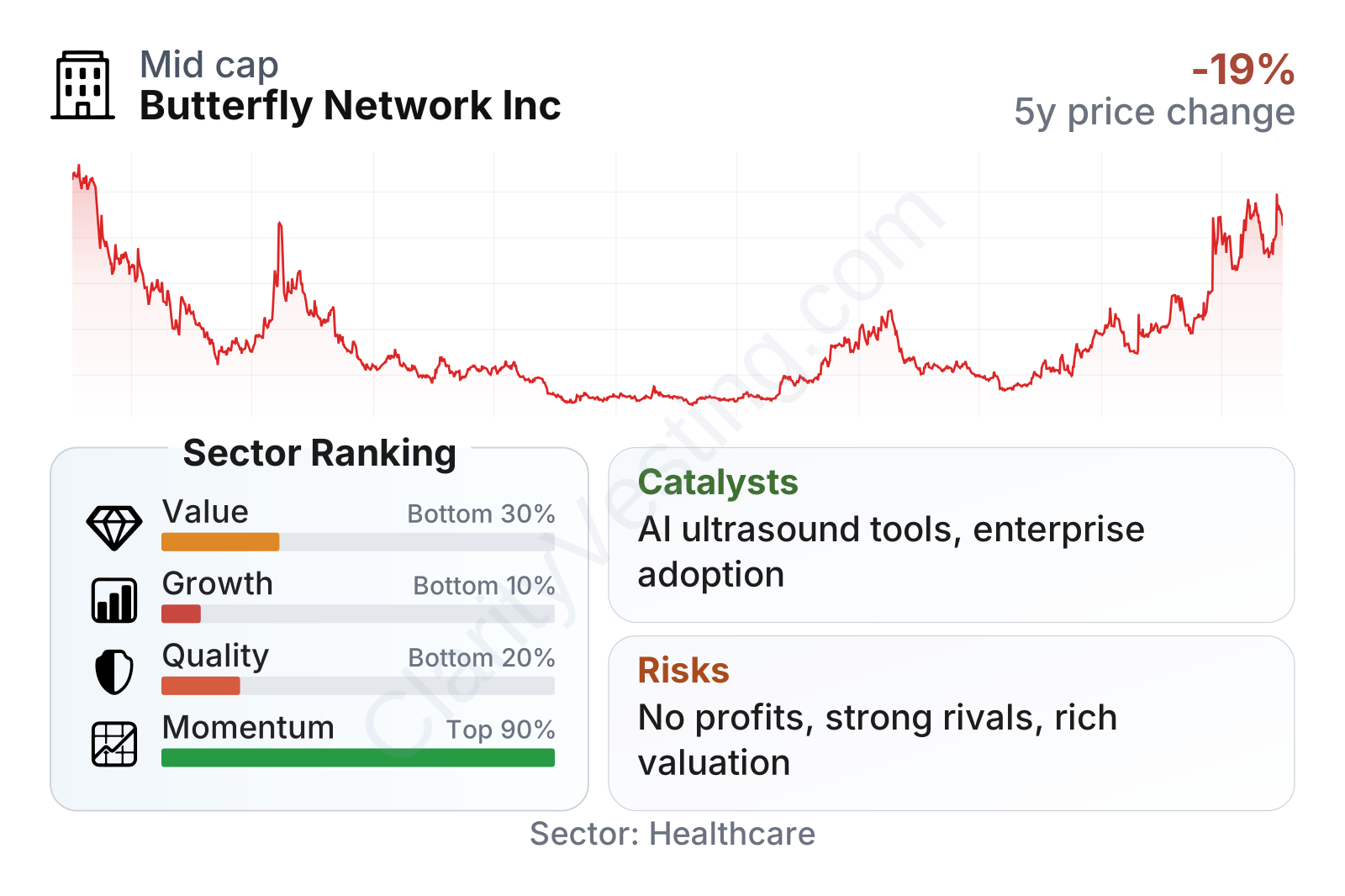
Butterfly is still a relatively small healthcare company by sector standards, but its stock has been extremely volatile. After a steep decline from 2021 into 2024, the shares rebounded sharply and recent price momentum has been much stronger than most healthcare names. That market enthusiasm stands in contrast with fundamentals that remain mixed: revenue growth has accelerated, but profitability, returns on capital, and cash generation still rank near the lower end of the sector.
The latest metrics table reflects that tension clearly. Valuation measures look demanding relative to the sector, especially on book value and cash-flow-based metrics, while quality indicators remain weak because margins and returns are still deeply negative. Momentum is the strongest area by far, but that tends to be the least stable factor when a company is still in an early commercial stage.
Growth
Butterfly operates in a part of healthcare that has a credible long-term tailwind. Point-of-care ultrasound is gaining attention because it can bring imaging closer to the patient, reduce dependence on larger systems for some use cases, and support faster decision-making in emergency care, primary care, hospital wards, and procedural settings. The broader shift toward portable devices, lower-cost imaging, and software-enabled workflows supports the company’s strategic direction.
The company’s strategy also makes sense conceptually. A lower-cost handheld device can expand access, while software subscriptions and enterprise deployments can increase lifetime value per customer. If Butterfly keeps adding users within hospitals and health systems, the installed base can become a foundation for recurring revenue rather than a one-time hardware sale.
Recent revenue growth has improved meaningfully after a weak stretch in 2023. The latest year-over-year growth rate is close to 40%, well above the healthcare sector median. That does not erase the earlier volatility, but it does suggest that commercial traction has picked up again. For a company at this stage, the key question is not only whether revenue grows, but whether that growth becomes consistent across multiple quarters.
Cash burn is still present, but the trend has improved sharply. Over the last several years, free cash flow has moved from very large negative levels to losses that are much smaller. That is one of the most important operational developments in the case, because it indicates progress toward a more sustainable business model even before full profitability is reached.
Recent company updates have highlighted product development, software expansion, and broader clinical use cases as growth drivers. Butterfly has also placed emphasis on artificial intelligence tools that can help with image guidance, workflow, and user support. If these features make ultrasound easier for less specialized users, that could widen adoption beyond traditional imaging departments and strengthen the company’s differentiation.
Another potential catalyst is the company’s exposure to healthcare systems that are under cost pressure. A portable device with a lower upfront cost than traditional machines may be attractive if clinical performance is sufficient for many bedside uses. International expansion, deeper penetration of enterprise accounts, and a larger base of recurring subscriptions could all become meaningful contributors if execution remains strong.
Risks
This article is for informational purposes only and does not constitute financial advice. Some content is AI-generated. See Disclaimer